
What to check in an aerospace automation company, and where we stand
We design and build custom machines and FANUC robot cells, and we built an automated tapping machine for an aerospace supplier. Our parent company, CalWest Manufacturing, is AS9100D and ISO 9001 certified and ITAR registered.
- Aerospace work shown
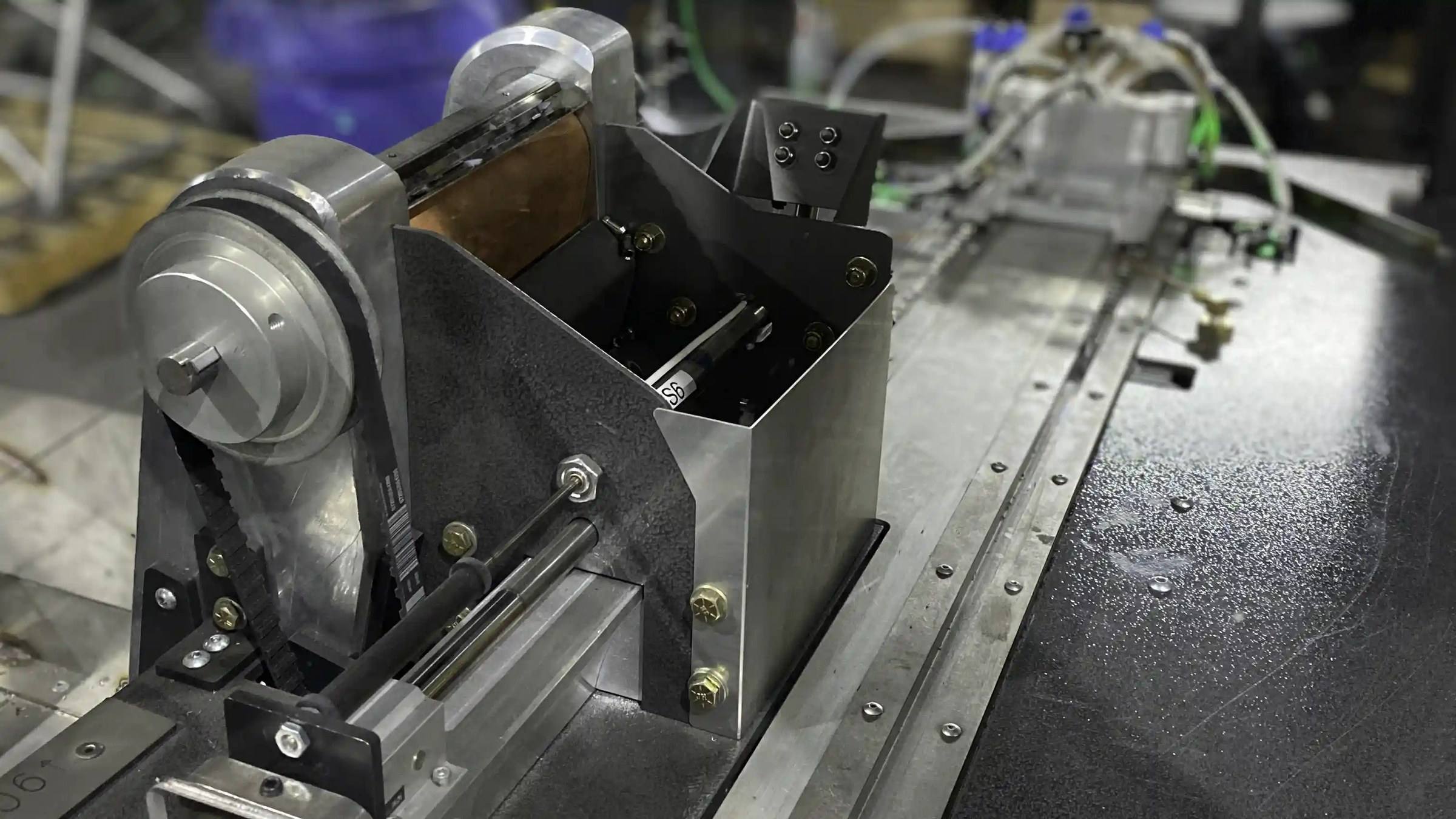
- Automated tapping machine for an aircraft part
- Controls
- PLC control of every mechanical function; HMI for monitoring
- Parent company
- AS9100D and ISO 9001 certified, ITAR registered
- Robots
- FANUC only
- Built in
- Fontana, CA
- Aerospace work shown
- Automated tapping machine for an aircraft part
- Controls
- PLC control of every mechanical function; HMI for monitoring
- Parent company
- AS9100D and ISO 9001 certified, ITAR registered
- Robots
- FANUC only
- Built in
- Fontana, CA
When a supplier of aircraft parts shortlists aerospace automation companies, the quality and export compliance people usually weigh in before engineering does. They want to know whose quality system covers the work, whether the company is registered under ITAR and how it will handle controlled drawings, and whether it has built anything like the job before.
What should an aerospace buyer check in an automation company?
Whichever integrator you talk to, most of what separates one from another shows up later, in design reviews and at run-off. A few things can be checked on the first call.
| Check | What to look for | Where we stand |
|---|---|---|
| Quality system | An AS9100 certificate and who holds it | CalWest Manufacturing, our parent company, is AS9100D and ISO 9001 certified |
| ITAR | Registration with DDTC, and a straight answer on how controlled technical data will be handled | CalWest Manufacturing is ITAR registered. Read the section below before sending anything controlled |
| Comparable work | A machine or cell close to your part and process, described plainly | An automated tapping machine for high-volume production of an aircraft part |
| Who does the work | Whether design, fabrication, panels and code are done in-house or sent out | Design, fabrication, wiring and programming in our Fontana shop |
AS9100D and ISO 9001: our parent company’s certifications
CalWest Robotics is the robotics division of CalWest Manufacturing, a Fontana contract manufacturer doing tube laser cutting, CNC tube bending, plate laser, press brake, welding and 5-axis CNC machining. The certifications belong to CalWest Manufacturing. Our cells are built in the same shop, and their frames, guarding and tooling come off the same laser, press brake, welding and 5-axis equipment.
AS9100D is the quality management standard for aviation, space and defense organizations, published by SAE International. It includes the ISO 9001:2015 requirements and adds aerospace-specific requirements on top of them.
Companies holding an accredited AS9100-series certificate must be listed in the IAQG’s OASIS database, and anyone can register as a user to look them up.
ITAR registered automation builders: what registration covers and what it doesn’t
Companies register under ITAR with the US State Department’s Directorate of Defense Trade Controls (DDTC). Under 22 CFR 122.1, anyone who engages in the United States in the business of manufacturing, exporting or temporarily importing defense articles, or furnishing defense services, has to register, even a manufacturer that never exports. The same section says registration “does not confer any export rights or privileges.” Licenses and other approvals are separate.
On an automation job, the practical issue is technical data. ITAR defines technical data as information required to design, make, assemble, operate, test, repair or modify a defense article, including information in the form of blueprints, drawings, photographs and plans (22 CFR 120.33). Releasing that data to a foreign person inside the United States counts as an export (22 CFR 120.50; release is defined in 120.56). A drawing sent to the wrong inbox, or a controlled part shown to a foreign person on a shop floor, can be an export problem without anything leaving the country.
Whether your part and its drawings are ITAR-controlled is for your export compliance officer to decide, not the automation builder. Confirm the handling with them before anything is sent. Defense programs add flowdowns and part records on top of this, which our page on defense manufacturing automation covers.
Our aerospace job: a custom tapping machine
This job is not a robot cell. An aerospace supplier needed to tap an aircraft part in high volume, and we built a custom machine for it: a feeder that presents the parts, a tapping mechanism, a PLC controlling every mechanical function, and an HMI where the crew watches the machine in real time. The full write-up of the tapping machine has more on the build.
On any automated tapping machine, thread quality depends on a few details a person at a tapping head handles by feel. The part has to sit square to the tap. The feed has to match the thread pitch, or the tap holder needs enough axial (tension/compression) float to take up the difference. And a broken or worn tap has to be caught before more parts run. On a machine those go into the fixture, the drive and the PLC logic. We write and test the PLC programs for our machines in-house.
Other aerospace manufacturing automation we can build
Beyond tapping, these are the kinds of jobs a supplier of aircraft parts might bring us. Each page shows work of that kind we have done, not necessarily for aerospace customers:
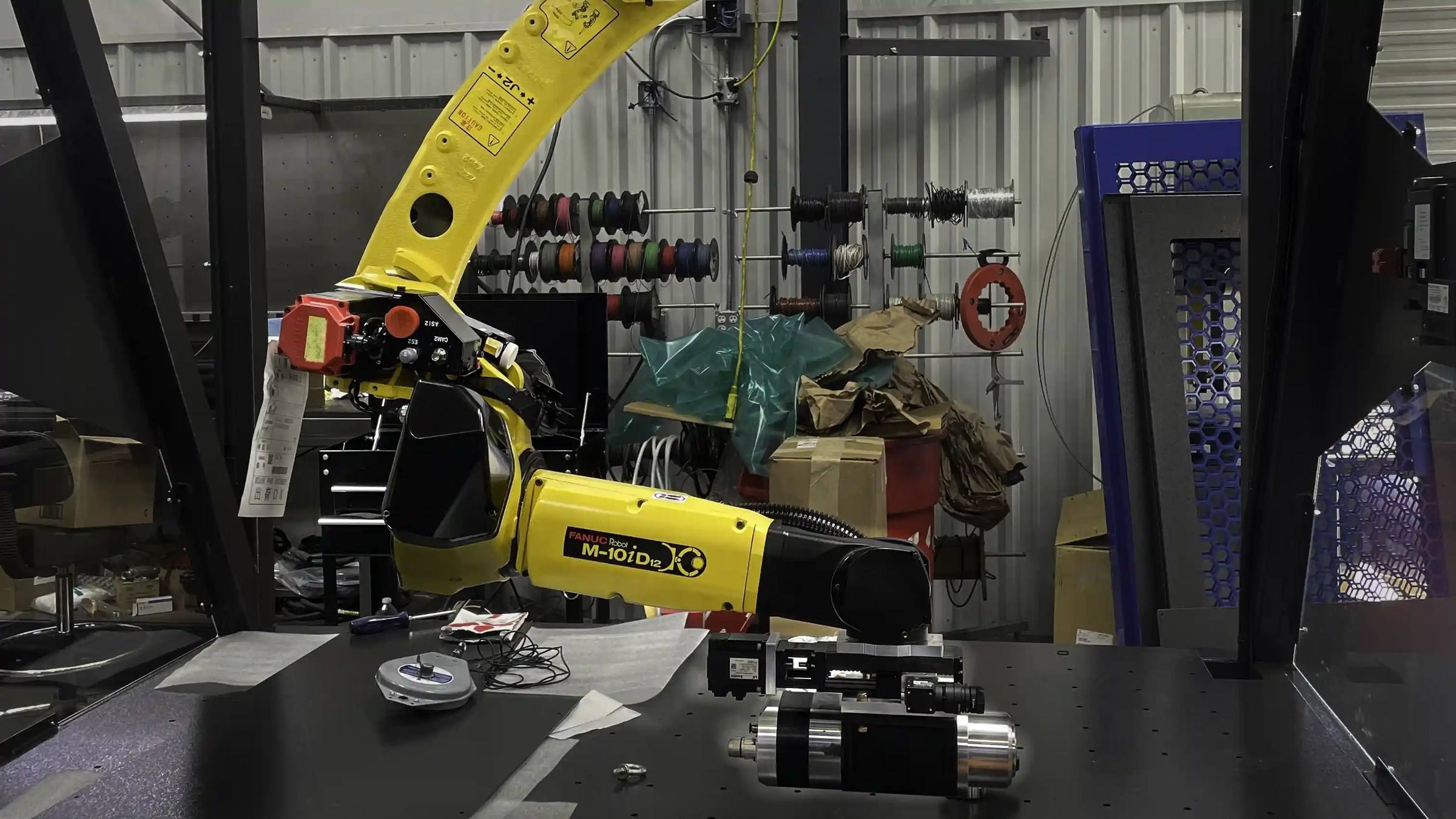
- FANUC robot cells designed, fabricated, wired, programmed and run off in our shop, for jobs where a robot fits
- Custom automation machines with feeders, mechanisms, PLC control and HMIs, for jobs where a robot isn’t the answer
- Robotic drilling and milling cells that drill hundreds of holes in complex 3D parts, with a camera checking each hole and logging the result
- Machine tending cells, including one that moves parts from a Swiss lathe into a heater and then a forge
- PLC and HMI retrofits for older machines that are still worth keeping
- Machine data and ERP integration, so counts, jobs and scrap post without re-keying
What to send us first
- What the part is in general terms, its material and rough size
- The operation: tapping, drilling, milling, loading a machine, or something else
- How many parts, and over what period
- A phone video of the job done by hand, if your site allows filming and nothing controlled is in the shot
- Whether the part or its drawings are export-controlled (yes, no or not sure is enough)
- Quality requirements your customer flows down to you, if you know them
Common questions
- Is CalWest ITAR registered?
- Yes. Our parent company, CalWest Manufacturing, is registered under ITAR with the State Department's Directorate of Defense Trade Controls. CalWest Robotics is its robotics division and works out of the same Fontana shop. Anyone in the US in the business of manufacturing or exporting defense articles has to register, but registration does not authorize any export by itself. Whether your part and its drawings are ITAR-controlled is a call for your own export compliance officer.
- How do we send you controlled drawings?
- Not as an attachment to a first email or text. Start with a call or an email that describes the job in general terms: material, rough size, the operation and the volume. That is usually enough to tell whether the job fits. Controlled drawings, models and photos wait until we have agreed with you, and your compliance officer has approved, how they will be handled.
- Which robots would you use in an aerospace cell?
- FANUC only. We are a FANUC Authorized System Integrator, and every robot cell we build uses FANUC robots. Models we have worked with include the LR Mate, M-10iD/12, M-20iD/25 and FANUC delta robots, with iRVision where the robot has to find the part. The right model for a job depends on part weight, reach, the forces involved and the floor space.
- Can you add controls or data collection to machines we already own?
- Yes. We write and test PLC logic for Allen-Bradley and Siemens in-house, build custom HMIs, and have replaced the PLC and operator screen on a legacy process machine. We also write custom Python that ties machines to an ERP. What fits a given machine depends on its existing controls, so a photo of the panel and nameplate is a good start.
Sources
- SAE International: AS9100D, Quality Management Systems, Requirements for Aviation, Space, and Defense Organizations
- Performance Review Institute: Online Aerospace Supplier Information System (OASIS)
- eCFR: 22 CFR 122.1, Registration requirements (ITAR)
- eCFR: 22 CFR 120.33, Technical data (ITAR)
- eCFR: 22 CFR 120.50, Export (ITAR)
- eCFR: 22 CFR 120.56, Release (ITAR)