
Consumer products manufacturing automation for plants with many SKUs
For a national lawn and garden brand's plant in Temecula, CA, we built FANUC palletizing cells at the end of the packaging lines and LR Mate cells that assemble spray nozzles. Here is what a consumer-product plant should settle before it buys a cell.
- Plant
- A national lawn and garden brand, Temecula, CA
- Palletizing
- FANUC robots at the end of each packaging line
- Assembly
- LR Mate robots at three bowl-fed tables
- Operator screen
- Cycle time per table, color changeover, fault status
- Built in
- Fontana, CA
- Plant
- A national lawn and garden brand, Temecula, CA
- Palletizing
- FANUC robots at the end of each packaging line
- Assembly
- LR Mate robots at three bowl-fed tables
- Operator screen
- Cycle time per table, color changeover, fault status
- Built in
- Fontana, CA
Consumer products manufacturing automation runs into one problem more than any other: variety. A plant making lawn and garden products, household goods or personal care items runs many SKUs down the same lines, often with a busy season and a slow one. The robot cell has to handle every case, color and pack the line runs, and the crew has to change it over without calling a programmer.
We have built two kinds of cells for one consumer-product plant. At a national lawn and garden brand’s plant in Temecula, CA, FANUC robots in cells we built palletize finished cases at the end of each packaging line, and LR Mate robots assemble spray nozzles at three bowl-fed tables. Both were designed, fabricated, wired and programmed in our Fontana shop and installed on the customer’s live production floor.
In short
Where does CPG automation usually start?
Many consumer-product plants start at the end of the line and work backwards. The jobs at the tail tend to be the most repetitive, and the product is already in a case.
- Palletizing. Lifting and stacking full cases all shift is heavy, repetitive work, and a FANUC robot can build the same pattern every time. This is the end of line automation job we have built for a consumer-product plant.
- Case packing. Loading packs, bottles or cartons into cases to a pattern that changes with the SKU. Robotic case packing covers grippers and the case erector and sealer on either side of the robot.
- Assembly. Small parts put together before packing: caps, nozzles, triggers, kits. Our assembly work is in this group.
- Kitting and tray loading. Placing several items into one tray or carton, often with a camera finding product on a belt.
The end-of-line packaging automation page goes station by station through the tail of a packaging line.
Assembly and palletizing in the same plant
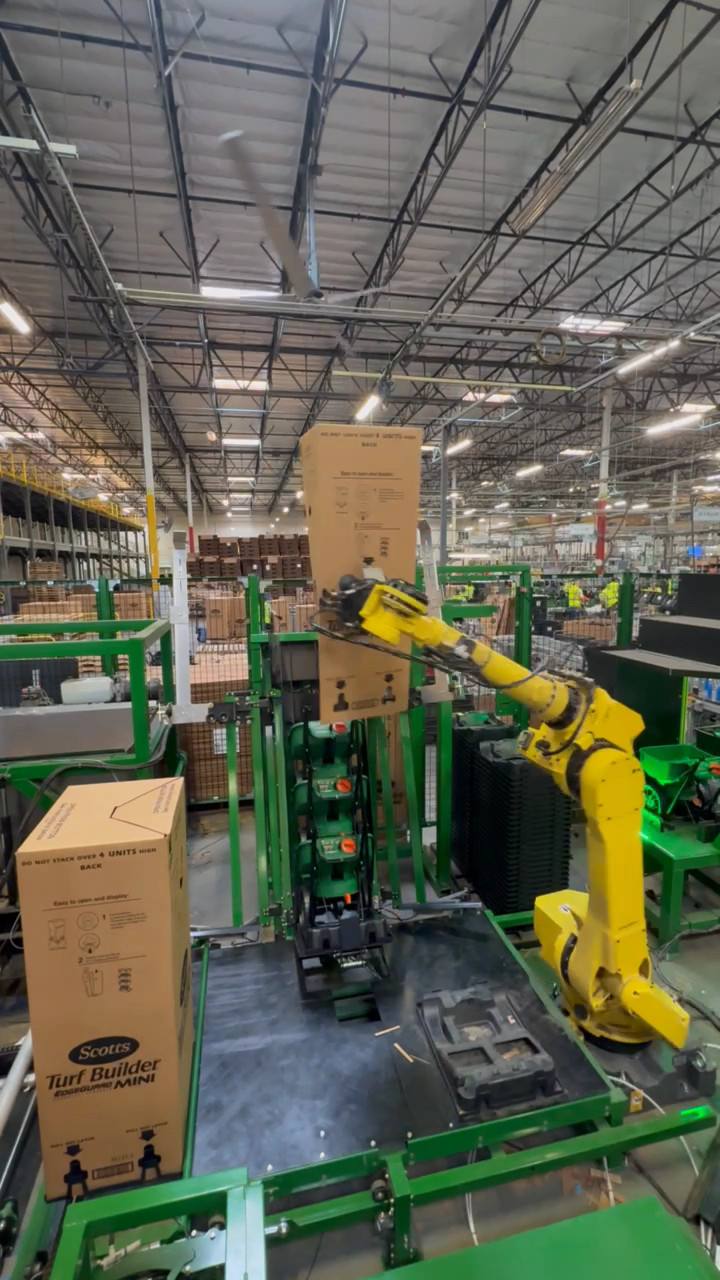
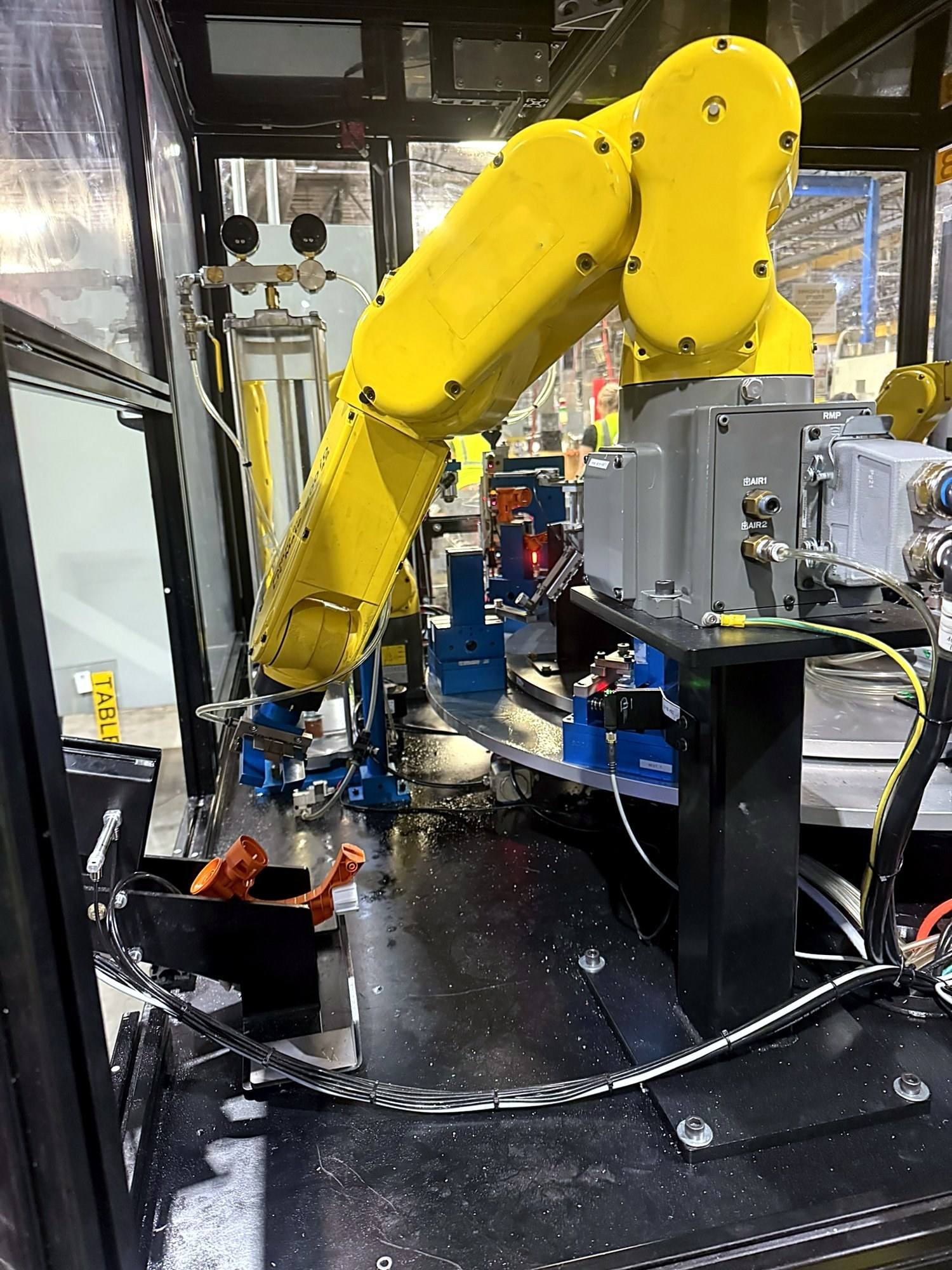
At the Temecula plant the two jobs look nothing alike. The palletizing cells pick each case off the end of the line, turn it and set it on the pallet layer by layer to the stack pattern (Fig. 1). The assembly cells handle small molded parts: bowl feeders present them one at a time, LR Mate robots pick them with fingers we machined to fit, and the nozzle is built in fixtures on three interlocked, light-curtained tables (Fig. 2).
One team did both jobs end to end: we designed, fabricated, wired and programmed the palletizing cells and the assembly tables, including the control panels and the operator screen. The write-ups for each job are the Temecula palletizing cells and the spray nozzle assembly cells.
Planning for SKU changeovers
The most useful thing a consumer-product plant can bring to the first meeting is the full product list, including what is coming next year. Each kind of change touches a different part of a cell.
| Change | What it touches in the cell | Usually |
|---|---|---|
| New SKU, same case size | Stack pattern, layer count | A recipe or program change |
| New case size | Stack pattern, pick point, gripper settings | A new pattern; sometimes a gripper change |
| New color, same part | Parts in the feeders and tracks | Empty the feeders, select the color on the screen |
| New part shape | Fingers, nests, feeder tooling, robot points | New tooling and a re-teach |
| New artwork or label on the same case | Usually nothing | No change, unless a camera reads the label |
On palletizers, some plants want the crew to add patterns themselves. FANUC’s PalletTool 3 software, for example, lets operators create and edit pallet patterns from the Tablet TP. Whether your crew adds patterns or calls a programmer is worth deciding at the design review, because it shapes the screens and the program.
Seasonal volume and the busiest hour
Many consumer products sell on a season, and a line that runs one shift in winter may run three in spring. Size the cell for the peak hour of the peak season, not the yearly average. A palletizer that keeps up in March and idles in November is fine; one that falls behind in March backs cases up into the packaging machines.
Two things help at peak: a stretch of accumulation conveyor ahead of the robot to absorb short stops, and two pallet stations so the robot keeps building while a full pallet is pulled. Both cost floor space, so they belong in the first layout, not a later change.
Color changeover on the operator screen
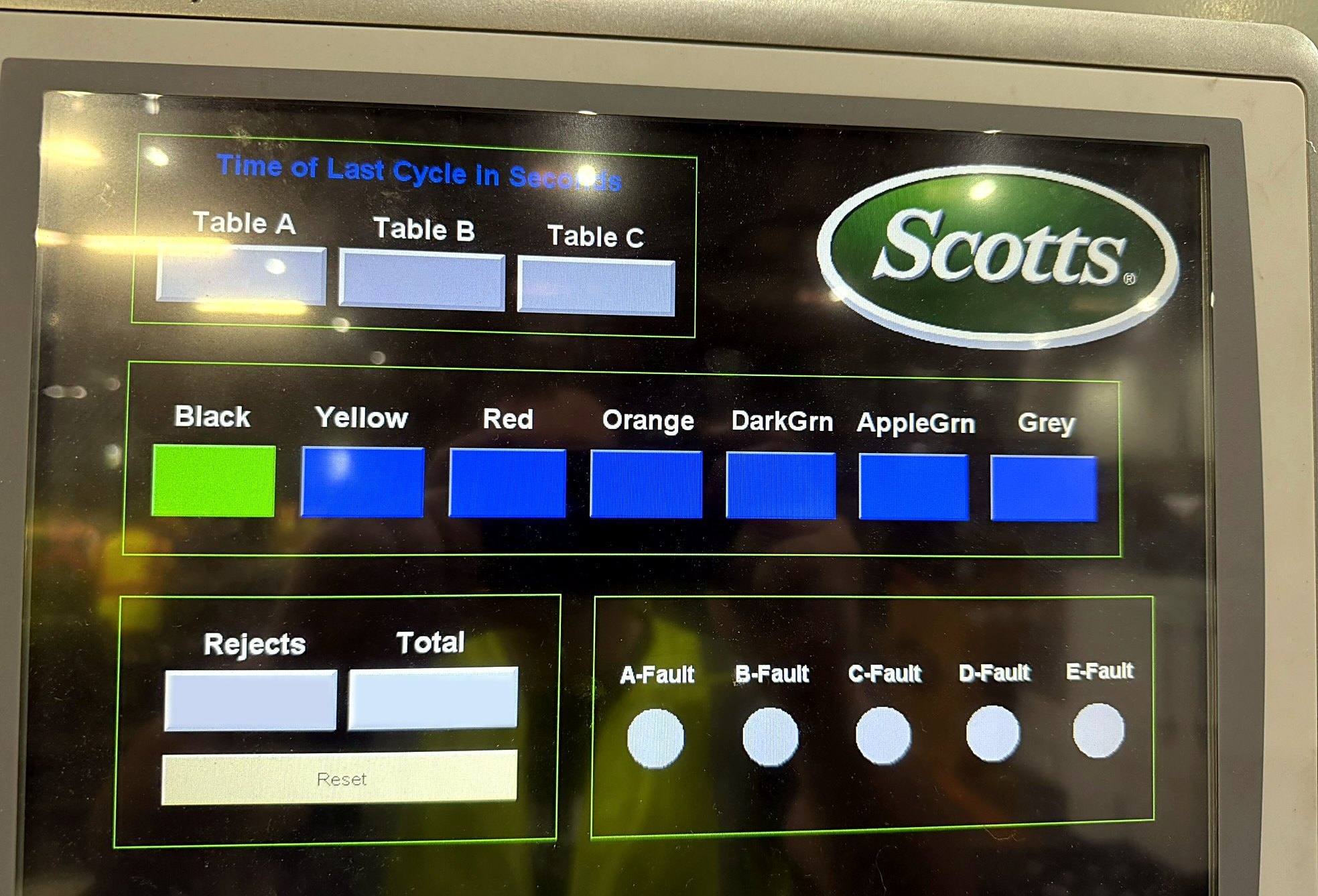
On the assembly cells, the operator screen we wrote shows the last cycle time for each of the three tables, a row of color buttons for changeover, reject and total counts, and fault lights (Fig. 3). A table running slow shows up in its cycle time, and the screen keeps track of which color is running.
We lay out custom HMI screens around the crew that runs the cell, in the words they use. If your plant already standardizes how machines report their state, for example with PackML, tell us before design so the cell’s PLC program follows it.
Installing on a line that is still shipping product
Consumer-product plants rarely get a long shutdown to install a cell, especially ahead of their busy season. The Temecula cells were installed and commissioned on the customer’s live production floor. What makes that workable is doing the debugging somewhere else: each cell is modeled in SolidWorks with the conveyors and machines it meets, robot paths are checked in FANUC ROBOGUIDE before they run, and the whole cell is run off in our shop before it ships. The time on your floor then goes to setting the cell, tying it into the line and commissioning it. Plan the install window around your slow season if you have one.
One builder for several cells
When the palletizer, the case packer and the assembly cells come from different builders, the screens, fault messages and stop signals differ from machine to machine. When one team builds them, a fault that crosses from one cell to the next gets traced by the people who wrote both sides. We write the PLC and safety logic in-house on Allen-Bradley or Siemens, and the robot programs too.
Counts, jobs and scrap can post to your ERP automatically, and every cycle and fault can be logged with a time stamp. Every cell is run off in our Fontana shop before it ships, and we install anywhere in the US. More of the work we build is on robot cells by application and industries.
What to send us
- A phone video of the line running at normal speed
- Every SKU the line runs, with case or part sizes, weights and colors
- A photo of each stack pattern or pack layout
- Cases or parts per minute at the busiest hour of the busiest season
- A floor sketch with columns, doors and forklift paths
- The machines on either side of the cell and the PLCs they run
Common questions
- Can one palletizing cell handle every SKU on the line?
- Often, if the whole range is planned in. The gripper has to hold the smallest and largest case, and the robot has to carry the heaviest case plus the tool within its payload and wrist limits. A new SKU in an existing case size can usually run on a pattern already in the program. A new case size needs a new pattern and sometimes new gripper settings. Send the full SKU list before design.
- How do operators change colors on an assembly cell?
- On our spray nozzle assembly cells, color changeover is on the operator screen, next to each table's cycle time and fault status. Most of the physical work in a color change is emptying the old color out of the bowl feeders and tracks so it doesn't mix into the new run. The screen keeps track of which color is running, so the crew isn't relying on memory.
- What happens when we add products after the cell is built?
- It depends on what changes. A new SKU in an existing case or part shape is usually a program or recipe change. A new case size, part shape or pack format can need new fingers, nests or feeder tooling, which we design and machine in-house. Tell us about products in development during design, so the gripper and fixtures leave room for them where that is practical.
- Can production counts from the cells go to our ERP?
- Yes. We write custom Python software that ties machines to an ERP, so counts, jobs and scrap post without anyone keying them in. Every cycle and fault can be logged with a time stamp and kept searchable, which helps when you need to know why a line fell behind on a given shift. What we connect to depends on your ERP and what it accepts.
- Do you build cells for plants outside California?
- Yes. Every cell is designed, fabricated, wired and programmed in our Fontana shop, run off here, then shipped and installed at your plant anywhere in the United States. The Temecula cells were installed and commissioned on the customer's live production floor. Cells we install can be reached over a secure VPN for program changes and troubleshooting when you allow it.