
Servo motion control for the axes around a robot
Indexers, slides, rotary tables and servo tools have to be sized, homed and tuned along with the rest of the cell. We program that motion in the same Fontana shop that builds the cell.
- PLC motion
- CompactLogix with Kinetix servo drives
- Beckhoff
- Custom HMI for a CNC tube bender on TwinCAT
- Robots
- FANUC
- Tested
- With the real load, at run-off in our shop
Most robot cells have something besides the robot that has to stop at an exact position: an indexing table, a slide, a lift, a servo-driven tool. Servo motion control is how those axes get there, with a motor that reports its own position and a drive that corrects the error many times a second. We have programmed Allen-Bradley CompactLogix controllers that run Kinetix servo motion alongside the machine sequence, and written a custom HMI for a CNC tube bender that runs on Beckhoff TwinCAT.
In short
When does an axis need a servo?
Plenty of motion in a cell doesn’t. A servo earns its cost when an axis has to stop at more than two places, follow a controlled profile, or move in step with something else.
| Actuator | Good for | Where it falls short |
|---|---|---|
| Air cylinder | Two positions, fast and cheap | No positions in between; the stops are mechanical |
| Motor on a variable frequency drive | Conveyors and anything that runs at a set speed | Not built for stopping at exact positions |
| Servo motor and drive | Many positions, controlled acceleration, coordinated moves | Costs more, and has to be sized, homed and tuned |
Common servo axes beside a robot
- Rotary indexing tables, so the robot works on one station while an operator loads another outside the guarding.
- Linear slides and rails that carry a part, a fixture or the robot itself.
- Lifts and gantries that bring parts up to the robot or carry them across a cell.
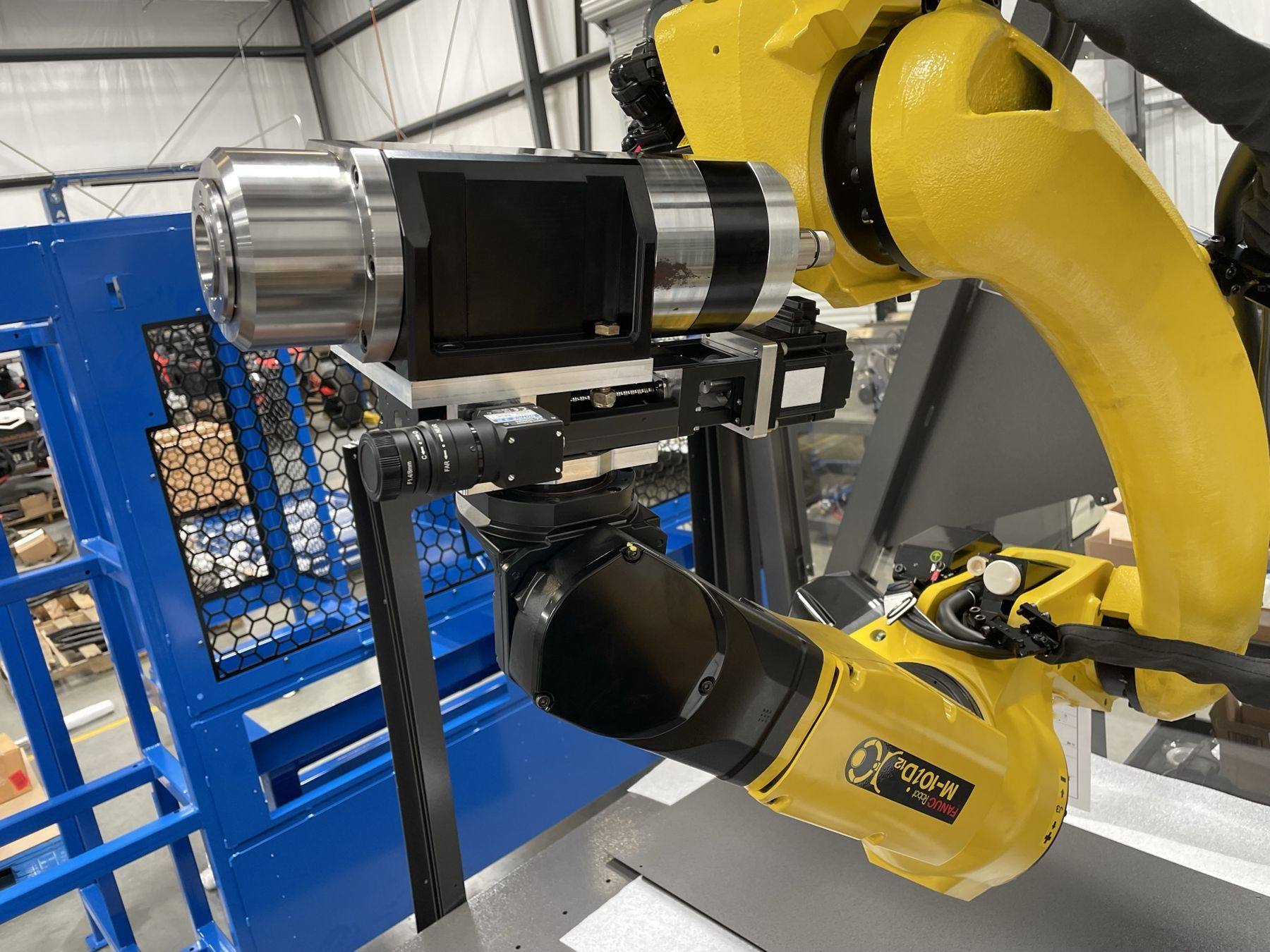
- Servo tools on the robot, such as a spindle on a servo-driven slide (Fig. 1), where the tool has its own axis of travel.
Who commands the axis: the PLC or the robot?
This is the first decision, and it shapes the panel, the programs and who can troubleshoot the axis later.
| Commanded by | Fits when | What it means |
|---|---|---|
| PLC (for example, Kinetix drives on a CompactLogix) | The axis works on its own schedule: indexers, lifts, feeders | Moves, interlocks and faults sit in the same PLC project as the machine sequence |
| FANUC robot controller (Extended Axis Control) | The axis has to move together with the robot’s path: rails, positioners | FANUC describes it as integrated motion control of servo-driven positioners, rails, grippers and more, run from the robot controller |
| A drive with built-in indexing | Simple moves between a few stored positions | The PLC picks a position number; less to program, less flexible |
Our FANUC robot programming page covers the robot side.
Coordinating a servo axis with the robot
When the PLC runs the axis and the robot works on what the axis carries, the two need a handshake in both directions, just like a fixture or a conveyor. A typical exchange for an indexing table:
- The PLC tells the robot the table is in position and the station is clamped. Only then may the robot enter.
- The robot tells the PLC it is clear of the table. Only then may the table index.
- If either signal drops in the middle of a move, the other side stops and the screen says which one dropped.
The interlock has to live in both programs. A robot that checks “table in position” once, at the start of its path, can still be inside the station when a fault reset lets the table move. Writing both sides in one shop and testing them together is how gaps like that get found before the cell ships.
Kinetix servo programming on CompactLogix
With Rockwell’s Integrated Motion on EtherNet/IP, Kinetix drives are configured and commanded from the Studio 5000 project, over the same Ethernet network as the rest of the I/O. The motion instructions are short and readable: MSO turns the servo on, MAH homes the axis, MAM moves it to an absolute position, MAJ jogs it and MAS stops it.
Two practical points. On a CompactLogix 5380, only controllers with an M or P in the catalog number support integrated motion, so check the part number before the panel is ordered. And Rockwell’s Motion Analyzer, a free sizing tool, checks a motor and drive against the real move profile before anything is bought. The rest of the Studio 5000 work is on Allen-Bradley PLC programming.
Beckhoff TwinCAT and EtherCAT
Beckhoff’s TwinCAT 3 turns a PC into a real-time controller, with its engineering tools inside Microsoft Visual Studio and programming in the IEC 61131-3 languages as well as C/C++. Beckhoff says its motion control covers everything from simple point-to-point moves up to robotics and CNC. Machines built on it usually run their drives over EtherCAT, which is standardized in IEC 61158 and IEC 61784 and uses distributed clocks to keep axes synchronized.
Many motion platforms also offer the PLCopen motion function blocks, such as MC_Power, MC_Home and MC_MoveAbsolute, which give motion code a common shape across hardware. Someone who knows those blocks on one platform can follow the motion code on another.
Sizing, homing, limits and tuning
Most servo problems on a running machine trace back to one of four things.
- Sizing. The motor has to accelerate the real load, including tooling and the heaviest part, through the real move in the time allowed, with margin. A load whose inertia is many times the motor’s own rotor inertia is harder to tune.
- Homing. An incremental encoder needs a homing move after power loss. An absolute encoder keeps its position through it, which saves a homing routine with a robot standing in the way.
- Travel limits. Software limits in the drive or PLC, overtravel switches, and hard stops as the last line, in that order.
- Safe torque off. The drive’s safe torque off input belongs in the cell’s safety circuit. It removes torque, so a vertical axis also needs a brake to hold the load. That is covered on safety PLC programming.
Tuning starts with the drive’s autotune and finishes with the real load on the axis, which is why a run-off with the complete cell tells you more than a bench test of the axis alone.
Built and tuned before it ships
The panel for the drives is built and wired in Fontana (see control panels), and the axes run with the rest of the cell during the run-off. Machines that are mostly motion with no robot at all are on custom automation, and every robot cell we build goes through the same steps. The rest of our controls work is on robot cell controls and software. To talk through an axis, call or text (818) 397-4809.
Common questions
- Should a servo axis be run by the PLC or by the robot?
- If the axis has to move along with the robot's path, like a rail the robot rides on or a positioner turning a part during a weld, it usually belongs to the robot controller as an extended axis. If it works on its own schedule, like an indexing table, a lift or a feeder, the PLC is usually the better home, because its moves, interlocks and faults sit with the rest of the machine sequence.
- What do you need to size a servo axis?
- The mass and shape of everything that moves, including tooling and the heaviest part. The travel, the positions it stops at and the time allowed for each move. Whether the axis is horizontal or vertical, how often it cycles, how accurately it has to stop, and any outside forces such as a press or a cutting load. With that, the motor, gearbox or screw, and drive can be sized with margin instead of guesswork.
- Do you program Beckhoff TwinCAT?
- Yes. Beckhoff TwinCAT is one of the control platforms we work with, and we have written a custom HMI for a CNC tube bender that runs on TwinCAT. If your machine is built on Beckhoff, send the controller model, the TwinCAT version and a description of what you want changed, and we will tell you whether the job is a fit.
- Why does a vertical axis need a brake if the drive has safe torque off?
- Safe torque off removes the motor's ability to produce torque. That stops the motor from driving the axis, but it also means nothing holds the load against gravity. A vertical slide or lift can fall when torque is removed unless a holding brake, a counterbalance or a mechanical lock takes over. The risk assessment for the axis should cover how the load is held and how the brake is checked.
- Can a servo axis be added to an existing robot cell?
- Often, if the panel has room, the PLC or robot controller supports the extra axis, and the safety circuit can be extended to cover it. Send photos of the cell and the panel, the PLC and robot controller models, and what the new axis has to do. Adding motion changes the risk assessment too, so the safety side gets reviewed along with the mechanics.
Sources
- Rockwell Automation: CompactLogix 5380 controllers
- Rockwell Automation: CompactLogix 5380 and Compact GuardLogix 5380 specifications, 5069-TD002
- Rockwell Automation: Kinetix Integrated Motion on EtherNet/IP servo drives
- Rockwell Automation: Program motion control (ControlLogix 5590 user manual)
- Rockwell Automation: FactoryTalk Motion Analyzer software
- FANUC America: Extended Axis Control
- Beckhoff: TwinCAT
- EtherCAT Technology Group: EtherCAT technology
- PLCopen: Motion control overview