
Robotic material handling between conveyors, machines and racks
FANUC robots that move parts from where they arrive to where the next step needs them. We design, build, wire and program each cell in Fontana, CA and install it at plants across the US.
- Robots
- FANUC
- Moves
- Conveyor, rack, tray, fixture, machine, pallet
- Finding parts
- Fixed pick points or FANUC iRVision
- Built in
- Fontana, CA
- Installed
- Anywhere in the US
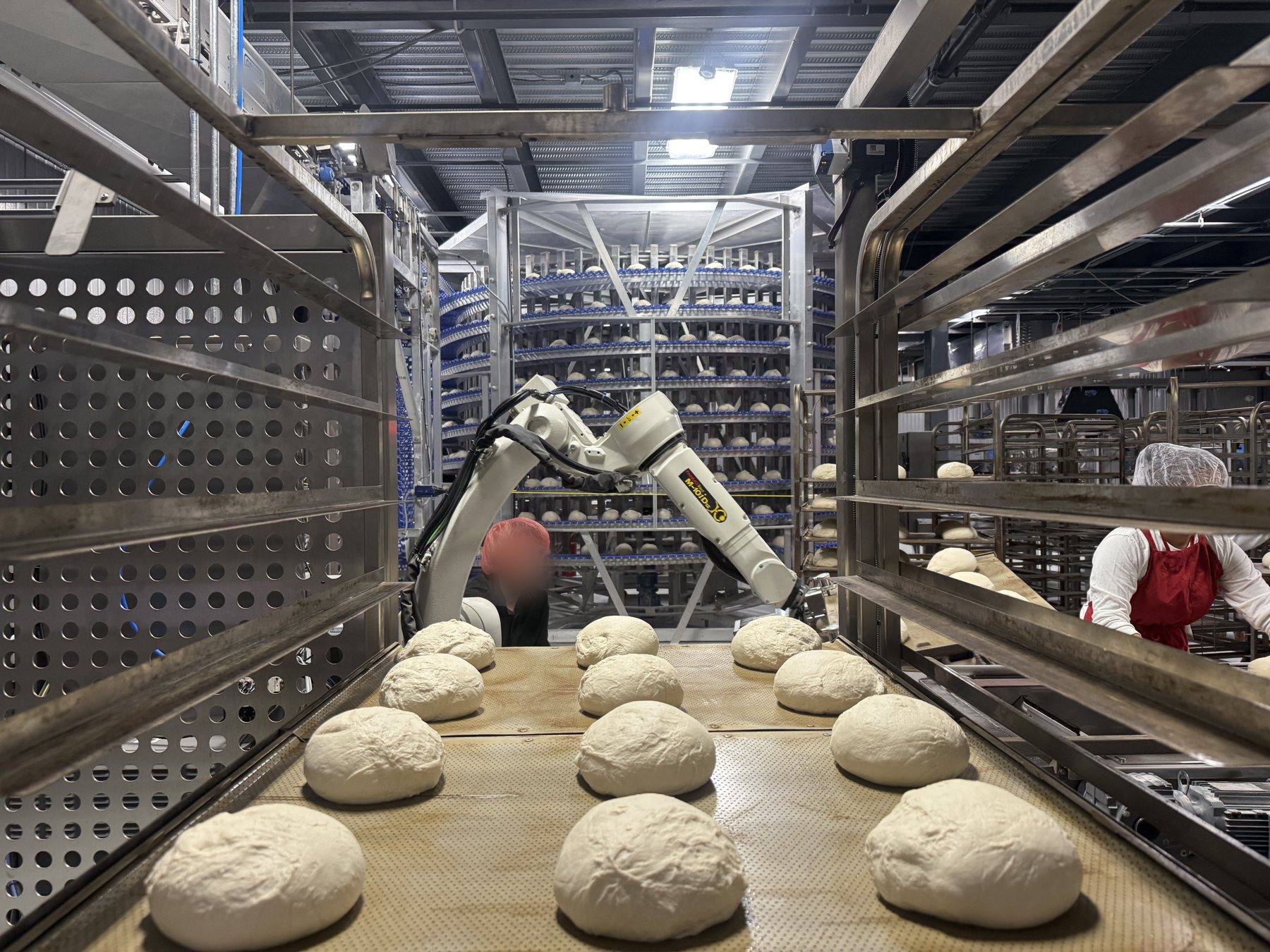
Robotic material handling covers the moves between processes: a part off a conveyor and into a fixture, a tray onto a rack, a case onto a pallet, a raw part into a machine and the finished part out. Most of the cells CalWest Robotics has built are material handling at heart. FANUC robots move dough between trays and racks at a commercial bakery, stack cases at the end of packaging lines, feed parts to assembly tables, and carry parts from a Swiss lathe to a heater to a forge.
In short
Where material handling robots fit
Robotic part transfer shows up all over a plant. These are the moves we see most, with the page that covers each one.
| Move | Example | More on it |
|---|---|---|
| Conveyor to pallet | Stacking finished cases at the end of a packaging line | Robotic palletizing |
| Belt to tray, tray to rack | Moving raw dough on a bakery floor | Bakery automation |
| Feeder to fixture | Placing molded parts into an assembly nest | Robotic assembly |
| Machine to machine | Loading, unloading and passing parts down a row of machines | Machine tending cells |
| Conveyor to conveyor | Transferring, turning or merging product between lines | Handshakes with conveyors, below |
The robot is the same kind of machine in each row. What changes is how the part arrives, what the gripper has to hold, and what the robot has to wait for before it moves.
How do you size a material handling robot?
Start with three numbers: the heaviest part, the farthest point the robot has to reach, and how many moves it has to make in an hour.
Payload is the part plus the gripper, plus anything else on the arm. A gripper that holds two parts at once carries both. FANUC’s material handling range runs from 0.5 kg to 2,300 kg of payload, so the choice is rarely limited by what exists. It is limited by floor space, cost and the rest of the cell.
Wrist ratings catch people out. FANUC rates each wrist axis for load moment and inertia as well as payload. The M-20iD/25, for example, is rated for 25 kg with 1,831 mm of reach, and its J6 axis for 32 N·m of load moment. A long gripper, or a part held well out from the flange, can hit the wrist limits while the weight is still under the payload rating.
Rate comes from the move time plus the time to grip and release, plus any time spent waiting on the machines or conveyors around the robot. In practice, the waiting often matters more than the robot’s speed.
How parts are presented to the robot
A robot pick and place is only as repeatable as the place the part comes from. There are three ways to get there:
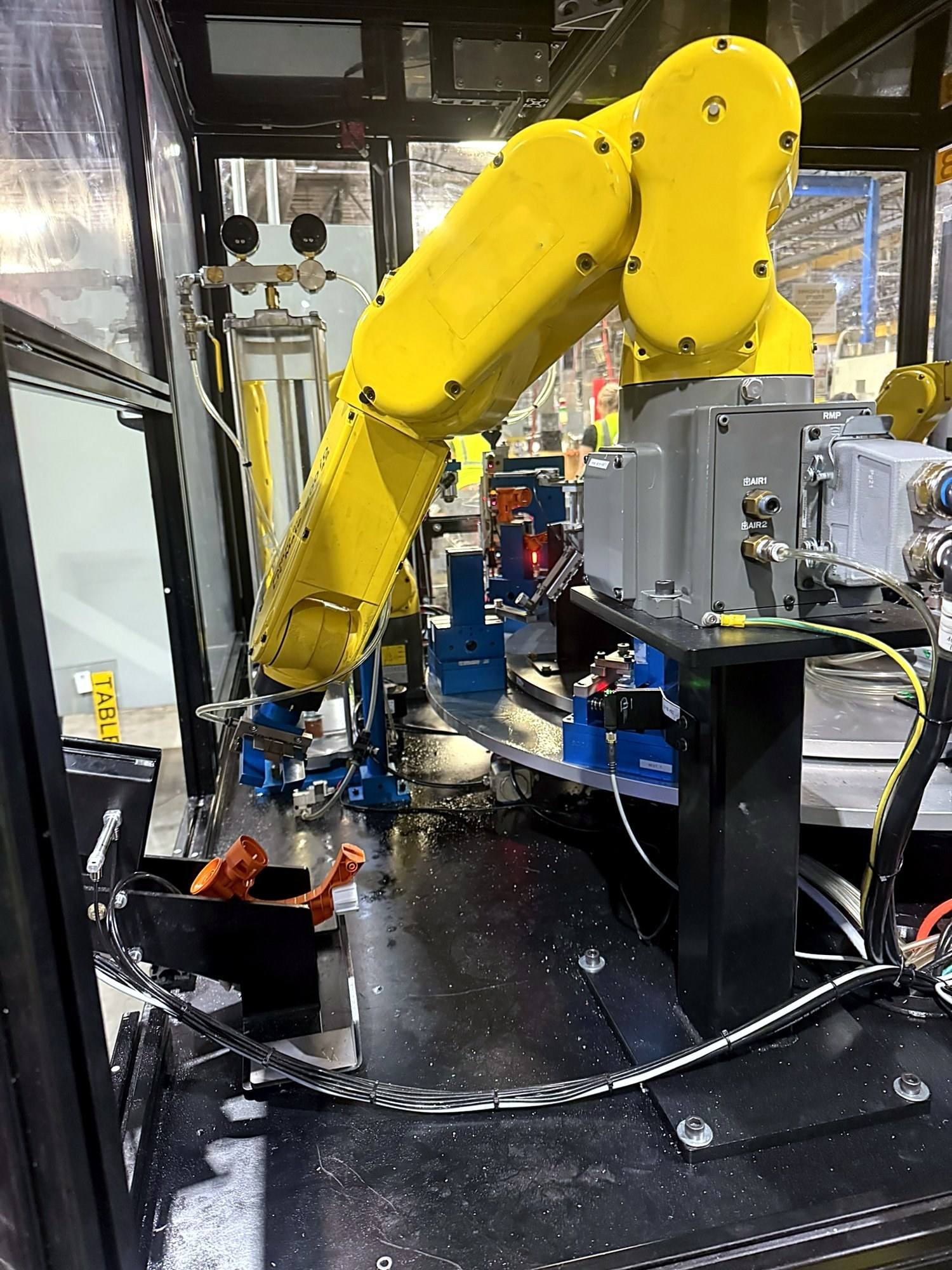
- Fixed pick points. A stop on a conveyor, a nest, a fixture or a rack dock holds the part where the robot expects it. In the spray nozzle assembly cells we built, bowl feeders present parts nonstop and in the same orientation, so the robot never has to look for them.
- A camera finds the part. FANUC iRVision locates each part and corrects the pick, from a camera fixed over the pick area or mounted on the robot’s arm. We tune vision picks on our own floor before a cell ships.
- The part is moving. iRPickTool tracks a moving belt with an encoder so the robot picks each part where it is now, not where the camera saw it.
Racks and carts need their own care. A rolling rack never parks in exactly the same spot, so the cell needs a dock or guide that locates it and a sensor that confirms it is in place before the arm reaches in.
Grippers for part transfer
Most material handling grippers fall into a few families:
- Vacuum cups or pads for parts with a flat, sealed face: cartons, sheet parts, trays.
- Mechanical fingers machined to the part, for parts that need to be held in a known orientation, like the molded parts in Fig. 2.
- Soft-touch fingers for product that marks or deforms, like raw dough.
- Dual grippers that take a finished part out and put a raw one in on the same visit, common in machine tending.
Each one should report what it holds: vacuum made, fingers closed, part present. We design grippers here and machine them on our own 5-axis, so one that needs to change after the first run can be changed the same week. Our end-of-arm tooling page goes further.
Handshakes with conveyors and machines
Every handoff in a material handling cell is a pair of signals. On a robot conveyor transfer, the infeed conveyor says a part is at the stop; the robot says it has the part and is clear. The machine says its door is open; the robot says the part is seated and it is out. We write that logic in-house on Allen-Bradley or Siemens PLCs, with EtherNet/IP between the PLC and the robot controller.
Plan for the stop, too. If the line downstream backs up while the robot is holding a part, the program needs somewhere to put it or a safe way to wait. Those decisions get made in the design review, not on your floor. Our page on conveyor integration covers stops, accumulation and spacing on the conveyor side.
Working on a floor with people
Material handling robots often sit where people already work, because that is where the parts are. Our bakery robots work on a live production floor with the crew nearby. They are industrial robots, so the cell still gets guarding, interlocked doors, and light curtains or area scanners where people load and unload, all chosen from a risk assessment. Your own safety professional should review it.
When a robot isn’t the right handler
A robot earns its place when the moves change: different parts, different patterns, different destinations. When the same short move repeats at a high rate forever, a dedicated mechanism, a pusher or a conveyor transfer can be simpler and cheaper. We build those too. Our custom automation page covers machines without a robot, like the tapping machine we built for an aerospace supplier.
How we build a material handling cell
Every cell goes through the same steps as every FANUC robot cell we build. It is modeled in SolidWorks with your parts, conveyors and machines. Robot paths are laid out and checked in FANUC ROBOGUIDE before they run on the real robot, and new motion is first stepped through slowly in T1. The frame, guarding and grippers are made in our Fontana shop, the panel is built and wired here, and the whole cell is run off before it ships to your plant, anywhere in the US.
What to send us
- A phone video of the move as it is done by hand today
- Sizes and weights of every part the robot will handle
- Where parts come from and where they go: conveyor, rack, tray, fixture or machine
- Make, model and control of any machine the robot has to talk to
- Moves per hour at peak
- A floor sketch with the space available and where people work
Call or text the robotics line at (818) 397-4809, or send your video through the contact page.
Common questions
- How big a robot do we need to move our parts?
- Add the heaviest part to the weight of the gripper, then check the reach to the farthest pick and place points. FANUC also rates each wrist for load moment and inertia, so a long gripper or a part held far from the flange can rule out a robot that looks big enough on payload alone. Send part weights and a floor sketch and we will size it from those.
- Can the robot pick parts that aren't in a fixed position?
- Yes. A FANUC iRVision camera, fixed over the pick area or mounted on the robot's arm, finds each part and corrects the pick. For parts moving on a belt, iRPickTool tracks the conveyor with an encoder so the robot picks each part where it is now. Vision adds cost and setup, so where a simple nest or stop can present the part the same way every time, that is often the better answer.
- Can a material handling robot work next to our crew?
- Yes, with safeguarding. Our bakery robots work on a live production floor with the crew working nearby. An industrial robot still needs guarding, interlocked doors, light curtains or area scanners, placed from a risk assessment of where people stand and what they do. Your own safety professional should review that assessment for your floor.
- Can one robot serve several conveyors or machines?
- Often. It depends on whether the robot can reach every point from one spot, and whether the combined work fits in the time available. When one robot would become the bottleneck, the work can be split between two. Our lathe-to-forge cell, for example, uses two FANUC robots across three machines.
- Do you work on FANUC robots someone else installed?
- Yes. We service and reprogram FANUC robots other companies installed, not only our own cells: teaching a new part, adding iRVision, moving a robot to a new spot, or finding out why a transfer keeps faulting. Call or text (818) 397-4809 with the robot model and what it needs to do.
- Do you install outside California?
- Yes. Every cell is built and run off in our Fontana shop, then shipped and installed at plants anywhere in the United States. Southern California plants are a same-day drive. When you allow it, cells we install can be reached over a secure VPN connection for program changes and troubleshooting.