
CNC machine tending robot cells for multi-machine flow
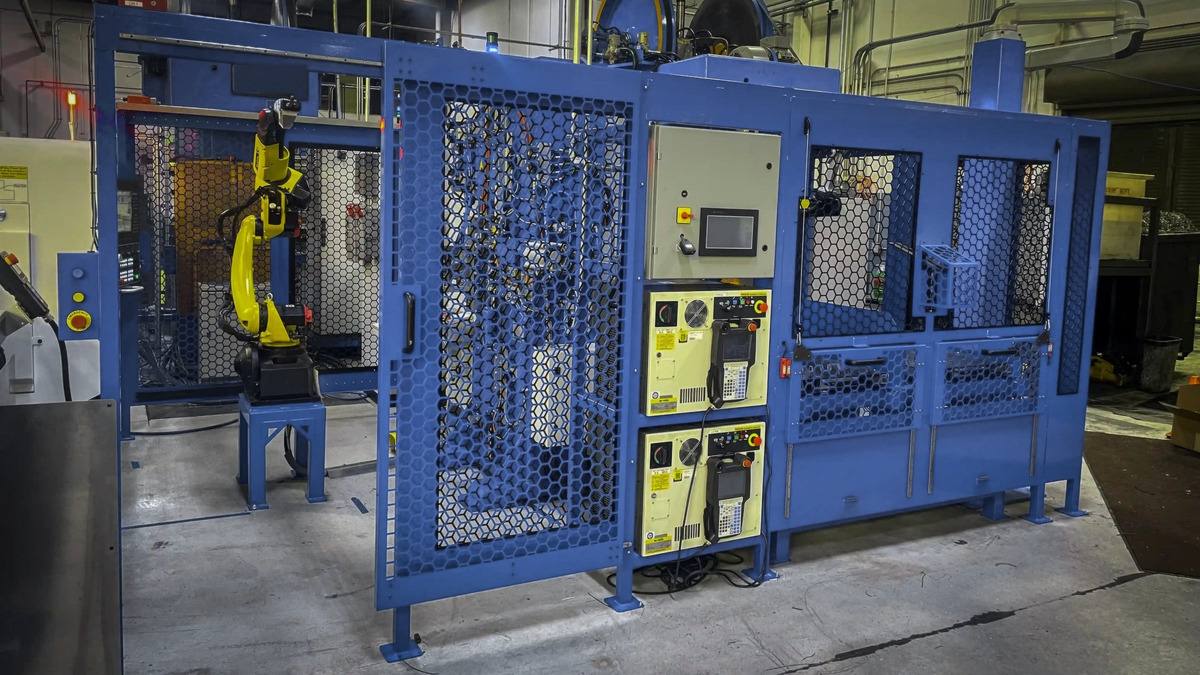
We build FANUC cells that load and unload machines and carry parts from one process to the next. Each one is designed, fabricated, wired and programmed in our Fontana shop.
- Robots
- FANUC industrial robots
- Example flow
- Swiss lathe, heater, forge, two output trays
- PLCs we program
- Allen-Bradley or Siemens, with a custom HMI
- Built in
- Fontana, CA
- Robots
- FANUC industrial robots
- Example flow
- Swiss lathe, heater, forge, two output trays
- PLCs we program
- Allen-Bradley or Siemens, with a custom HMI
- Built in
- Fontana, CA
A machine tending robot cell loads raw parts into a machine, takes finished parts out and passes them to the next step, so the machine keeps running without someone standing at it. The tending cell CalWest Robotics has built carries parts through several machines in a row, which is the harder version: parts need somewhere to wait between machines, and the cell needs a plan for when one machine stops and the rest keep going.
Why is multi-machine tending harder than a single load and unload?
In a single CNC machine tending cell, the robot waits for cycle complete, reaches in once the door is open, swaps the finished part for a raw one and tells the machine to start again. The engineering is mostly in the signals between robot and machine and in the gripper. Parts also need a clean place to wait on the way in and out.
At a CNC lathe the robot works at the chuck. At a mill or machining center it loads a vise or fixture, which has to clamp on a signal from the machine rather than by hand. Either way the machine needs an automatic door, and the chuck or fixture is usually blown clear of chips and coolant before the next part goes in. In a shop that changes jobs often, each part family also needs its own fingers and its own program, so plan the changeover along with the cell.
Put two or three machines in a row and each one runs on its own clock. The cell now has to decide where a part waits when the next machine is busy and which robot owns each handoff. It also needs a rule for what the rest of the line does when one machine faults.
| One machine | Several machines in a row | |
|---|---|---|
| Timing | The robot follows one machine’s cycle | The robots balance cycles that don’t match |
| Where parts wait | Infeed and outfeed staging | Staging plus buffers between machines |
| Handoffs | Machine to robot and back | Machine to robot, robot to robot, robot to the next machine |
| When one thing stops | The cell stops | Upstream parts need somewhere to go; downstream machines run out of work |
| Gripper | One part condition | The part can change shape, temperature or orientation between steps |
One robot serving three machines can end up as the bottleneck. Splitting the route between two robots can keep each machine fed, as long as the split balances the cycles. When the move is short and repeats exactly, a dedicated mechanism can beat a robot, which is covered on custom automation. Sizing each FANUC machine tending robot starts with payload, meaning the part plus the gripper, and the reach it needs into every machine it serves. FANUC also rates each wrist for load moment and inertia, and a dual gripper that hangs well out from the flange can hit those limits while still under the rated payload.
Case study: Swiss lathe to heater to forge
Our lathe-to-forge cell moves parts through three machines with two FANUC robots, and it supports lights-out operation.
-
Swiss lathe
Parts come off a Swiss-type lathe. The first robot takes each one and loads it into the heater.
-
Heater
The part stays in the heater for its heating cycle.
-
Forge
When the heating cycle ends, a second robot takes the part and places it into the forge.
-
Output
The cell's output goes onto two trays.
A flow like this runs on three clocks: the lathe’s cycle, the heating cycle and the moment the forge is ready for the next part. The cell’s programs have to keep those in step.
A Swiss-type lathe is normally fed from bar stock rather than by a lathe tending robot, so in this cell the robot’s job starts when the finished part comes off the lathe.
Handling parts after a heating cycle also changes the gripper: the fingers, their material and anything mounted near the heater or forge have to suit the temperature. We design and machine our own end-of-arm tooling, so a finger that needs to change can be remachined the same week.
What a cell needs to support lights-out operation
Lights-out means the cell keeps working with nobody watching it, and our lights-out manufacturing guide goes through each piece in more depth. In general, that takes:
- Enough raw stock loaded, and enough tray, bin or conveyor space for everything the cell makes before someone comes back.
- Sensing at every handoff: part in the gripper, part seated in the machine, pickup clear. A missed pick nobody notices can send the next part into a machine that is still loaded.
- A planned response to each fault: stop safely, park the robot, hold the state and record what happened.
- A way to reach the right person when the cell stops, so nobody has to walk out and check.
- A time-stamped log of every cycle and fault, showing what happened while the shop was empty.
For cells that need it, we write this kind of software ourselves: cycle and fault logging, status and push alerts to phones, and ERP links that post counts without re-keying. More on that under machine data and ERP integration.
Guarding and controls for a tending cell
A tending cell runs with nobody inside it. Anywhere a person can reach into the robot’s space needs a safeguard, whether that is an interlocked service door, a light curtain at a load station or the machine’s own guarding. If a machine’s own enclosure forms part of the cell wall, its door interlocks have to be tied into the cell’s safety circuit as well.
We do a risk assessment on every cell and choose the safeguards from it, and your own safety professional should review it as well. Our robot safety standards guide walks through the US and ISO standards behind it, and robot cell guarding covers how we build the guarding itself.
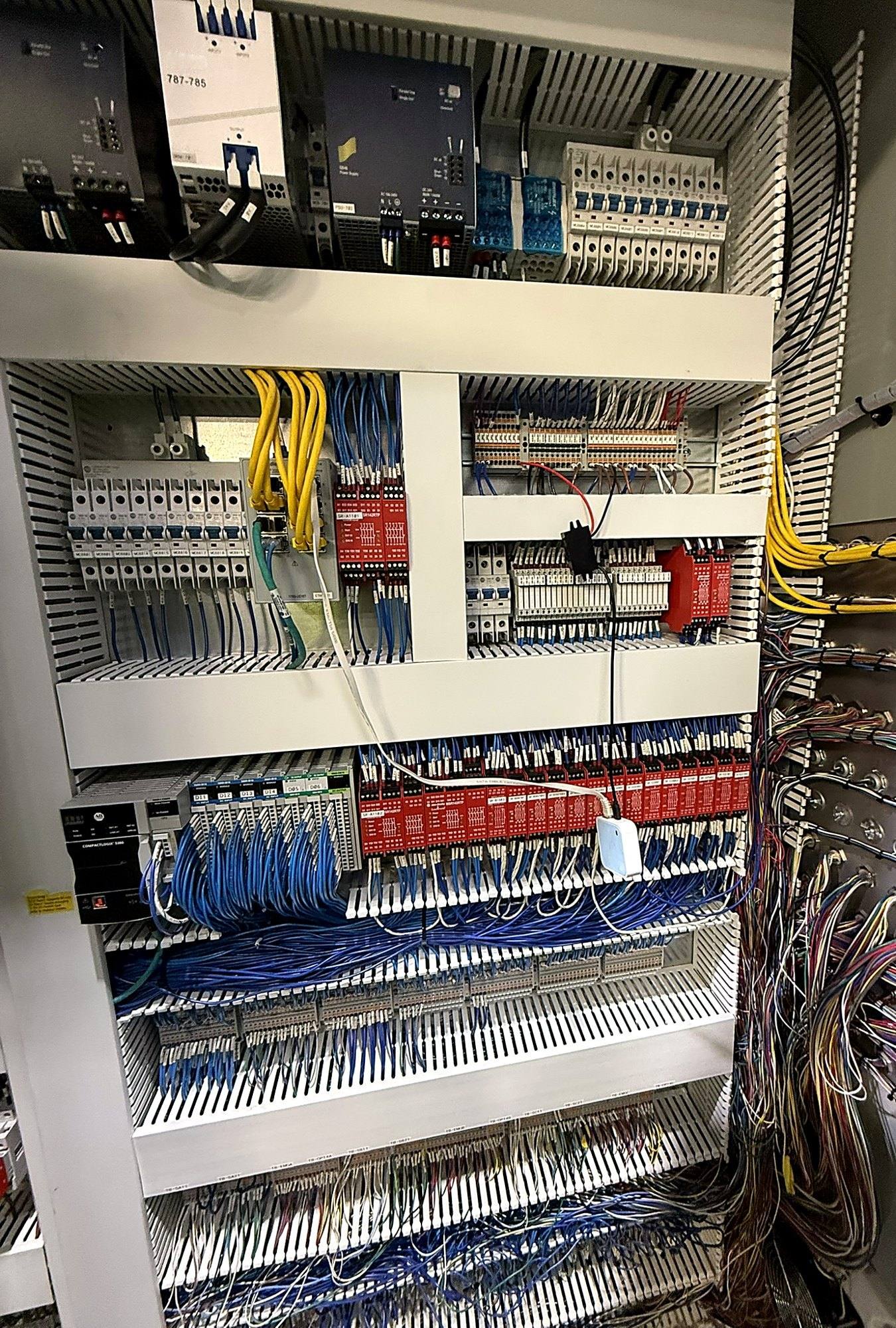
We write the PLC and safety logic in-house on Allen-Bradley or Siemens and test it here, along with FANUC robot programs tuned on our floor, and the whole cell is run off in our Fontana shop before it ships. The operator screen is a custom HMI laid out for the crew who will run the cell. How the robot talks to each machine depends on that machine’s control, which is why the make, model and control of every machine are on the list below.
What to send us for a machine tending cell
- The machines the part passes through, in order, with the make, model and control of each
- Part drawings or a sample part, for every size you plan to run
- A phone video of the manual process, from raw part to finished part
- How parts arrive and leave today: bar stock, bins, trays or a conveyor
- How long you want the cell to run between visits from an operator
- Photos of the floor space and anything the cell has to fit around
If the robot will be doing the machining itself rather than feeding a machine, look at robotic drilling and milling. Every application we build is listed under FANUC robot cells by application.
Common questions
- Can one cell tend more than one machine?
- Yes. Whether one robot can serve several machines depends on its reach, the combined cycle times and how the machines are laid out. When one robot would become the bottleneck, the work can be split between two. Our lathe-to-forge cell uses two FANUC robots across three machines: a Swiss lathe, a heater and a forge.
- What does a cell need to run without an operator?
- Enough raw material loaded and enough tray or bin space for everything it makes before someone comes back. It also needs sensors that confirm each handoff, a planned response to every fault it can detect, guarding that keeps people out while it runs, and a way to tell the right person when it stops. A log of every cycle and fault shows what happened while nobody was there.
- Can the robot talk to our existing machines?
- It depends on each machine's control. Many CNC machines can be ordered or upgraded with an automation interface that gives the robot signals like door open, clamp, cycle start and cycle complete. Older machines may have none of that, and a controls retrofit is sometimes the practical fix. Include the make, model and control of every machine when you send us your process, because it is one of the first things to check.
- Do you write the robot and PLC programs yourselves?
- Yes. We write the FANUC robot programs and the PLC and safety logic in-house, on Allen-Bradley or Siemens, and test them in our shop. The operator screens are custom HMIs written for the crew that will run the cell. None of the code is handed to an outside programmer.