
An automated tapping machine for an aerospace supplier
A custom feeder and tapping mechanism for high-volume production of one aircraft part. A PLC controls every mechanical function, and an HMI lets the operator follow the machine as it runs.
| Customer | An aerospace supplier |
|---|---|
| Scope | Feeder design, Tapping mechanism, PLC controls, Monitoring HMI |
| Equipment | Custom parts feeder, Custom tapping mechanism, Belt drive |
| Controls | PLC control of every mechanical function |
| Software | HMI for real-time monitoring |
CalWest Robotics built this machine around a single part, and there is no robot in it. When the part and the step never change, a dedicated machine is usually simpler than a robot doing the same work.
The job: high-volume tapping of one aircraft part
On one part at high volume, every cycle is the same. A part arrives, sits in the same place, gets tapped and moves out of the way for the next one. We don’t name customers, so the part is described only in general terms.
What we built: a custom parts feeder and tapping mechanism
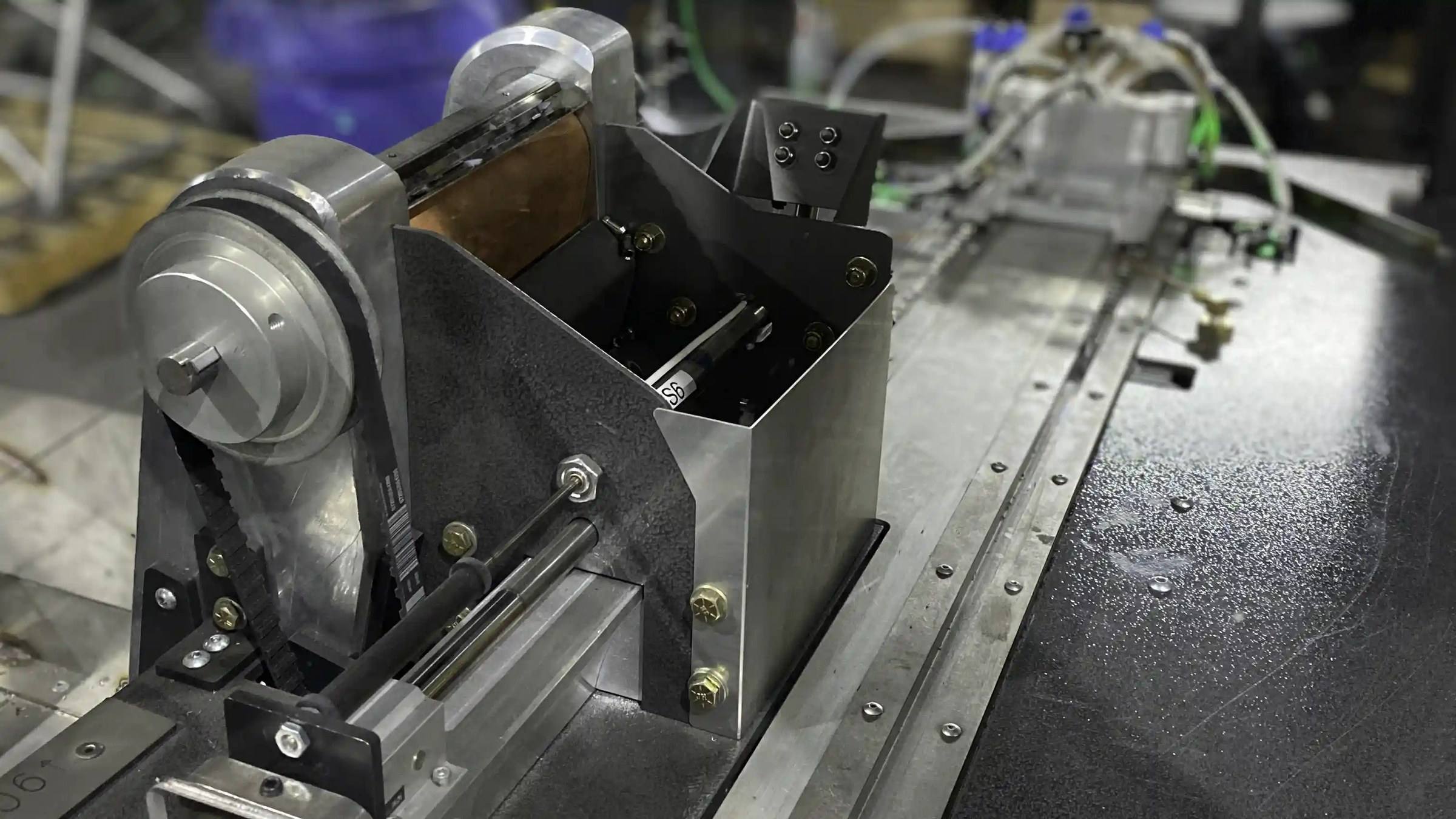
The two main custom pieces are a parts feeder and a tapping mechanism, both designed around this one part. Fig. 1 shows the belt drive and the feeder.
A feeder’s job is to hand the mechanism the next part in the same position every time. If a part sits off-center, the tap comes down off the hole’s axis; if it sits tilted, the tap enters at an angle. Either one can mean a bad thread or a broken tap. On a custom tapping machine, the feeder matters as much as the tapping head.
Custom machines are mostly one-off parts: plates, brackets, guides and machined blocks. Our parent company, CalWest Manufacturing, runs laser cutting, press brake forming, welding and 5-axis machining in the same Fontana shop, so a part that needs to change can be remade in-house.
How the PLC runs the tapping machine
Every mechanical function on this machine runs under PLC control, the feeder and the tapping mechanism included. In general, the logic that takes the most care on a PLC-controlled tapping machine is what happens when something goes wrong. It has to confirm a part is in place before the tap moves, stop in a known state when a step doesn’t finish, and tell the operator where it stopped.
We write PLC logic for Allen-Bradley and Siemens controllers and test it in-house. Our PLC programming page covers how we approach it.
Real-time monitoring on the HMI
An HMI on the machine gives the operator real-time monitoring, so the machine’s state is on a screen rather than worked out by watching the mechanism. We design operator screens around the people who use them, not from a template; see custom HMI. The rest of our controls and code, from data logging to ERP links, is on automation software.
When is a custom tapping machine a better fit than a robot?
| Custom tapping machine | Robot cell with a spindle | |
|---|---|---|
| Parts | One part, or a family that holds and feeds the same way | Several parts, or parts that change often |
| Holes | Fixed position and direction | Many positions and angles, including on 3D parts |
| When the part changes | Feeder or tooling parts are remade | Mostly a program and fixture change |
A six-axis robot earns its place when the holes are many and at different angles. We built one of those for drilling complex 3D parts, written up on robotic drilling and milling. Custom automation covers when we would suggest a machine over a robot.
Our parent company’s certifications
CalWest Manufacturing, our parent company, is AS9100D and ISO 9001 certified and ITAR registered. The aerospace automation page covers what aerospace buyers usually ask a supplier, and our page on automation for defense suppliers covers controlled drawings and part records.
Starting a custom machine project
What to send us for a custom machine
- A part drawing with the hole and thread callouts
- The material
- How many parts you run per shift or per year
- How parts reach the station today: loose, in trays or off another machine
- A short video of the step as it is done now
If the part or drawing is export-controlled under ITAR or EAR, don’t email or text it. Call the robotics line at (818) 397-4809 before sending anything.
If the job turns out to need a robot after all, we build FANUC robot cells in the same shop, and robot cell design explains how we model one in SolidWorks before building it. Our other jobs are on the projects page.
Common questions
- Do you build automation that is not a robot?
- Yes. This tapping machine has no robot in it: a custom parts feeder, a tapping mechanism, PLC control of every mechanical function and an HMI for monitoring. We also retrofit the controls on older machines, replacing the PLC and the operator screen. If a dedicated machine would be the simpler build for your job, we will say so.
- Which PLC platforms do you program for custom machines?
- We write and test PLC logic for Allen-Bradley and Siemens controllers in-house. We have also programmed an AutomationDirect Do-more BRX PLC with a C-more HMI on a legacy machine retrofit, and Allen-Bradley CompactLogix with Kinetix servo motion. If your plant standardizes on one platform, tell us at the start so the machine uses controllers your maintenance team already supports.
- Can you tap parts that have holes at many different angles?
- A dedicated tapping machine is built around one part. When a part has holes at many positions and angles, a six-axis robot carrying a spindle can reach them from different directions, which is how our drilling cell for complex 3D parts works. Whether tapping belongs on the robot too depends on the thread size, the material and the tolerance, so we would look at your drawing before saying either way.
- What happens if a custom machine needs a change after it is built?
- Most of a custom machine is one-off parts, so a change usually means remaking a bracket, a guide or a tooling block, and sometimes editing the PLC program to match. Our parent company's shop has laser cutting, press brake forming, welding and 5-axis machining under the same roof, so a modified part can be made in-house instead of waiting on an outside shop.