
Robot cell controls and software from the team that builds the cell
The robot programs, PLC logic, panels and operator screens for every CalWest cell are written and built in our Fontana shop by the same team that builds the frame.
- Robots
- FANUC, R-30iB controllers
- PLCs
- Allen-Bradley, Siemens
- Panels
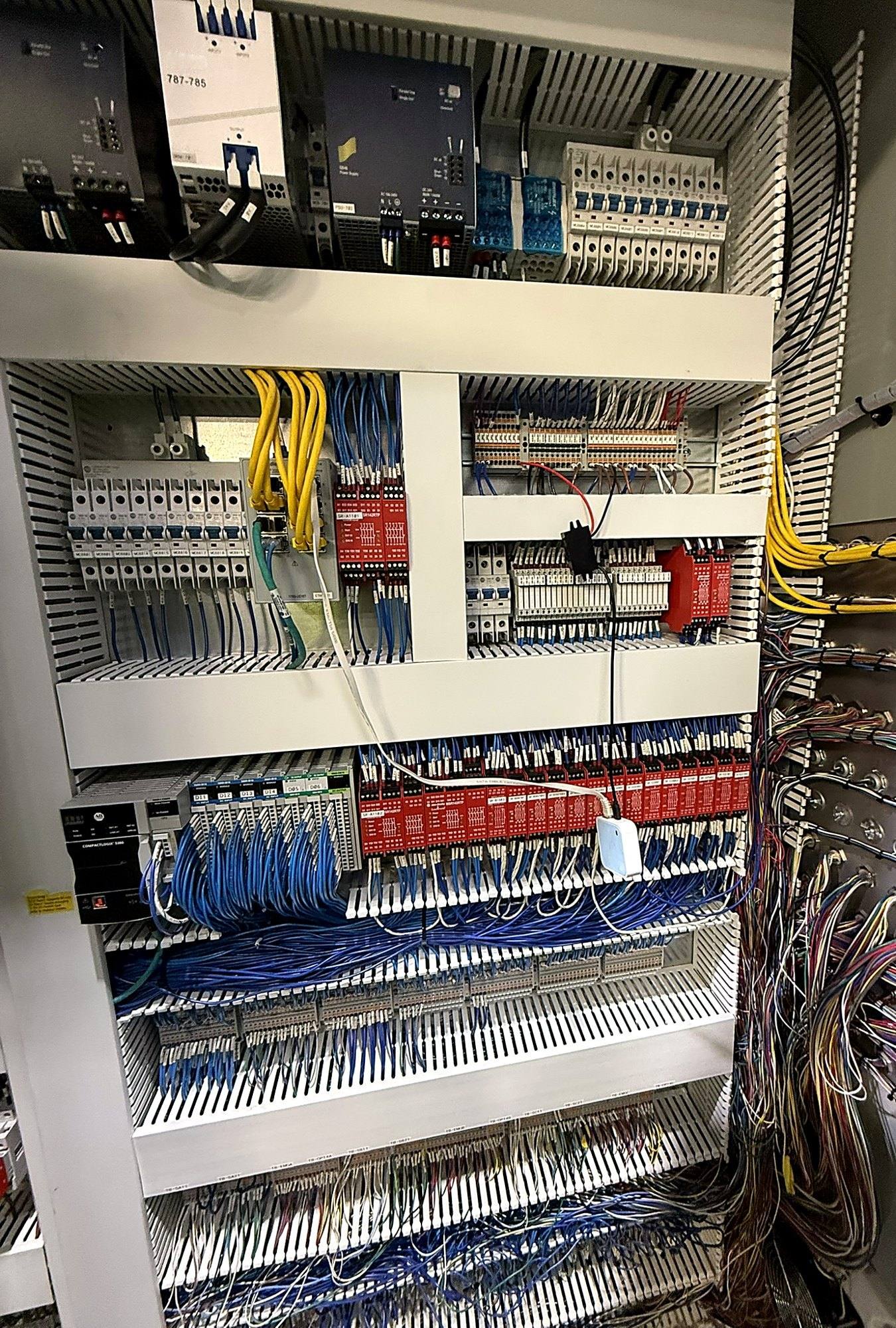
- Built, wired and tested in Fontana
- Data
- Custom Python to your ERP
- Robots
- FANUC, R-30iB controllers
- PLCs
- Allen-Bradley, Siemens
- Panels
- Built, wired and tested in Fontana
- Data
- Custom Python to your ERP
Robot cell controls and software cover more than the robot program. Around the FANUC program sit the PLC that runs the conveyors and feeders, the safety circuit on the guarding, the panel all of it is wired into, the operator screen and, on some jobs, a link to your ERP.
What the controls and software cover
Five pieces of work sit behind a running cell.
| Work | What we write or build | Where it runs |
|---|---|---|
| FANUC robot programming | Paths, stack patterns, vision picks and conveyor tracking | R-30iB controllers, with iRVision and iRPickTool on vision cells |
| PLC and safety logic | Cell sequence, interlocks, safety logic and servo motion | Allen-Bradley and Siemens PLCs |
| Control panels | Layout, build, wiring and test | Built in our shop, mounted at the cell |
| Operator screens | HMI screens laid out for the crew that runs the cell | Touch screen at the cell |
| Machine data and ERP | Cycle and fault logs, counts, jobs and scrap | Custom Python between the machines and the ERP |
How robot integration with a PLC works
In most cells the robot controller owns the motion, and the PLC and safety circuit own everything around it: conveyors, the bowl feeders on assembly cells, guard door switches, light curtains and the operator screen. The two trade a short list of handshake signals, such as part present, robot clear of the fixture, cycle complete and fault. That exchange runs over hard-wired I/O or an industrial network such as EtherNet/IP or PROFINET.
Most of what makes a cell easy or hard to live with comes down to that handshake. When the robot side and the PLC side come from different companies, a mismatch at startup means two parties working out whose code is wrong. In our cells one team writes both, tests them together on our floor, and fixes whichever side needs it.
On a vision-guided delta robot line, the robots also have to split the work between themselves, like the two deltas sharing one belt on a tray loading line we built.
The PLC programming and FANUC robot programming pages go into each side of the handshake in more detail.
Robot cell programming, wiring and run-off
Every cell goes through the same five steps: design, fabricate, wire, code and install. Design and fabrication are covered on the robot cell design page. The last three are where the controls and software get built and proven:
-
Wire
The control panel is built, wired and tested here, then connected to the cell for the run-off before anything ships.
-
Code
Robot paths and vision, PLC and safety logic and the operator screens are written in-house, along with any desktop, web or iPhone software the job calls for.
-
Install
The finished cell runs off in our Fontana shop, where the robot programs are tuned. Then it is commissioned on your floor.
The controls and software are part of every robot cell we deliver, and we also write them for machines we didn’t build, as the retrofit section below shows.
Custom automation software for the plant floor
Some cells need to report to the business as well as run. We log every cycle and fault with a time stamp so it can be searched later. We also write custom Python that posts counts, jobs and scrap straight to the ERP, so nobody re-keys them at the end of a shift. Which ERP you run decides how that link is built, so tell us at the start. Status and push alerts can go to an iPhone app, which puts a stopped cell in front of a supervisor who is somewhere else in the building.
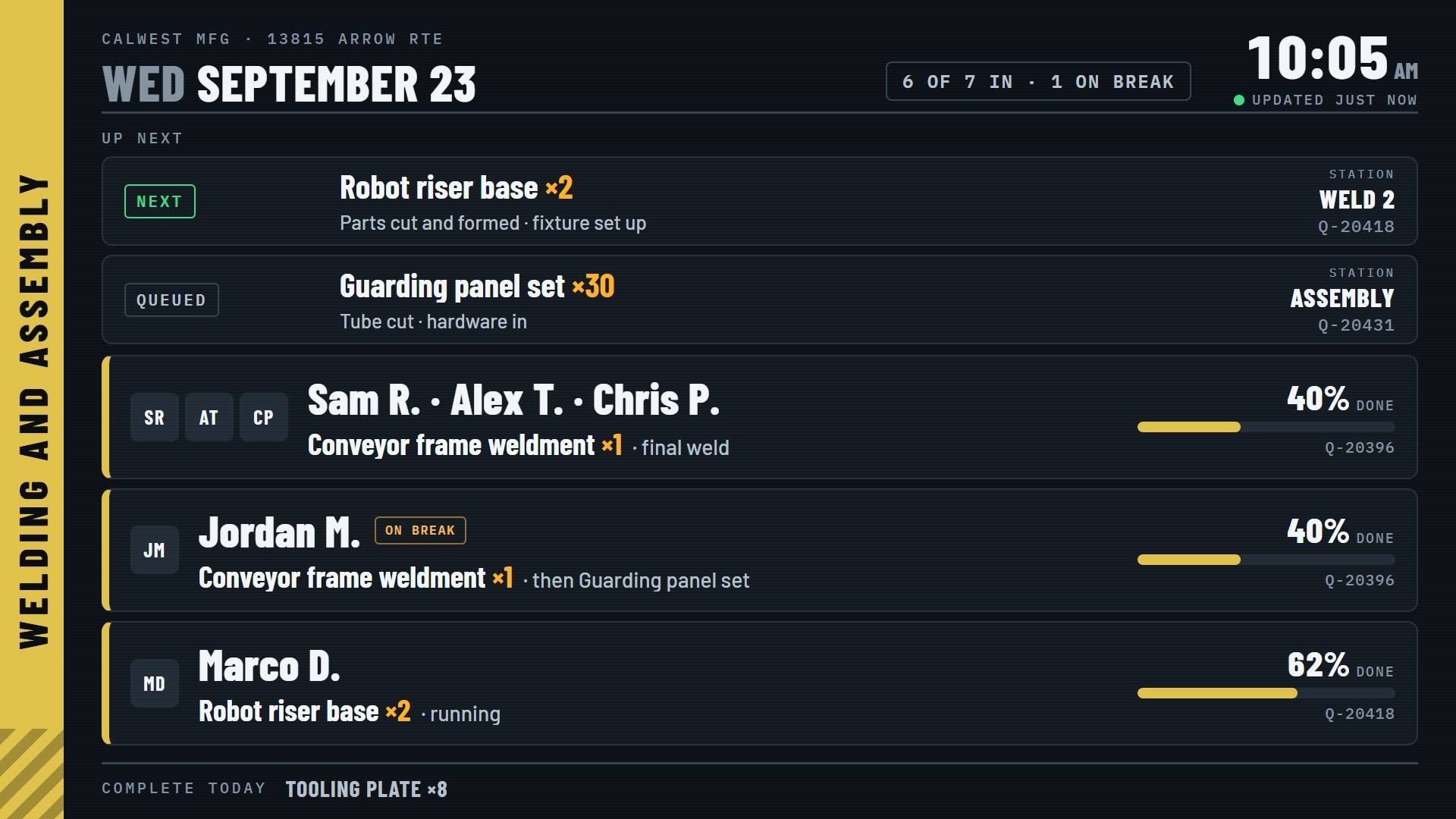
We run CalWest Manufacturing on software we wrote: department boards on the shop TVs, live job tracking, and an iPhone app with jobs, schedules, team chat and push alerts.
Retrofits of legacy machine controls
A machine with sound iron and failing controls often doesn’t need to be replaced. We swap the PLC, the HMI and the wiring that goes with them, then test the machine before it goes back into production. One of these jobs moved a legacy process machine to an AutomationDirect Do-more/BRX PLC with a C-more touch screen. The controls retrofit page covers how we plan the cutover.
New machines that aren’t robot cells get the same PLC and HMI work. The automated tapping machine we built for an aerospace supplier has PLC control of every mechanical function, including the custom feeder and the tapping mechanism, and an HMI for real-time monitoring.
Also in this section
-
Offline programming
Paths laid out and checked in FANUC ROBOGUIDE before they run, then stepped through in T1 and touched up on the floor.
-
Allen-Bradley PLCs
Studio 5000 programs for CompactLogix, ControlLogix and GuardLogix, with the FANUC handshake written by the same team.
-
Siemens PLCs
S7-1200 and S7-1500 programs written in TIA Portal, for cells that have to match a Siemens plant standard.
-
Safety PLCs
GuardLogix and safety relay circuits for E-stops, doors, light curtains and muting, designed from a risk assessment.
-
Servo motion
Servo axes beside the robot: Kinetix on CompactLogix, robot-driven axes and TwinCAT machines, sized and tuned in-house.
-
Manufacturing software
Department TV boards, live job tracking, an iPhone app and ERP links, written by a shop that runs on them.
-
Machine monitoring
Every cycle and fault logged and searchable, downtime by reason, OEE from real records, and stop alerts on iPhone.
Common questions
- How does a FANUC robot talk to a PLC?
- The FANUC controller runs the robot's motion. The PLC runs the rest of the cell, such as conveyors, feeders and the operator screen, while guard door switches and light curtains go through a safety relay or safety PLC connected to the robot's stop circuit. The robot and the PLC exchange handshake signals like part present, robot clear and cycle complete over hard-wired I/O or an industrial network such as EtherNet/IP or PROFINET. We write both sides and test them together on our floor before the cell ships.
- Do you build the control panels yourselves?
- Yes. Every panel for a CalWest cell is built, wired and tested in our Fontana shop. It is then powered up with the cell's own robot and PLC programs during the run-off here, so wiring and I/O problems turn up in our building instead of during commissioning on your floor.
- Do you replace the controls on older machines?
- Yes, if the machine itself is in good shape and the controls are the problem. To start, send photos of the panel, the model numbers of the current PLC and HMI, and any drawings, manuals or program backups you still have. A short video of a full cycle shows us what the machine is supposed to do, which matters most when the old program can't be read.