
End-of-line packaging automation for consumer products
We build FANUC robot cells for the tail end of consumer-product lines, from delta robots loading trays to palletizers stacking finished cases.
- Palletizing
- FANUC robots at the end of each packaging line
- Tray loading
- Two FANUC delta robots with iRVision and iRPickTool
- Assembly
- LR Mate robots fed by bowl feeders
- Controls
- Allen-Bradley or Siemens, panels built in-house
- Built in
- Fontana, CA
- Palletizing
- FANUC robots at the end of each packaging line
- Tray loading
- Two FANUC delta robots with iRVision and iRPickTool
- Assembly
- LR Mate robots fed by bowl feeders
- Controls
- Allen-Bradley or Siemens, panels built in-house
- Built in
- Fontana, CA
A consumer-product line tends to end the same way. Product goes into a tray or carton, cartons go into cases, and sealed cases get stacked on a pallet for the warehouse. End-of-line packaging automation puts robots on those last hand transfers. CalWest Robotics builds these cells around FANUC robots in Fontana, CA. The jobs we can point to are palletizing cells, a tray loading line with two delta robots, and a set of assembly cells.
In short
Where do robots fit at the end of a packaging line?
Every plant lays its line out differently, but the stations after the product is made usually come in the same order. Some suit a robot. Others are normally done by a standard packaging machine that a robot cell hands product to or takes it from.
| Station | The job | Usually done by |
|---|---|---|
| Product handling | Loose product picked off a belt into trays, cartons or thermoforms | Delta robot, often with vision and belt tracking |
| Case erecting | Flat blanks folded into open cases, bottom flaps taped or glued | A standard case erector |
| Case packing | Packs or cartons loaded into the case | A dedicated case packer, or a robot with a gripper that picks a group |
| Case sealing | Top flaps closed and taped or glued shut | A standard case sealer |
| Palletizing | Sealed cases stacked to a pattern on a pallet | A palletizing robot (FANUC builds four- and five-axis models for it) or a six-axis arm, with a case gripper |
| Stretch wrapping | Finished pallet wrapped for shipping | A standard stretch wrapper |
The packaging-line cells we have built sit at the two ends of that table: product into trays, and cases onto pallets. Packaging line robots rarely stand alone. Each cell takes product from one machine and hands it to the next, so it has to know when the machine upstream is feeding, when the one downstream is full, and what to do when either one stops. We work that handshake out during design, before the cell is built. At the start of a line, inbound pallets of empty containers or components can be unloaded by a depalletizing robot that feeds the first machine.
Palletizing finished cases at the end of each line
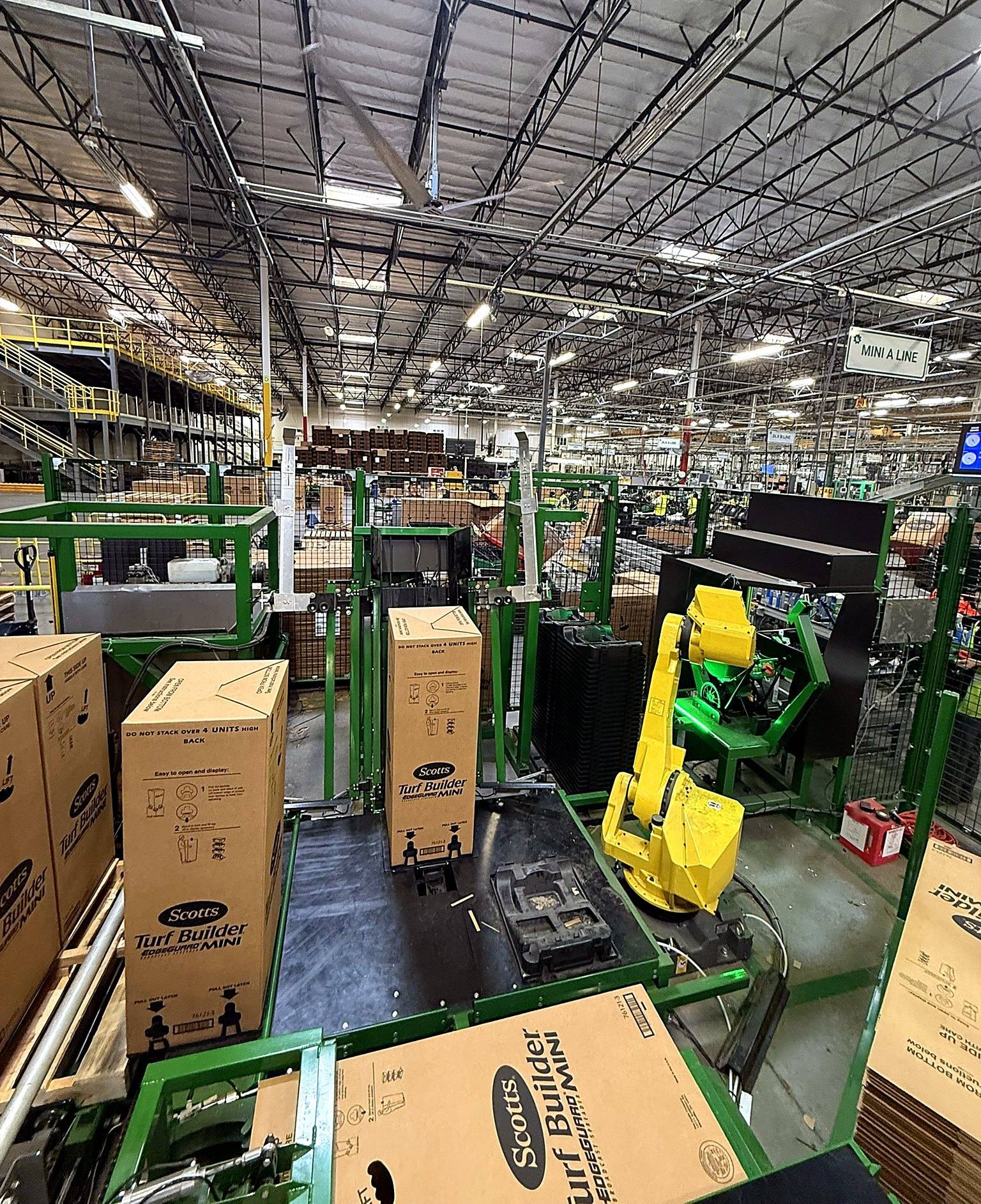
At a Temecula, CA plant belonging to a national lawn and garden brand, FANUC robots in cells we built stack finished cases onto pallets at the end of each packaging line. The job is written up as the Temecula palletizing cells project.
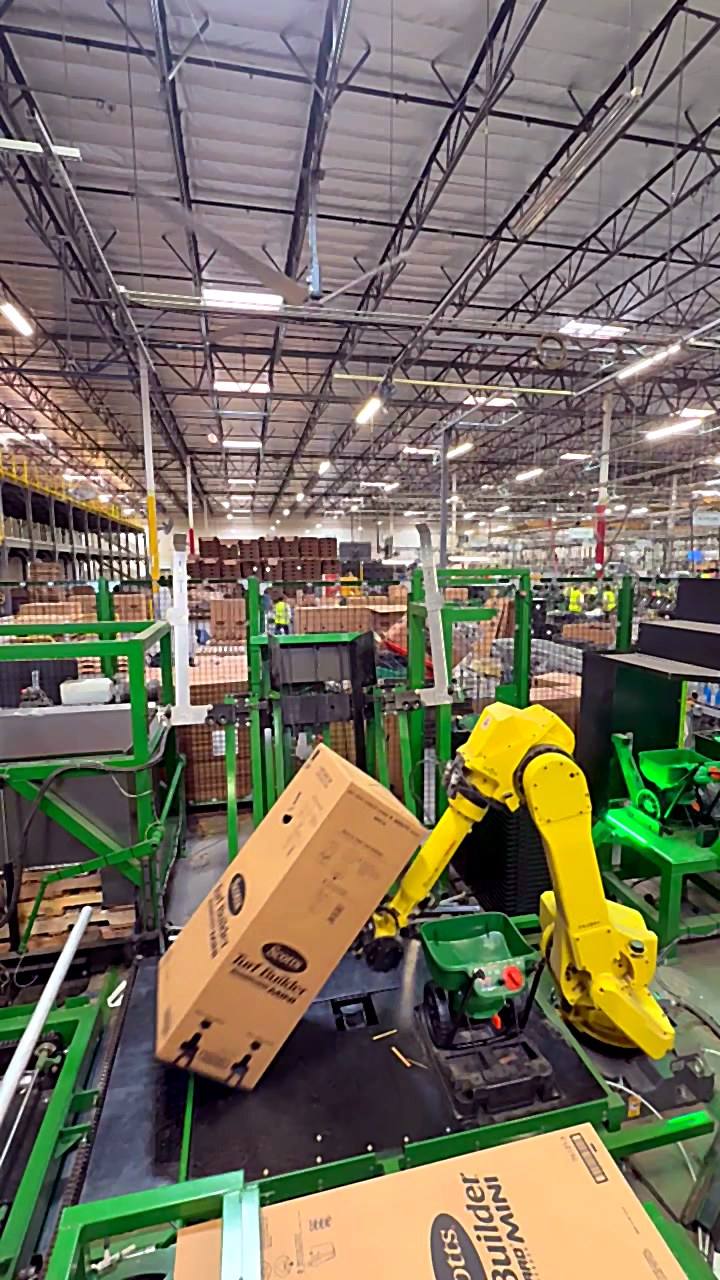
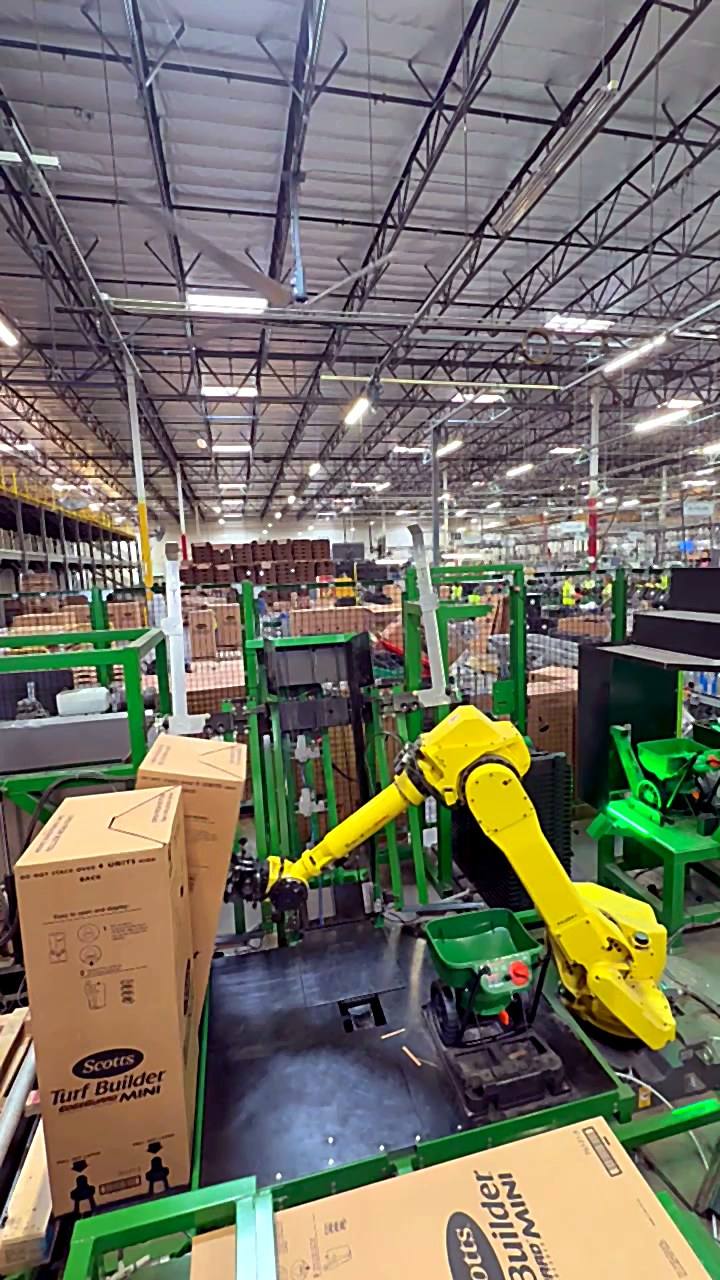
Seen from the packaging side, three things decide how well a palletizer fits the line: how cases arrive at the pick point, how much conveyor sits between the last packaging machine and the robot to soak up short stops, and how full pallets leave without holding up the line. Grippers, stack patterns and safety at the pallet stations are covered on our robotic palletizing page, and what a palletizing cell quote is made of has its own guide.
Loading trays with delta robots
When loose product comes down a belt and has to go into trays, a delta robot is usually the right arm. It hangs above the belt, the product is light and the moves are short. On the delta tray loading line we built, FANUC iRVision finds each part on the moving belt and iRPickTool splits the picks between two delta robots, which place the parts into trays. Delta robot pick and place explains when a delta fits and when a six-axis arm does better.
Assembly cells in the same plant
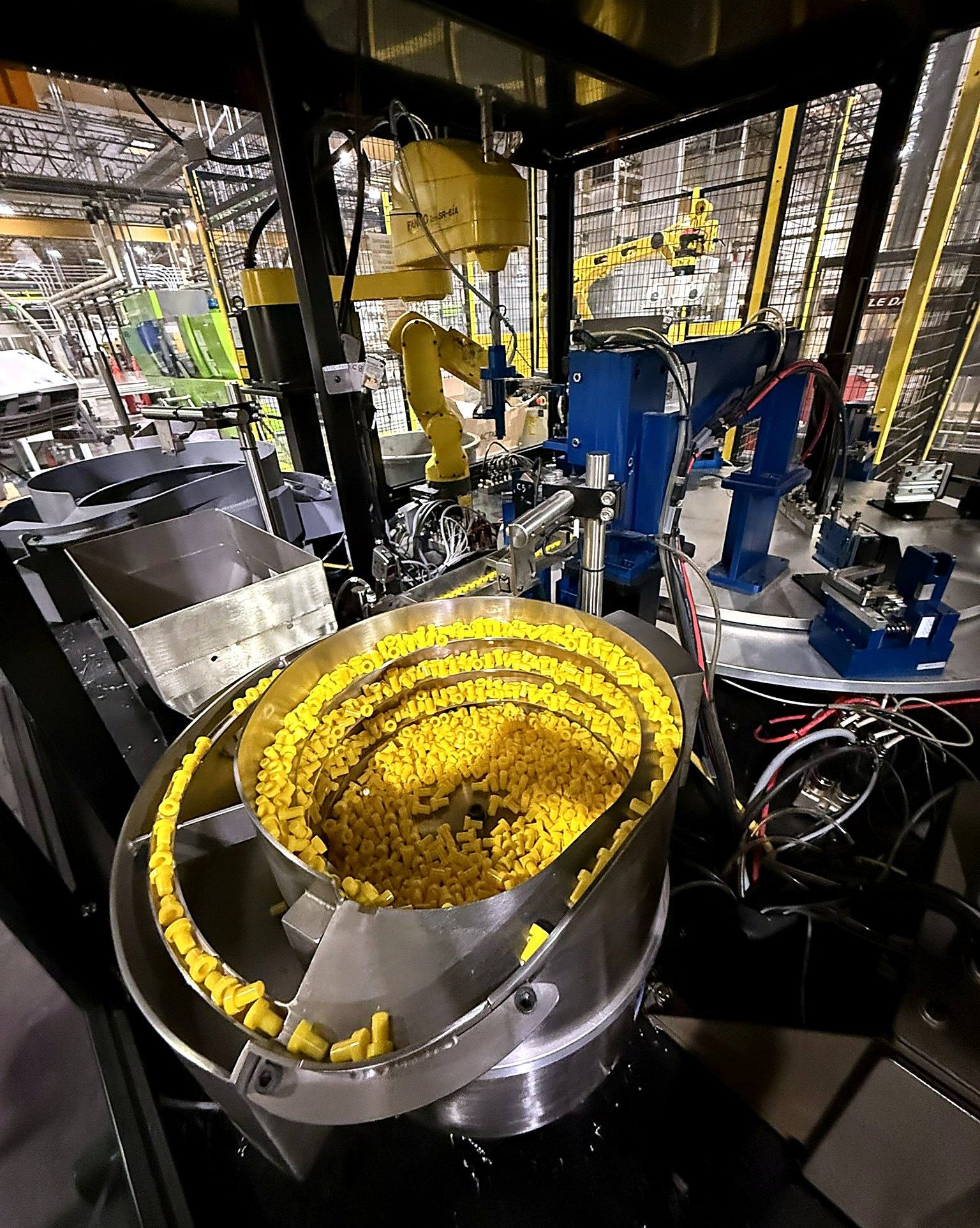
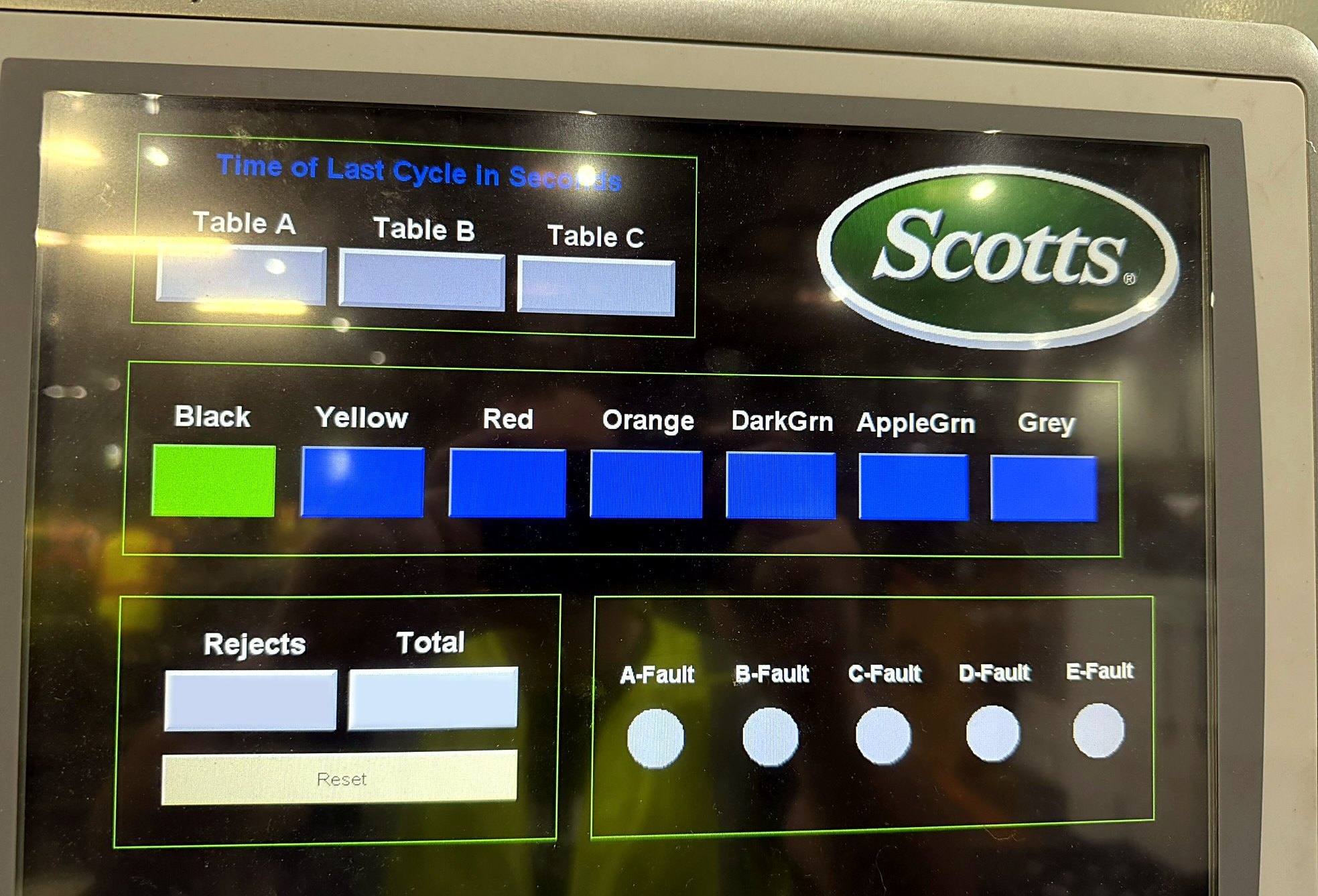
Some consumer-product plants assemble product in the same building where they pack it. At the same Temecula plant, LR Mate robots in cells we built assemble spray nozzles at three tables, with bowl feeders supplying the parts (Fig. 3). Part feeding, finger design and changeovers are covered on the robotic assembly page.
Running several robot cells on one packaging line
When the palletizer, the tray loader and the machines between them come from different suppliers, the screens, fault messages and stop signals usually differ from one machine to the next. If one team builds all the cells, they share one set of conventions. We write the PLC and safety logic in-house on Allen-Bradley or Siemens, and the robot programs too, so a fault that crosses from one cell to the next gets traced by the people who wrote both sides. Our PLC programming page has more on how we write and test that logic.
If your plant already standardizes how machines report their state, tell us before design starts. Some plants use PackML, which was developed by OMAC and adopted by ISA as technical report ISA-TR88.00.02. It defines a common state model and a set of named data tags, called PackTags, for packaging machines. Knowing that up front shapes how the cell’s PLC program is written.
Each cell gets an operator screen laid out around the people who run it; see custom HMI screens. Production counts and fault logs can go to your ERP too, which is covered on machine data and ERP integration.
What changes on a consumer-product line?
Usually the hardest part is the SKU count. Many products share one line, and the cell has to run all of them. These are the questions we ask early:
- Case range. The gripper has to hold the smallest and the largest case on the line. If one tool can’t cover both, the changeover has to include a tool swap.
- Pattern changes. On a palletizer, a new SKU in an existing case size can often run on a pattern already in the program, sometimes with a different layer count. A new case size needs a new stack pattern and can also mean new pick points and gripper settings.
- Product and tray changes. On a vision line, a new product can need a new vision model and new pick heights. A new tray layout is mostly a program change.
- Color and variant changeovers. On an assembly line, a color change means clearing the old color out of the feeders and tracking which one is running. The screens on our Temecula assembly cells show color changeover status next to cycle times and faults.
- Peak rate. Size the cell to the busiest hour of the busiest season, not the yearly average.
What to send us
- A phone video of the end of the line running at normal speed
- Every SKU the line runs, with case or tray sizes and weights
- A photo or drawing of each stack pattern or tray layout
- The line rate at its busiest hour, in cases or parts per minute
- A floor sketch with columns, doors and forklift paths near the end of the line
- The machines on either side of the cell and the PLCs they run
Work we have done for a commercial bakery and an aerospace supplier is listed with the other industries we build for.
Common questions
- Can one integrator handle palletizing and tray loading?
- Yes. We have built both: FANUC palletizing cells at the end of packaging lines, and a tray loading line where two FANUC delta robots share one belt. We write the PLC and robot programs ourselves, so if both cells on your line come from us, one team answers for the signals between them.
- What happens to the line when the palletizer stops?
- Cases back up toward the packaging machines. To keep a short stop, such as a pallet change or a cleared fault, from stopping the machines upstream, many lines have a stretch of accumulation conveyor ahead of the palletizer. How much depends on the case rate and how long a typical stop lasts. A layout with two pallet stations also helps, because the robot keeps building on one pallet while the other is swapped.
- Can one robot cell run all of our SKUs?
- Often, if the full range is planned in from the start. The gripper has to hold every case or product on the line, and the robot has to carry the heaviest one plus the tool within its payload and wrist load limits. Some changes are only a program change, while others need a new tool or new fixtures. Send us the whole SKU list before design so nothing gets left out.
- Can the robot cells talk to the packaging machines we already have?
- The cell has to know when the machine ahead of it is feeding and when the one after it can take more. That is done with hardwired signals or over the plant network, depending on what the existing machines offer. We write the PLC logic in-house on Allen-Bradley or Siemens. If your plant uses PackML states and tags, tell us at the start, because it shapes how the cell's program reports its state.
- Can production counts from the cells go into our ERP?
- Yes. We write custom Python software that ties machines to the ERP, so production counts, job numbers and scrap go in without anyone keying them by hand. Every cycle and fault can be logged with a time stamp and kept searchable, which helps when you need to find out why a line fell behind on a given shift. What we connect to depends on your ERP and what it accepts, so we look at that during design.