
Custom automation machine builder for jobs a robot doesn't fit
Some jobs are done better by a dedicated machine than by a robot arm. We design, fabricate, wire and program those machines in the same Fontana shop that builds our FANUC robot cells.
- Built in
- Fontana, CA
- Fabrication
- Laser, press brake, weld, 5-axis
- Controls
- PLC and HMI, written in-house
- PLC brands
- Allen-Bradley, Siemens
Not every process needs a robot arm. When the job is one operation on one part, repeated all day, a dedicated machine with its own feeder and mechanism is often the simpler build. CalWest Robotics works as a custom automation machine builder for those jobs, and we also build custom mechanisms into our FANUC robot cells when a job needs both.
When does a custom machine beat a robot?
A six-axis robot is a general-purpose tool. You pay for its reach and its flexibility whether the job uses them or not. When the motion is short and always the same, a cylinder, a servo slide, an indexer or a cam can often do the work with less hardware and fewer parts to maintain.
In the trade this is called a special purpose machine: built around one part and one process. Because of that, a new part design can mean new tooling or a new mechanism, where a robot might only need a new program and new fingers.
| What the process looks like | What it usually points to |
|---|---|
| One operation on one part, or a small family of similar parts | A dedicated machine |
| A short, fixed motion repeated at high volume, such as feed, clamp, tap or press | A dedicated machine |
| Many part numbers and frequent changeovers | A robot cell |
| Several operations at different positions or angles on the same part | A robot cell |
| A product design that is still changing | A robot cell, or a machine designed so its tooling can be swapped |
| Moves that change from part to part, next to steps that never change | A robot cell with custom mechanisms built in |
Plenty of jobs land in the last row. We sort that out from a video of the process before we quote either one. Our guide on how to automate a manufacturing process walks through choosing which process to start with.
Example: a feeder and tapping mechanism for an aircraft part
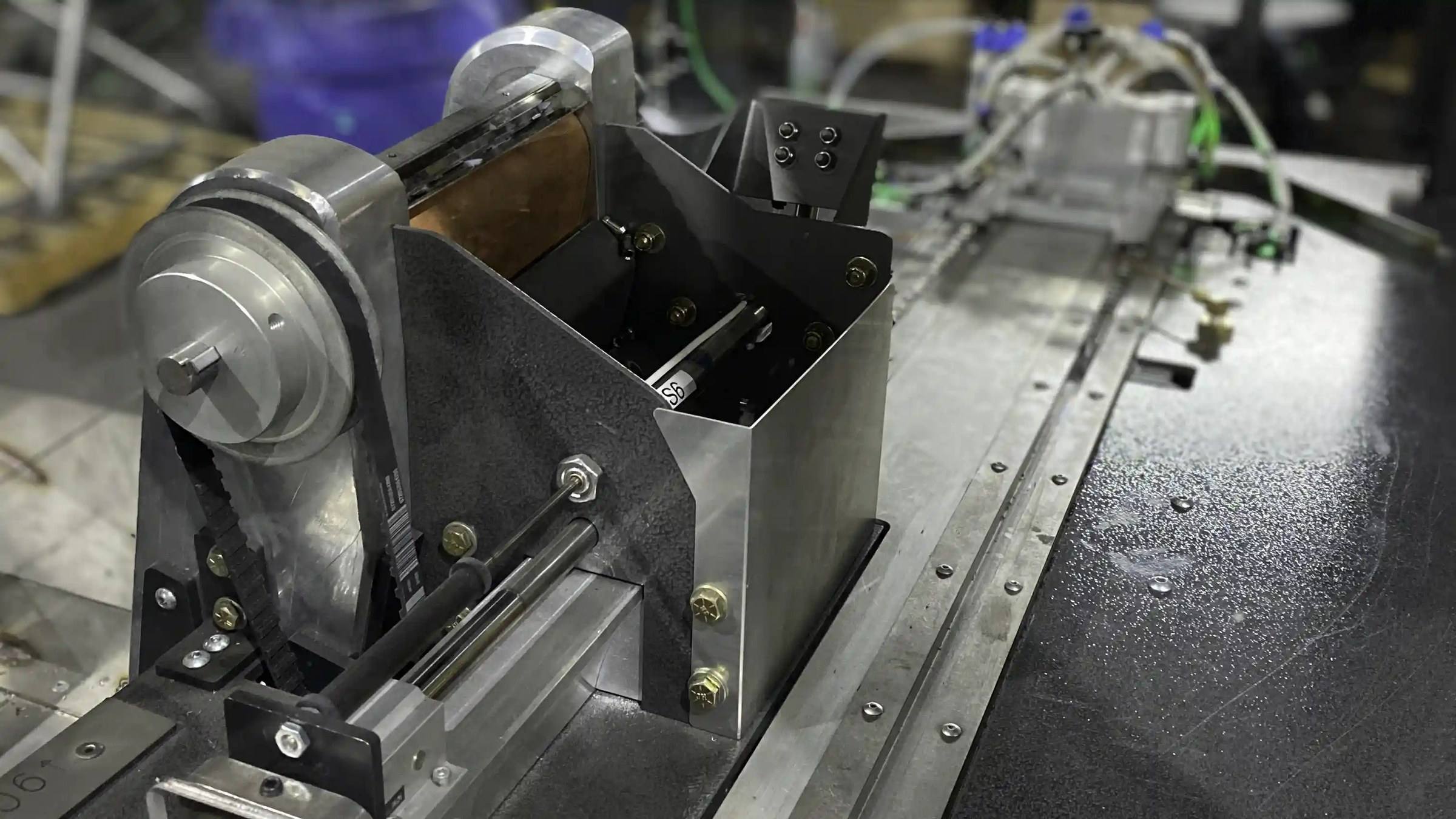
For an aerospace supplier, we built an automated tapping machine for high-volume production of an aircraft part. It is custom mechanical automation, with a custom feeder that presents the parts to a tapping mechanism made for the job. The PLC controls every mechanical function of the machine, and an HMI gives the operator real-time monitoring of what it is doing.
Fig. 1 shows the feeder hopper and its belt drive on the machine table. We keep the customer and the part confidential. The aerospace tapping machine project page has the full write-up, and what an aerospace buyer should check in an automation builder is on our aerospace automation page.
Custom mechanisms inside our robot cells
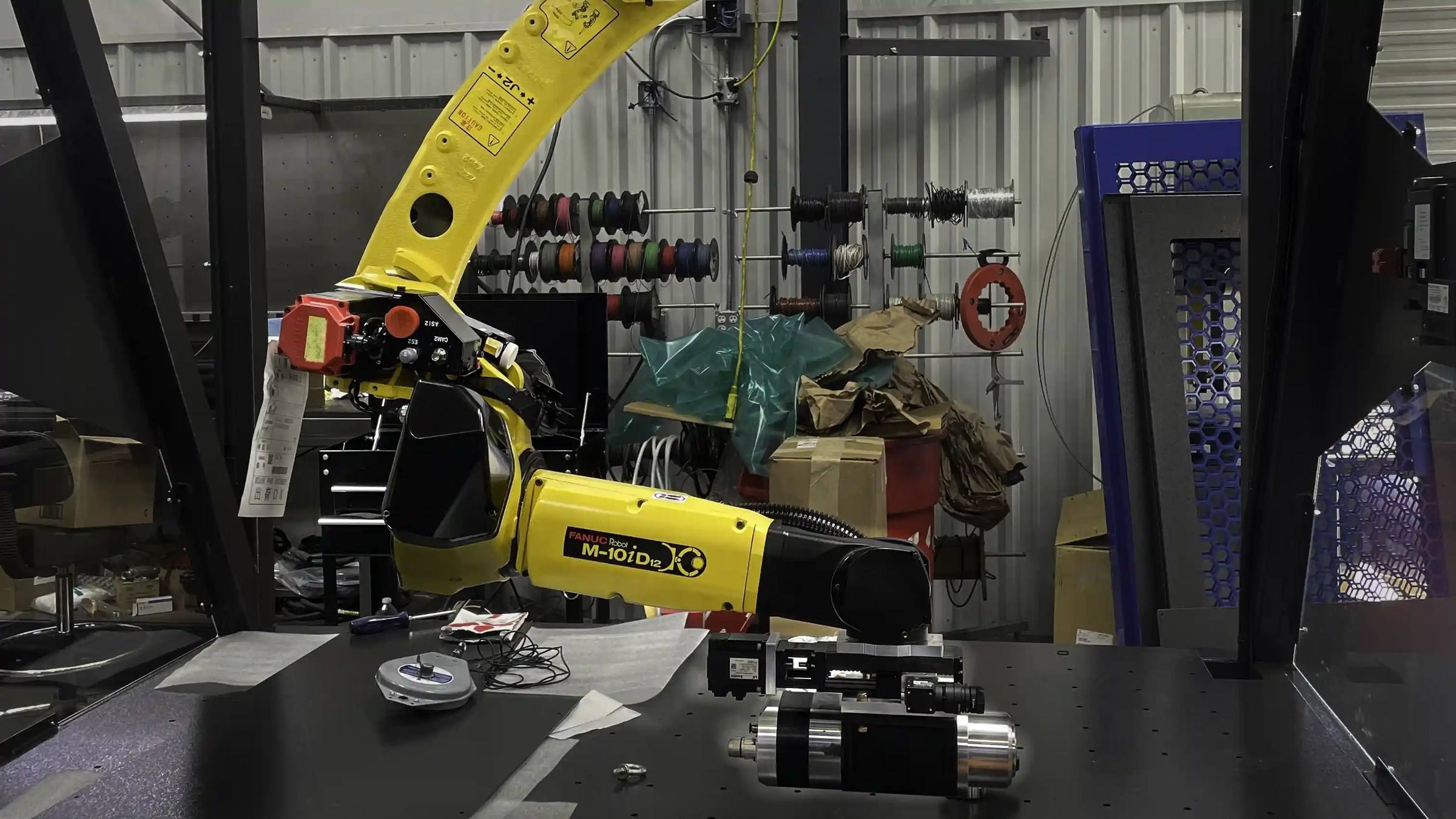
Custom mechanisms also go inside robot cells, as the parts of the cell that are not the robot. Each one is modeled in SolidWorks with the rest of the robot cell it goes into, and built in the same shop. Two from jobs we have built:
- A fixture table for drilling 3D parts. In our robotic drilling cell, a FANUC robot mounted inverted carries a router head with tool changing. Under it, a custom fixture table holds each part aligned to the CAD model. A calibration step comes before drilling, and a vision system checks each hole and logs the quality data.
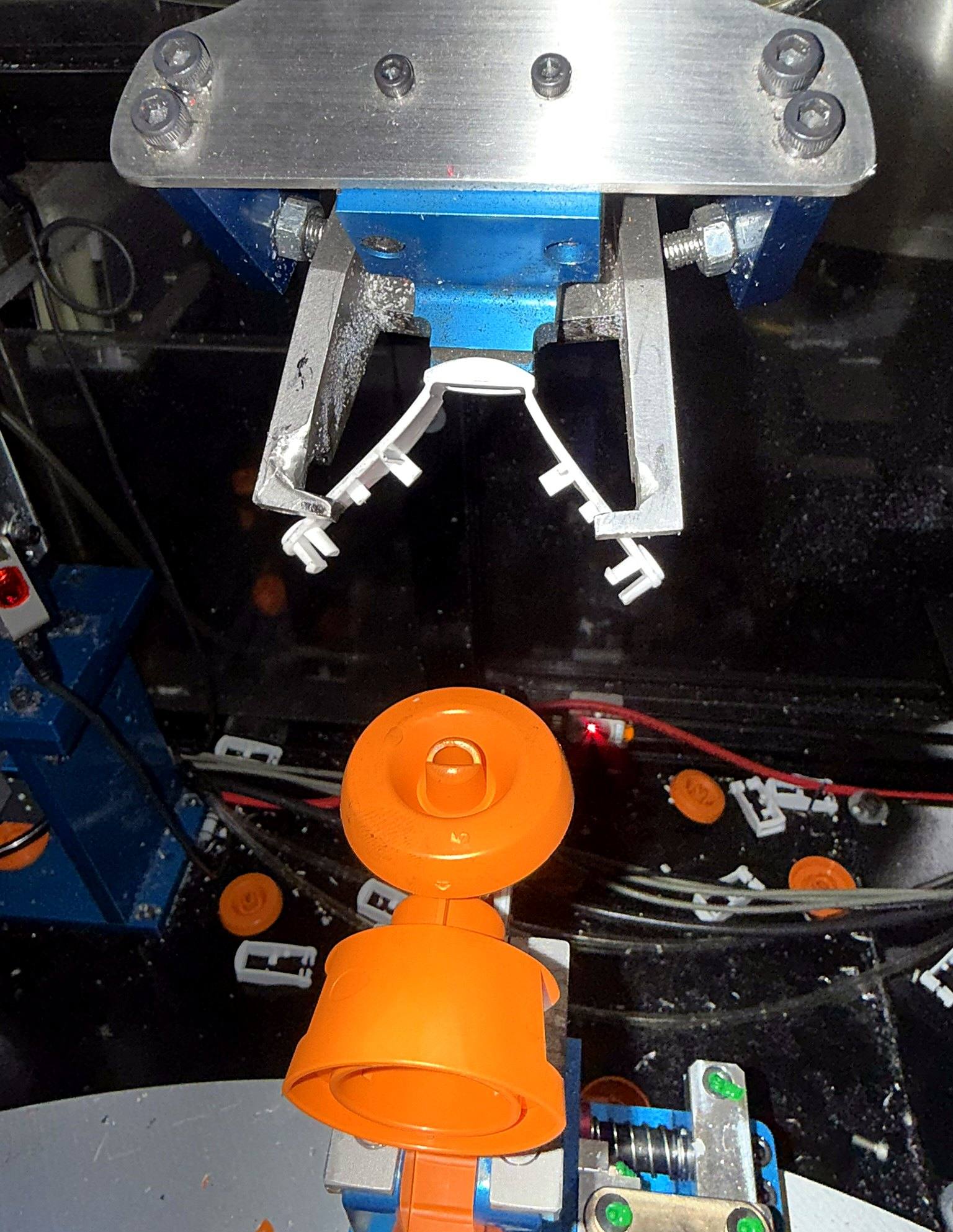
- Fingers machined to the part. In a set of spray nozzle assembly cells, bowl feeders present parts to LR Mate robots nonstop, and the gripper fingers were machined in-house to fit the part. Because the fingers come off our own 5-axis, a change to them can be made the same week. More on that under end-of-arm tooling.
How we build a special purpose machine
A custom machine goes through the same five steps as one of our robot cells, with one team answerable for all of it.
-
Design
The feeder, the mechanism, the frame and the guarding are modeled together in SolidWorks, so fit and clearances are checked before any metal is cut.
-
Fabricate
Frames and guarding are laser cut, formed on the press brake and welded at CalWest Manufacturing. Precision parts come off the 5-axis.
-
Wire
The control panel is built, wired and tested in our shop.
-
Code
We write the PLC logic for every motion and the operator screens the crew will use.
-
Install
The machine is run off in our shop first, then commissioned on your floor.
The design step is covered in more detail under robot cell design. The controls side has its own pages: PLC programming for the logic and custom HMI for the operator screens.
What safety rules apply to a machine with no robot?
A machine with no robot in it falls outside the robot safety standards, but it still has to be guarded. OSHA 1910.212 requires one or more methods of machine guarding to protect the operator and others near the machine from hazards such as those created by the point of operation, ingoing nip points, rotating parts, flying chips and sparks.
ISO 12100 sets out the general method for machinery risk assessment and risk reduction. NFPA 79 is the electrical standard for industrial machinery, which covers the control panel and wiring. We start each machine with a risk assessment and design the guarding and safety functions from it. Have your own safety professional review the result before the machine goes into production.
Legacy machine retrofits
Sometimes the machine you need already exists and only the controls have given out. If the mechanics are sound, a retrofit replaces the PLC, the HMI and the wiring that goes with them, and the frame and mechanisms stay in service.
On one job we moved a legacy process machine onto an AutomationDirect Do-more/BRX PLC with a C-more touchscreen for the operator. How we plan that kind of cutover is on the controls retrofit page.
A custom machine builder in Fontana, CA
Our shop is at 13815 Arrow Rte in Fontana, in the Inland Empire. Whether a job turns into a dedicated machine, a robot cell, a mix of the two or a retrofit, we make that call from the same few things:
Useful to send with the first email
- A phone video of the process as it runs today
- A part drawing, or photos of the part next to a tape measure
- The volume you need and how many shifts you run
- For an existing machine: photos of the panel and operator screen, plus the controller model numbers
Common questions
- Do you build machines without robots?
- Yes. Along with FANUC robot cells, we build special purpose machines with their own feeders and mechanisms, PLC control of every motion and an operator screen. One example is an automated tapping machine for an aerospace supplier, built around a custom feeder and tapping mechanism for high-volume production of an aircraft part.
- How do you decide between a custom machine and a robot cell?
- We look at the process first. One short, repeated motion on one part at high volume usually points to a dedicated machine. Many part numbers, frequent changeovers or several operations at different angles usually point to a robot, because a robot can take a new program where a machine may need new hardware. Plenty of jobs end up as a mix.
- Can you update the controls on an older machine instead of replacing it?
- Often, if the mechanics are still sound. A controls retrofit replaces the PLC, the HMI and the wiring that goes with them, and the new control panel is built, wired and tested in our shop before it goes in. On one job we moved a legacy process machine onto an AutomationDirect Do-more/BRX PLC with a C-more touchscreen. To start, send photos of the panel and the operator screen along with the controller model numbers.
- Can one machine combine a robot with custom mechanisms?
- Yes, and many do. The robot handles the moves that change from part to part, and fixed mechanisms such as fixtures, feeders and clamps handle the ones that don't. Our robotic drilling cell is one example: a FANUC robot with a tool-changing router head works over a custom fixture table that holds each part aligned to the CAD model. The split between robot and mechanism is settled in SolidWorks, before any metal is cut.