
Food and beverage automation with washdown-rated FANUC robots
We build FANUC robot cells for food floors, from soft-touch dough handling on a working bakery line to washdown-rated robots in stainless guarding. Each cell is designed, fabricated, wired and programmed in our Fontana, CA shop, then installed at your plant.
- Robots
- FANUC arms and delta robots, washdown-rated where the cell gets washed
- Food work shown
- Raw dough handling on a live bakery floor
- Guarding
- Stainless, laser-cut and welded in our shop
- Controls
- Allen-Bradley or Siemens, panel built in-house
- Installed
- Plants anywhere in the US
- Robots
- FANUC arms and delta robots, washdown-rated where the cell gets washed
- Food work shown
- Raw dough handling on a live bakery floor
- Guarding
- Stainless, laser-cut and welded in our shop
- Controls
- Allen-Bradley or Siemens, panel built in-house
- Installed
- Plants anywhere in the US
Food and beverage automation mostly comes down to two kinds of robot work. One is handling exposed product: raw dough, portions, pieces lying on a belt. The other is packaging: loading packs into cases and stacking cases on pallets. The first decides how the cell is built and cleaned. The second looks a lot like any other packaging line. CalWest Robotics builds both around FANUC robots in our Fontana, CA shop and installs them at plants across the US.
In short
Where food processing robots fit in a plant
The same plant can need two very different cells, and sanitation is the line between them. Before we look at robots, we ask whether product is exposed where the cell sits and how that area gets cleaned.
| Zone | Typical robot job | What drives the cell design |
|---|---|---|
| Exposed product | Picking raw or unwrapped product off a belt, tray or rack | Washdown, food-contact grippers, product that slumps, sticks or tears |
| Primary packaging | Placing product into trays, cartons or thermoforms | Speed, product lying at random on a moving belt, often washdown |
| Secondary packaging | Loading packs, bags or bottles into cases | Pattern changes by SKU, the case erector and sealer on either side |
| End of line | Stacking cases or bundles on a pallet | Heavy loads, pallet changes, forklift traffic at the cell |
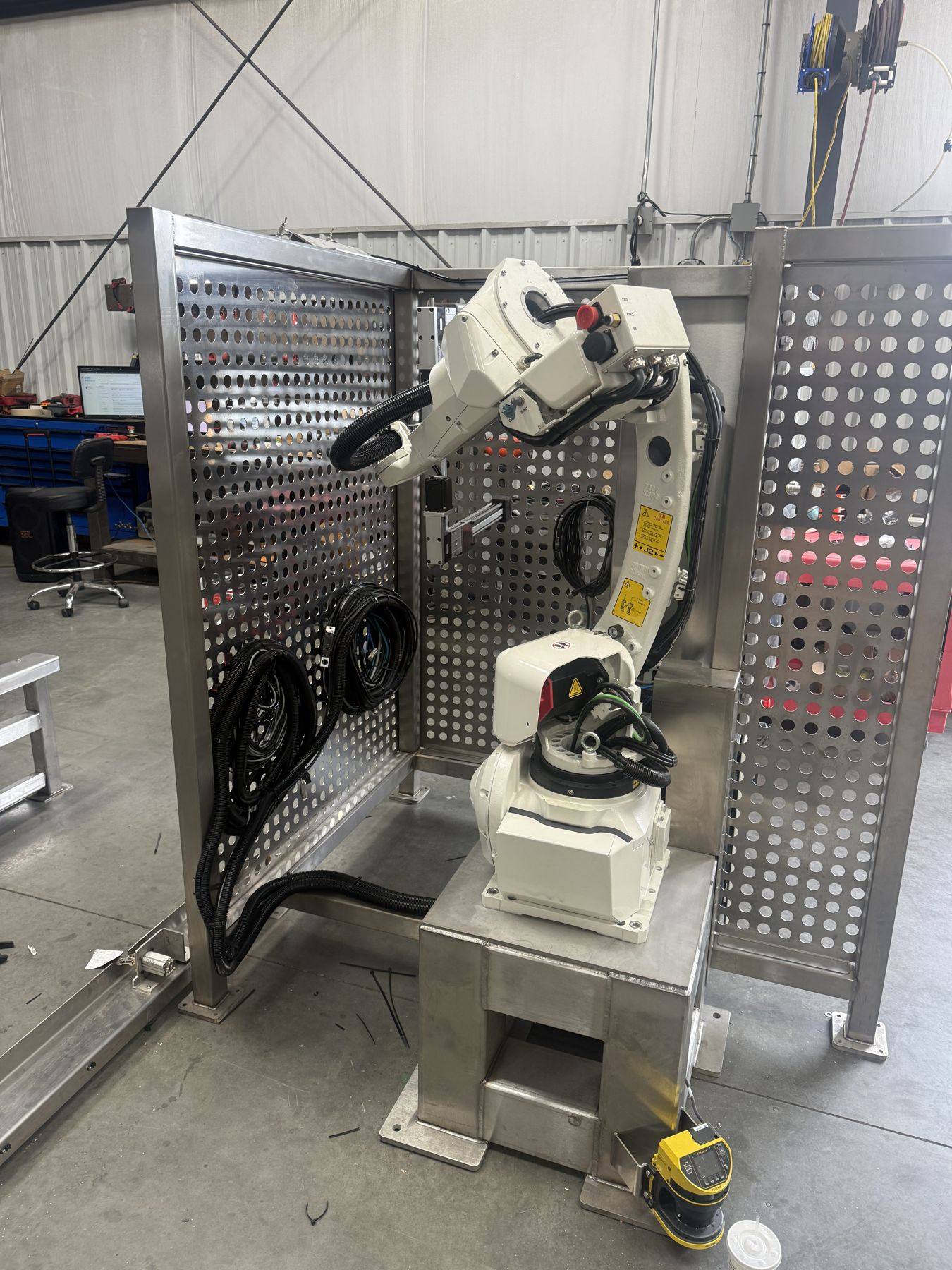
The food work we can point to sits in the first zone: robots moving raw dough on a commercial bakery’s production floor, and a washdown-rated FANUC robot in stainless guarding (Fig. 1). Our palletizing cells were built for a consumer-product plant, not a food plant, but the end of a food line asks the same questions.
What makes a robot cell food grade?
No single stamp makes a robot cell “food grade.” What exists are rules for food plant equipment and your plant’s own food safety plan. FDA’s current good manufacturing practice rule for human food, at 21 CFR 117.40, requires plant equipment to be designed and built so it can be adequately cleaned. Food-contact surfaces have to be corrosion-resistant and made of nontoxic materials, and seams on them have to be smoothly bonded or maintained. Equipment has to be built and used so food isn’t adulterated with lubricants, metal fragments or other contaminants. Equipment in the room that never touches food still has to be kept clean and sanitary.
On a robot cell, those rules turn into specific choices:
- Lubricant. A robot’s reducers and bearings are greased. Over exposed food, that grease should be an H1 lubricant, registered for incidental food contact. NSF registers H1 lubricants only if they are formulated to FDA’s ingredient list in 21 CFR 178.3570. FANUC’s washdown-capable LR Mate, for one, comes with NSF H1 grease.
- Gripper materials. Anything that touches product is a food-contact surface. Fingers, cups and pads have to be made from materials suited to food contact, and the gripper should come apart for cleaning without a toolbox.
- Frames and guarding. Flat ledges hold water and debris. Sloped tops, open frames that can be sprayed from every side, and tube sealed by welding so water can’t get inside make a frame easier to clean.
- Cables and hoses. They need to be routed so they can be wiped down and don’t sit in standing water, with fittings that suit the cleaning method.
Your sanitation team and food safety plan have the final say on every one of these, so we start with how the area is cleaned.
Washdown robots: which IP rating do you need?
How a cell is cleaned decides which robot goes in it. A dry wipe-down, a low-pressure rinse and a hot, high-pressure washdown with chemicals are very different jobs for a robot’s seals.
Protection against dust and water is stated as an IP code, defined in IEC 60529. The first digit is protection against solids and dust, the second against water. FANUC’s food-grade range includes a washdown-capable LR Mate with stainless steel wrist flanges and NSF H1 grease, and a stainless delta robot rated IP69K for high-pressure washdown. Ratings and finishes differ by model, so check the spec sheet of the exact arm against your sanitation procedure.
The robot in Fig. 1 sits on a welded stainless pedestal inside perforated stainless guarding, with a safety laser scanner at its base. Guarding and pedestals are laser-cut, formed and welded in our own building, so building them in stainless is a material choice, not an order to an outside shop. How we lay guarding out is on the robot cell guarding page.
Handling raw food without damaging it
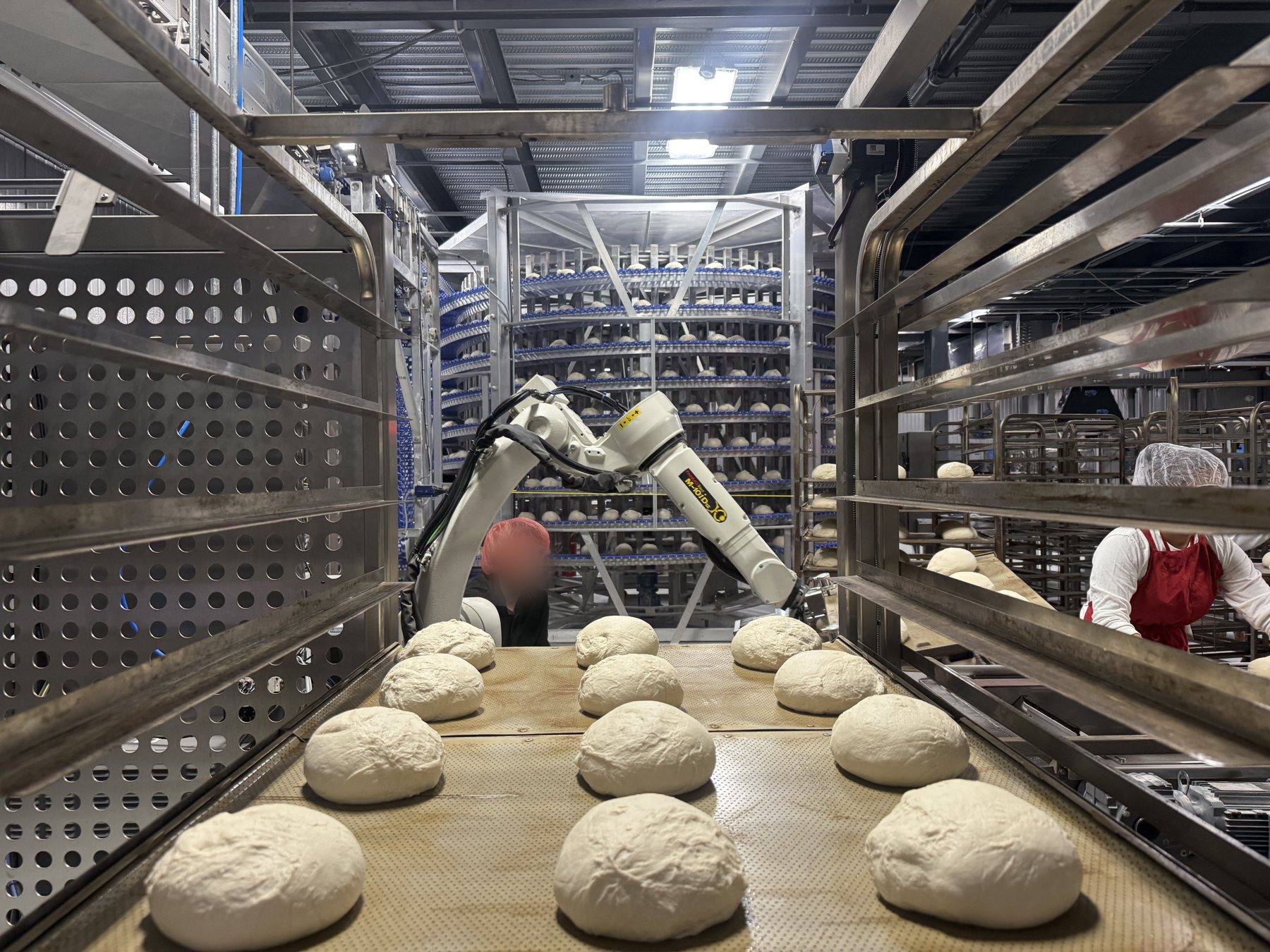
Raw dough is the food product we know best. Robots in cells we built move raw dough between trays and racks on a commercial bakery’s live production floor, with the crew working beside them (Fig. 2).
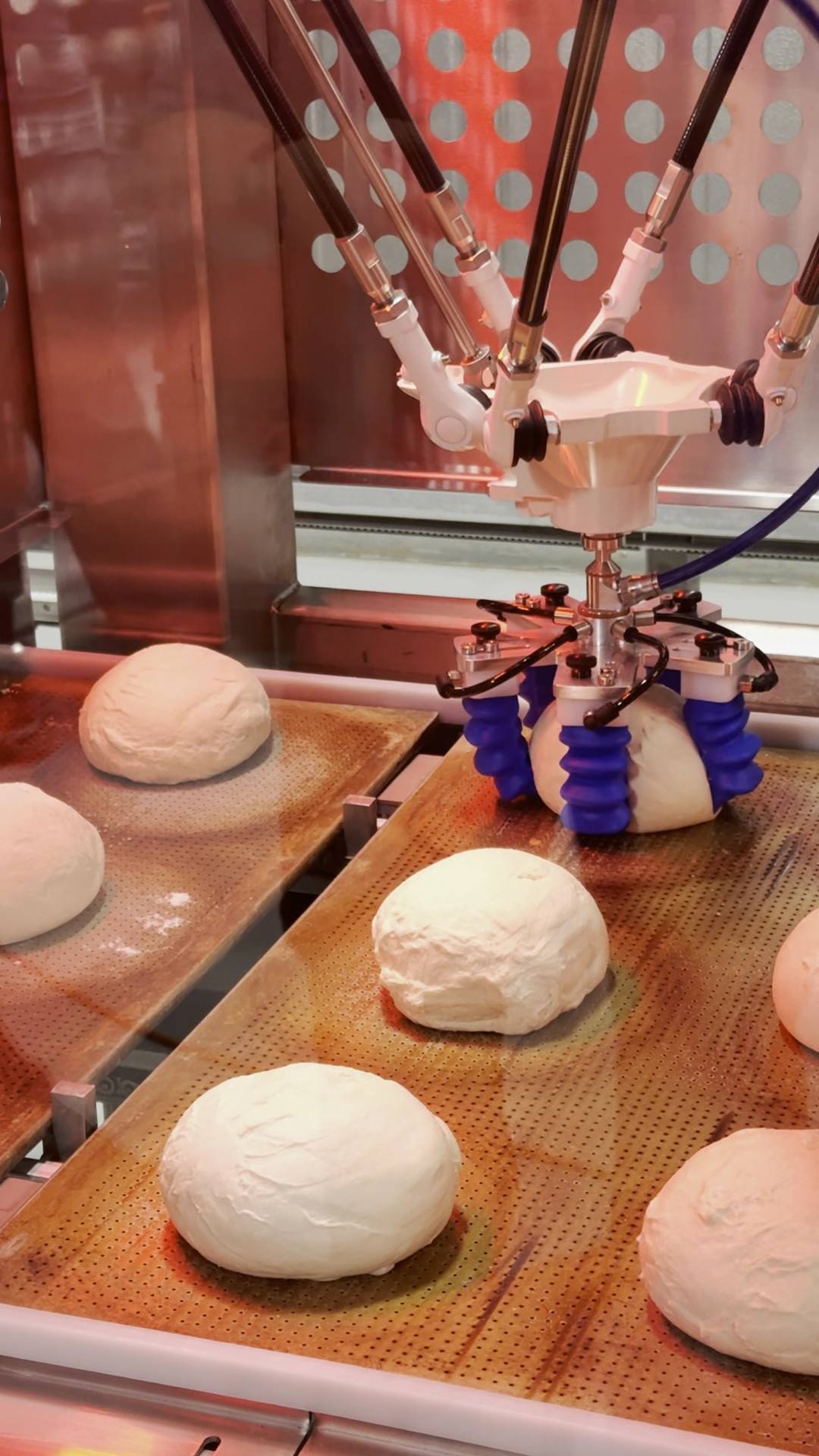
Delta robots in our dough cells use soft-touch grippers. Flexible fingers close around a dough ball and lift it without marking it, then set it down in the shape it arrived (Fig. 3).
The same few facts shape most exposed-food cells: whether the product holds its shape or slumps, sticks or tears; whether it arrives at a fixed spot or lies at random on a moving belt; and whether the gripper touches the product or only its tray. Those pick the gripper and often the robot. Light, fast picks off a belt suit a delta robot. Reaching into a rack shelf or carrying full trays suits a six-axis arm. Our bakery automation page covers dough handling in depth, and end-of-arm tooling covers how we build and mount grippers.
Food packaging automation: cases and pallets
Once product is sealed in its pack, the sanitation demands drop and the cell looks like most packaging cells. Two robot jobs show up on most food and beverage lines:
- Case packing. A robot picks packs, bags, cartons or bottles in a group and sets them into a case, to a pattern that changes with the SKU. Robotic case packing covers grippers, pattern changes and the case erector and sealer on either side of the robot.
- Palletizing. A robot stacks sealed cases or shrink-wrapped bundles on a pallet, layer by layer. We built FANUC palletizing cells for the end of a consumer-product plant’s packaging lines, and the same approach applies to cases of food or drink. See robotic palletizing.
Beverage plants mostly fall in this zone. Filling and capping run on dedicated machines, and bottles and cans are sealed before a robot handles them. The robot cell’s job is to take product from those machines and hand it on without stopping the line.
Changeovers and allergen cleaning
Many plants run several products on one line, and switching between products with different allergens usually means a full clean. 21 CFR 117.40 names allergen cross-contact as one of the things equipment has to be maintained to prevent. A robot cell can make that clean easier or harder.
Grippers that come off without tools, frames you can reach from every side, and no hidden pockets under the robot base all shorten a sanitation crew’s shift. Each product’s settings can live in the robot and PLC programs, so the crew selects the next product on the operator screen instead of re-teaching points. We write the PLC logic and the screens in-house, laid out for the crew who runs the line.
Robots working beside the crew
Food lines tend to have people close by: loading racks, topping up product, clearing jams. An industrial robot still needs safeguarding, so the cell layout decides where people stand and what the robot does when someone comes closer. The usual tools are fixed guarding with interlocked doors, light curtains across openings where someone loads or unloads, and safety laser scanners like the one in Fig. 1, which can slow the robot as a person approaches and stop it before they can reach it.
We do a risk assessment for each cell layout and choose the safeguards from it, and your own safety professional should review it too. Our robot safety standards guide walks through the US and ISO standards behind it.
Built in Fontana, installed at your plant
Each cell is modeled in SolidWorks along with the conveyors, racks and machines it has to meet on your floor. Robot paths are laid out and checked in FANUC ROBOGUIDE before they run, and the whole cell is run off in our shop before it ships. We install anywhere in the United States; Southern California plants are a same-day drive. Once a cell is running, we can reach it over a secure VPN for program changes and troubleshooting when you allow it.
Every application we build is listed on robot cells by application, and the other plants we have built for are on industries.
What to send us for a food or beverage cell
- A phone video of the crew doing the job by hand, start to finish
- The product: weight, size, how it arrives and what it goes onto
- Whether the product is exposed where the cell will sit
- How the area is cleaned: dry, low-pressure rinse or full washdown, and with what chemicals
- The rate the line has to hold at its busiest hour
- A photo or sketch of the floor space, including where people work
For a first look, a video and a few answers from that list are enough. Call or text our robotics line, or use the contact page.
Common questions
- Do food processing robots have to be stainless steel?
- Not always. What matters is whether the robot works over exposed product and how that area is cleaned. FANUC's food-grade models come with food-grade grease and builds meant for washdown, with stainless parts on some of them, such as the stainless wrist flanges on its washdown-capable LR Mate. A robot that only stacks sealed cases at the end of the line usually doesn't need a food-grade build at all.
- What is an H1 lubricant, and why does a robot need one?
- An H1 lubricant is registered for use where incidental contact with food is possible. NSF registers it only if it is formulated to FDA's ingredient list in 21 CFR 178.3570. A robot's reducers and bearings are greased, so a robot working over exposed food should come with H1 grease from the factory. Confirm it on the spec sheet of the exact model you are quoted.
- Can you build the guarding and frames in stainless?
- Yes. Guarding, pedestals and frames are laser-cut, formed and welded in our Fontana shop, the same shop that does CalWest Manufacturing's contract fabrication. For food floors that get washed down we build them in stainless steel, like the perforated guarding and welded pedestal in Fig. 1. We ask how your crew cleans the area before we design the frame.
- Can one robot cell run more than one product?
- Often, if every product is planned in from the start. The gripper has to hold all of them, and the robot has to carry the heaviest plus the tool. Each product's settings can be stored in the program, so the crew picks the next product on the operator screen instead of re-teaching. A product with a different shape or texture may need its own gripper, so list every product before design.
- Do you install food cells outside California?
- Yes. We build every cell in our Fontana shop and ship and install it at plants anywhere in the United States. The cell is run off here before it ships, so your floor time goes to setting it, tying it into your line and commissioning it. Southern California plants are a same-day drive. Cells we install can be reached over a secure VPN for program changes when you allow it.
Sources
- eCFR: 21 CFR 117.40, Equipment and utensils (FDA current good manufacturing practice for human food)
- eCFR: 21 CFR 178.3570, Lubricants with incidental food contact
- NSF: How registrations prove lubricants are food grade
- FANUC America: food-grade robotics at PACK EXPO Las Vegas (September 2025)
- IEC 60529, Degrees of protection provided by enclosures (IP Code)