
Robot integrator in Southern California, building cells in Fontana
Southern California is our home region. The shop is in Fontana, and plants across the five southern counties are a same-day drive away.
If you are looking for a robot integrator in Southern California, we’re in Fontana, in the Inland Empire. CalWest Robotics designs, fabricates, wires and programs FANUC robot cells in one shop at 13815 Arrow Rte, runs each cell there with the customer’s parts, and then installs it on the customer’s floor. For plants in Los Angeles, Orange, San Diego, Riverside and San Bernardino counties, that floor is a same-day drive from where the cell was built.
In short
How much manufacturing is in Southern California?
A lot, and of very different kinds. The five southern counties had about 656,000 private manufacturing jobs in 2025 by the Bureau of Labor Statistics’ annual count, a little over half of California’s 1.22 million. The mix changes sharply from county to county:
| County | Manufacturing jobs, 2025 | Largest manufacturing industries by jobs | More on that area |
|---|---|---|---|
| Los Angeles | 301,800 | Aerospace products and parts 52,100; food 38,400; fabricated metal 36,400 | Los Angeles County |
| Orange | 149,500 | Computer and electronic products 32,100; fabricated metal 20,400; medical equipment and supplies 20,000 | Orange County |
| San Diego | 109,800 | Computer and electronic products 28,300; transportation equipment 20,700, including aerospace 12,500 | San Diego County |
| San Bernardino | 50,800 | Food 9,100; fabricated metal 7,700; plastics and rubber 4,700 | Inland Empire |
| Riverside | 44,000 | Fabricated metal 7,200; plastics and rubber 4,800; food 4,700 | Inland Empire |
The two inland counties also employ more people in warehousing than in manufacturing, which matters for us because a distribution center needs palletizing, case handling and conveyors as much as a factory does. Each county page goes into what its plants make and which of our cells fit them.
The cells we built for a plant in Temecula
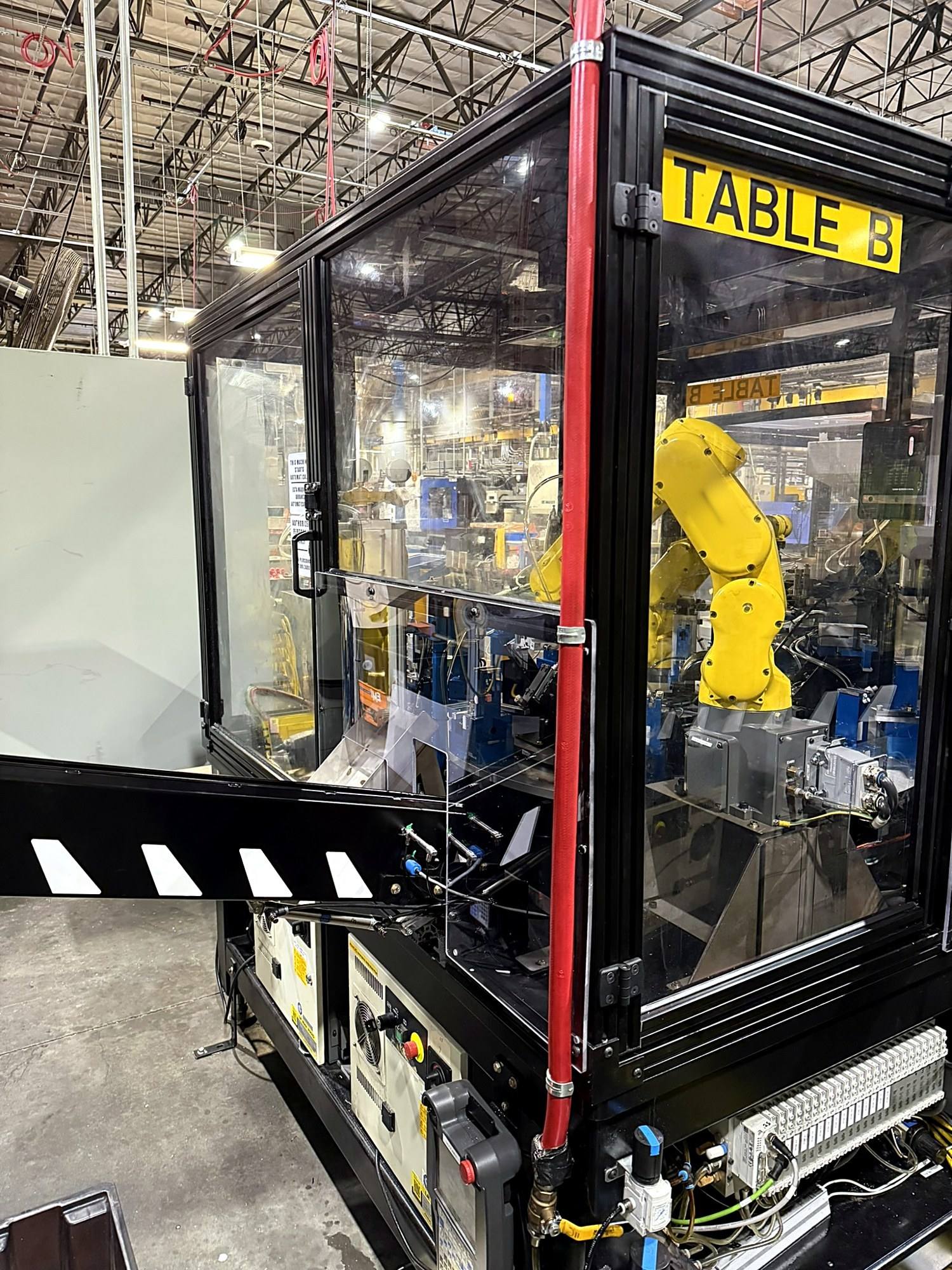
The Southern California job we can show the most of is about 56 miles down the road from the shop, at the Temecula plant of a national lawn and garden brand. We built two kinds of cells there, all designed, fabricated, wired and programmed in Fontana and then installed and commissioned on the plant’s live production floor.
At the end of each packaging line, FANUC robots build the pallets: every case is gripped off the line, turned, swung onto the pallet and placed to the stack pattern, layer by layer. In the assembly area, LR Mate robots assemble spray nozzles at three tables, with bowl feeders presenting parts nonstop and fingers machined in our shop to fit the part. Each table is interlocked and light-curtained, and the operator screen shows cycle time per table, color changeover and fault status. The Temecula palletizing job is written up in full.
What a short drive changes on a robot project
Being in the same region doesn’t change how a cell is built. It changes how easily the two sides can get in front of the same piece of equipment.
Before the design review, the spot where the cell will go can be looked at in person: the ceiling height, the columns, the forklift aisle, the upstream machine and the signals it can give. Those details are easy to miss in a sketch and expensive to discover on install day.
The run-off is a day trip for your people. Bring the operator lead and the maintenance tech who will own the cell, and if something on the test sheet needs a second look, coming back for it is a drive, not a travel budget. The stages and what we need from you at each are on how a project works with us.
At install, the crew that built the cell comes from the shop where it was built, and parts made in-house, such as a remachined gripper finger, are a short drive behind them. After handover, cells we install can be reached over a secure VPN connection for program changes and troubleshooting when your plant allows it, and a visit for hands-on work is a drive rather than a flight.
| Stage | Where it happens | Who travels |
|---|---|---|
| First look at the process | Your plant, or a phone video | We can come to you, or you send the video |
| Design review | Your plant, our shop or a video call | Whichever suits the people who need to be there |
| Build | Our Fontana shop | Nobody; you can visit during the build |
| Run-off (FAT) | Our Fontana shop | Your operator lead, maintenance tech and whoever signs off |
| Install and SAT | Your plant | Our team, from the shop that built the cell |
| After handover | Remote over VPN, or at your plant | Us, when the work needs hands at the cell |
California’s manufacturing sales tax exemption
A cell bought for a California plant may also cost less in tax than the quote suggests. California law gives qualifying manufacturers a partial exemption from sales and use tax on machinery and equipment used in manufacturing, administered by the state’s tax agency, CDTFA, and most of a robot cell can fall within it. Whether your purchase qualifies depends on your business and how the equipment is used, so have your CPA confirm it before you order. Our guide to California automation incentives, linked below, walks through the tests and the certificate the seller needs.
FANUC robots that are already on your floor
Some plants already run FANUC robots that someone else installed, sometimes years ago and sometimes with the original integrator no longer around. We service and reprogram those as well as our own cells: teaching a new part, adding iRVision to a robot that used to rely on a fixed nest, moving a robot to a new line, or finding out why a cell has stopped. In this region that work is a drive. Call or text the robotics line with the robot model, the controller and what it needs to do.
Which robot cells we build
The jobs we have built so far went into a packaging and assembly plant, a commercial bakery and an aerospace supplier, along with cells for machine tending, drilling 3D parts and vision-guided picking. The applications, from palletizing to welding, are listed on what a turnkey robot cell includes. The robots are all FANUC, the PLC logic is Allen-Bradley or Siemens to match your plant, and our parent company, CalWest Manufacturing, is AS9100D and ISO 9001 certified and ITAR registered.
Send a phone video of the manual process or a part drawing to sales@calwestmfg.com, call or text (818) 397-4809, or use the contact page. We come back with a cell concept and a plan.
Common questions
- Do you only work in Southern California?
- No. Southern California is our home region, but we ship and install cells at plants anywhere in the United States. What changes with distance is the travel: here, the run-off in our shop and visits to your plant are a drive rather than a flight, and the install crew comes from the same shop that built the cell.
- Is CalWest Robotics in Los Angeles?
- No. Our only shop is at 13815 Arrow Rte in Fontana, in San Bernardino County, about 47 miles east of downtown Los Angeles by road. Everything is built there, and the team that builds a cell drives out to install it. Our parent company, CalWest Manufacturing, runs its laser, bending, welding and machining departments in the same building.
- Can we see one of your cells run before we buy?
- Your own cell runs in our shop at the factory acceptance test before it ships, and you're invited to watch and push on it. Whether another customer's cell is on our floor when you visit depends on timing and on that customer, so ask when you call. Our Fontana shop hours are Mon–Fri 7:00am – 3:45pm.
- Do you service FANUC robots you didn't install?
- Yes. Besides our own cells, we service and reprogram FANUC robots other companies installed, such as teaching a new part, adding iRVision, moving a robot or finding out why a cell stopped. Call or text (818) 397-4809 with the robot model and what it needs to do. We don't publish response times, so ask what to expect for your job.
Sources
- BLS QCEW: 2025 annual averages, California (CSV)
- BLS QCEW: 2025 annual averages, Los Angeles County (CSV)
- BLS QCEW: 2025 annual averages, Orange County (CSV)
- BLS QCEW: 2025 annual averages, San Diego County (CSV)
- BLS QCEW: 2025 annual averages, San Bernardino County (CSV)
- BLS QCEW: 2025 annual averages, Riverside County (CSV)
- CDTFA: Manufacturing and research and development equipment exemption