
Bakery automation systems that work alongside your crew
We build FANUC robot cells that move raw dough between trays and racks on a working bakery floor, with the crew still at their stations. Each cell is designed, fabricated, wired and programmed in our Fontana shop.
- Robots
- FANUC six-axis arms and delta robots
- Product
- Raw dough on trays and racks
- Grippers
- Soft-touch fingers for dough
- Food floors
- Washdown-rated FANUC arm in stainless guarding
- Built in
- Fontana, CA
- Robots
- FANUC six-axis arms and delta robots
- Product
- Raw dough on trays and racks
- Grippers
- Soft-touch fingers for dough
- Food floors
- Washdown-rated FANUC arm in stainless guarding
- Built in
- Fontana, CA
Most of the work on a bakery floor that suits a robot is a hand transfer: someone lifting dough off a belt onto a tray, or loading trays into a rack, for a whole shift. Those are the jobs our bakery automation systems take over. At CalWest Robotics we build them around FANUC robots, like every other robot cell we design and build in Fontana, CA.
In short
Dough handling robots on a live bakery floor
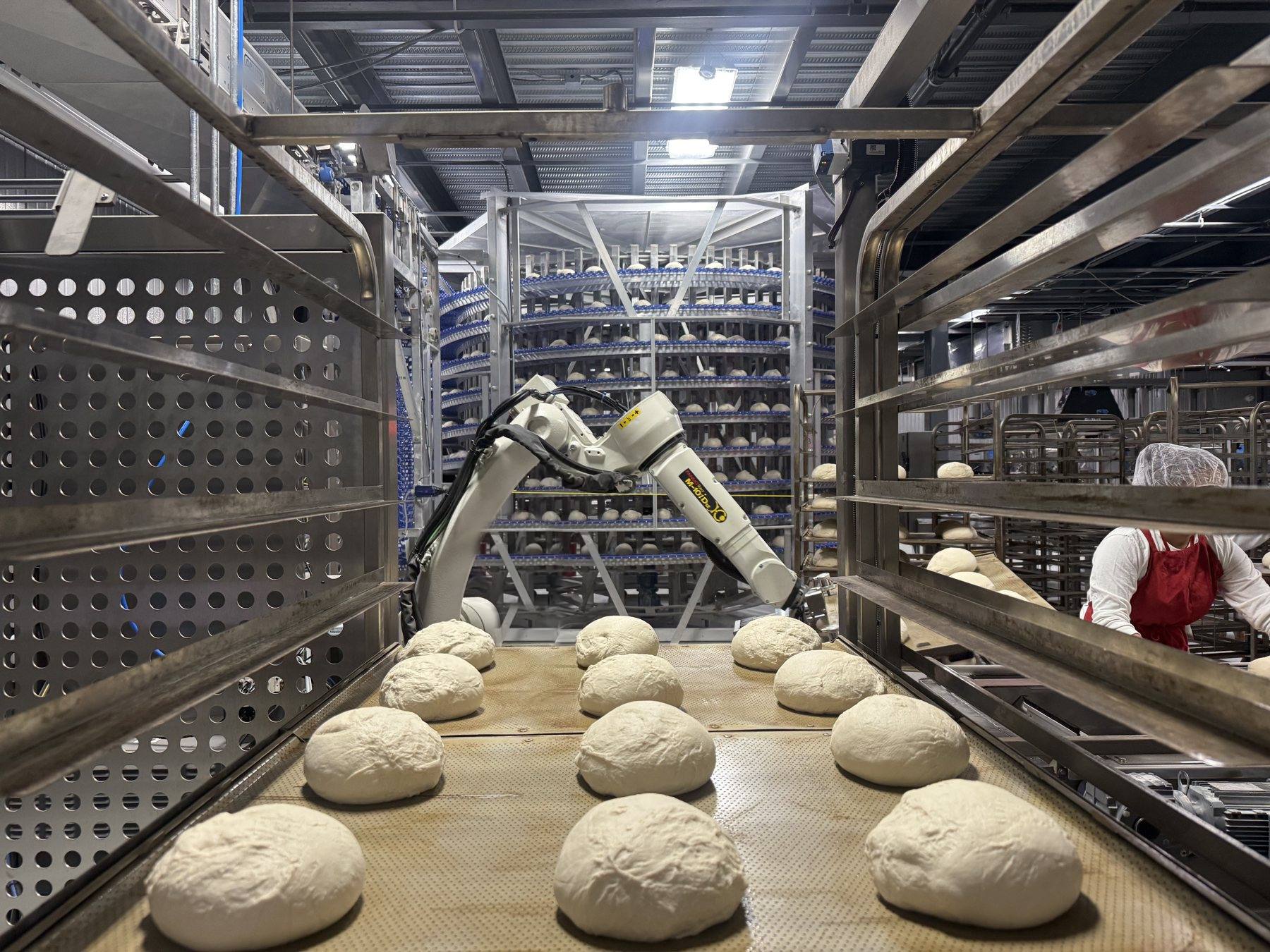
Our bakery robots work on a commercial bakery’s live production floor. FANUC robots move raw dough between trays and racks, and the bakers keep working the same floor around them. Fig. 1 shows one at a rack, with a spiral conveyor behind it and a baker at the next rack over.
A six-axis arm suits tray and rack work. It can reach into a rack shelf, set a tray down level and back out without touching the uprights. A delta robot works in the space below its base and can’t reach sideways into a rack.
On a tray and rack cell, these details decide whether it runs all shift:
- Rolling racks never park in exactly the same spot. The cell needs a dock or guide that locates the rack, and a sensor that confirms it is in place before the arm reaches in.
- Trays bend and wear. Pick and place heights need some margin, or a check that the tray is seated.
- Dough keeps changing as it proofs. A ball that holds its shape at one stage slumps at the next, and that changes how the gripper should close.
- Every spot where a baker pushes in a rack or pulls out a tray is a spot the safety design has to cover.
| Robot | FANUC six-axis arm for tray and rack work; FANUC delta robot for fast picks off a belt |
|---|---|
| Gripper | Soft-touch fingers for raw dough; multi-cup vacuum for firm product with a closed surface |
| Vision | FANUC iRVision and iRPickTool when product arrives at random positions on a moving belt |
| Guarding | Laser-cut and welded in our shop; stainless on food and bakery floors |
| Safety devices | Interlocked doors, light curtains or safety laser scanners, chosen from the risk assessment |
| Controls | Panel built, wired and tested in our shop; Allen-Bradley or Siemens PLC |
| Operator screen | Custom HMI written for the crew that runs the line |
Can robots handle raw dough without marking it?
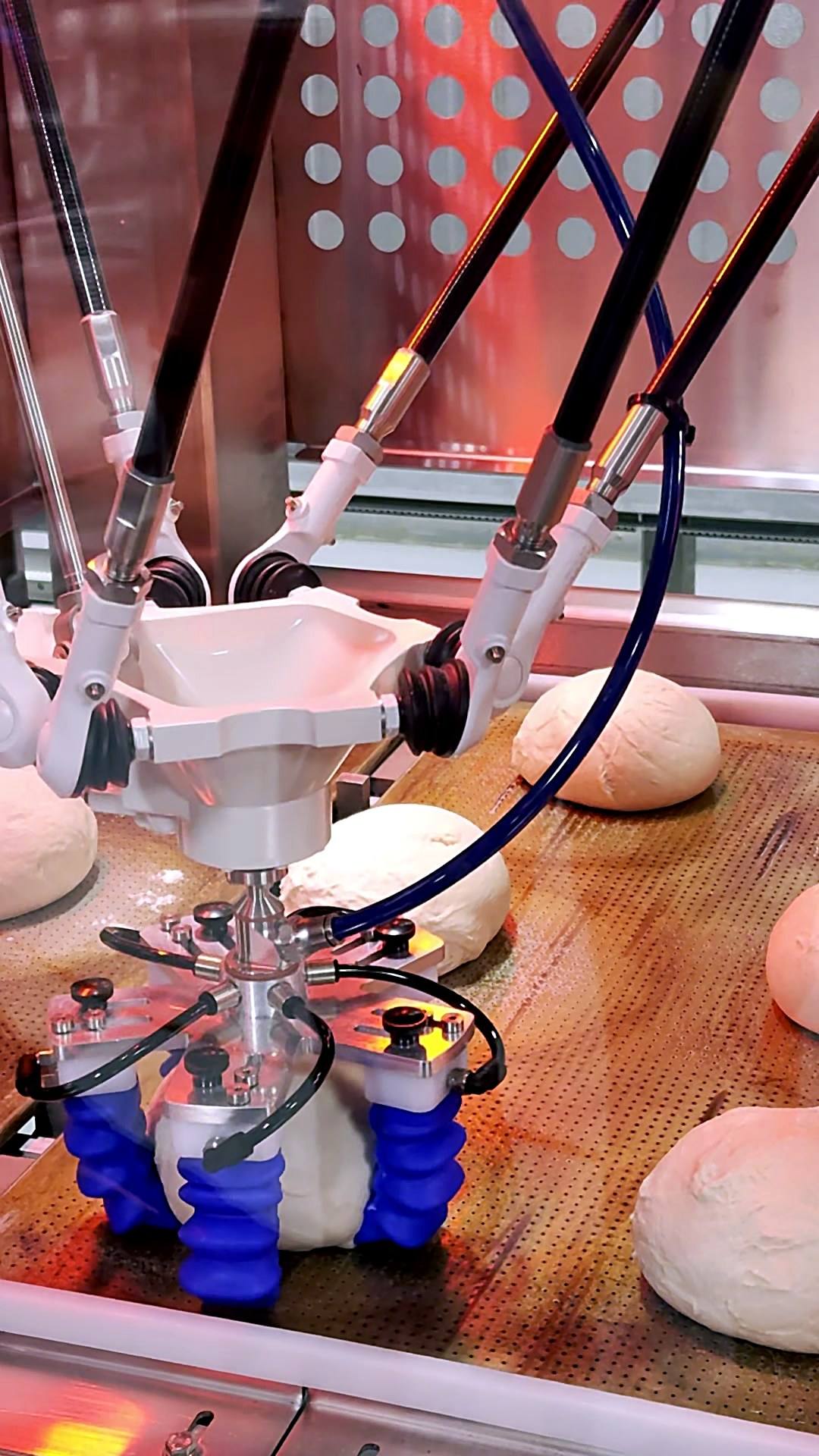
Yes, with the right gripper. Raw dough is soft and tacky, and it keeps moving as it proofs. Hard fingers leave a dent. A vacuum cup can pull the surface up into the cup or tear it.
Our delta dough cells use soft-touch grippers. Flexible fingers close around the dough ball and spread the grip over a wide area, so the dough leaves the tray in the shape it arrived. Fig. 2 shows the blue soft fingers closed around a dough ball over a perforated tray.
A delta robot suits this job because the product is light and the moves are short: pick a ball, set it down nearby, go back for the next. The arms hang from an overhead frame, which keeps the floor under the robot clear for conveyors. Our page on delta robot pick-and-place cells covers where else they fit.
Vacuum still has a place in a bakery. Firm product with a closed surface picks cleanly on a multi-cup vacuum tool.
Choosing a food-grade robot gripper for dough comes down to dough weight, hydration, surface flour, proof stage and what the dough is set onto. We select the soft fingers for the product and integrate them on the robot, and the mounts and adapter plates around them are machined in-house, as our end-of-arm tooling page describes.
Picking product that arrives at random on a belt
When product comes down a belt in random positions, the robot has to find each piece. FANUC iRVision locates it, and iRPickTool uses a belt encoder to track it, so the robot picks it where it is now rather than where the camera saw it. We have built this on a tray-loading line where two FANUC delta robots share the picks off one belt. The delta tray-loading line write-up covers that job, and our line tracking guide explains the setup.
Where robots fit on a bakery line
Mixing, dividing and baking run on dedicated bakery machines. Robots take the transfers between them and the work at the end of the line. Here is each of those steps, with what we have built at it.
| Step | Typical robot job | What we have built |
|---|---|---|
| Raw dough | A delta robot with soft-touch fingers picks dough balls and sets them down nearby | FANUC delta robots moving raw dough without marking it |
| Trays and racks | A six-axis arm loads and unloads trays at a rack shelf | FANUC arms moving dough between trays and racks, alongside the crew |
| Product on a belt into trays | Delta robots with FANUC iRVision and iRPickTool pick product lying at random on a moving belt | Two FANUC delta robots sharing the picks of firm, round product off one belt |
| Packing | A robot picks packs in groups and loads them into cases | Not for a bakery. Packaging automation covers the packaging-line cells we have built |
| End of line | A robot stacks finished cases on a pallet, layer by layer | Built for a national lawn and garden brand, not a bakery. See robotic palletizing |
Food-grade washdown robots in stainless guarding
Where a cell gets sprayed down at sanitation, the robot has to be built for it. FANUC makes food-grade versions of some of its arms, SCARA and delta robots. Its September 2025 food-grade release lists NSF H1 food-grade grease, a washdown-capable LR Mate with stainless steel wrist flanges, and an IP69K rating on its stainless delta robot. Ingress ratings and finishes differ by model, so check the spec sheet for the exact arm against how your crew cleans.
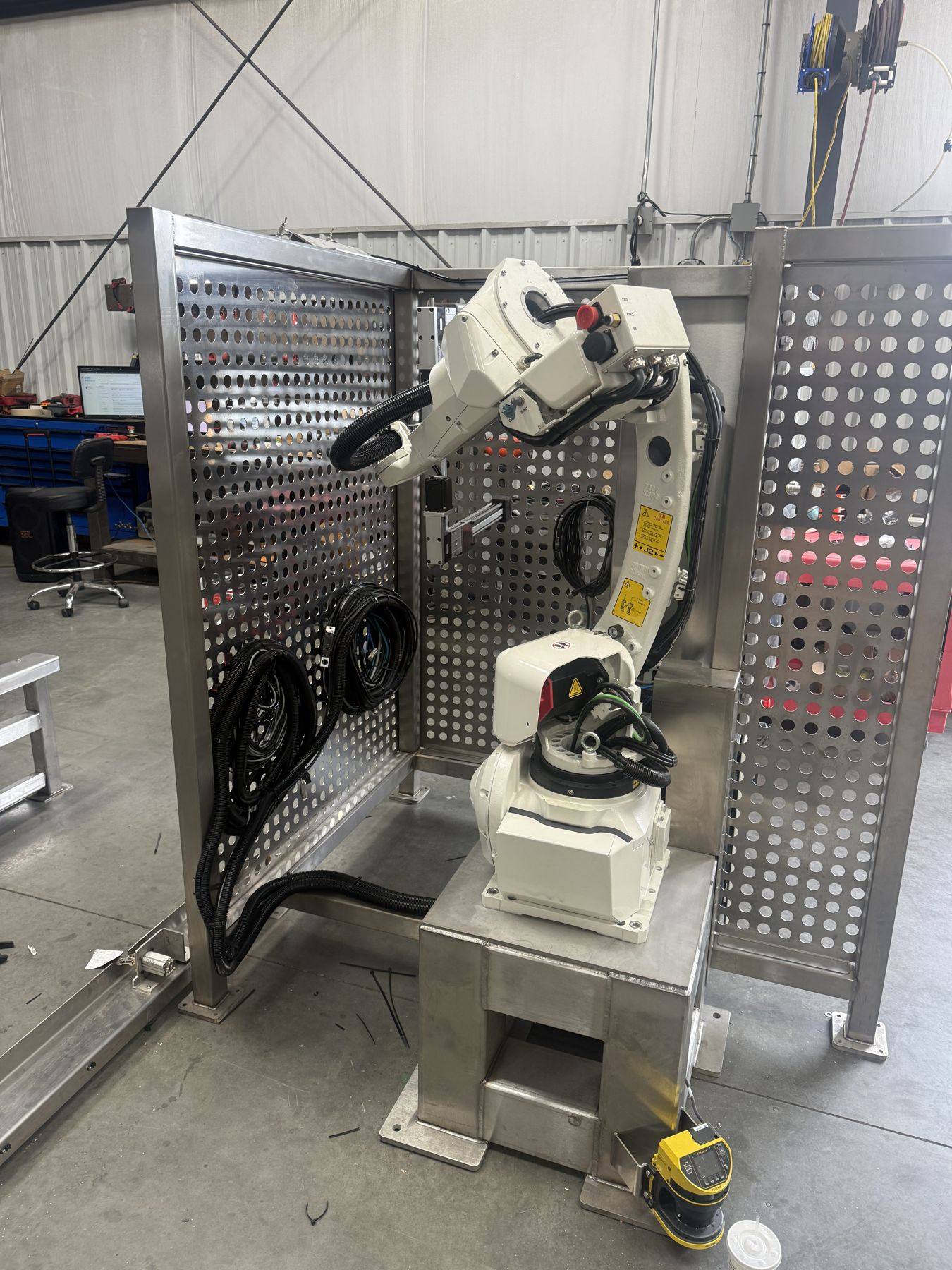
Guarding, pedestals and frames get washed too, so for food and bakery floors we build them in stainless. Fig. 3 is a washdown-rated FANUC robot on a stainless pedestal inside perforated stainless guarding. It is a full industrial arm in a food-grade build, so it runs behind guarding and safety devices like any industrial robot. How we design and cut guarding is on the robot cell guarding page.
Can a robot work next to your bakers?
Yes. Our dough-handling robots share the floor with the bakery crew, but an industrial robot still needs safeguarding, so the cell design decides where people stand and what the robot does when someone comes closer. The usual tools are:
- Fixed guarding around the robot’s reach, with interlocked doors that stop the robot when opened
- Light curtains across openings where a baker loads or pulls a rack or tray
- Safety laser scanners that drop the robot to a safety-monitored slow speed as someone approaches and stop it before they can reach it, with the stop zone sized from the robot’s stopping time
We do a risk assessment for each cell layout and choose the safeguards from it, and your own safety professional should review it as well. Our robot safety standards guide walks through the US and ISO standards behind it.
Installing on a running production floor
A bakery line usually can’t wait while a cell gets debugged in place, so we do as much as possible in our Fontana shop first. The cell is modeled in SolidWorks along with the racks, trays and conveyors it has to meet on your floor, and it runs off here before it ships. How we design and build a robot cell goes through each step.
Some downtime is usually needed to set the cell and tie it into your conveyors and controls, and how much depends on the layout. Because the debugging happens in Fontana, your floor time goes to setting the cell and commissioning it. How we work covers the run-off and the commissioning on your floor.
What to send us for a bakery cell
- A phone video of the crew doing the transfer by hand, start to finish
- The product: dough weight, how it arrives, and what it goes onto (tray, rack or belt)
- Tray and rack dimensions or drawings, if you have them
- The rate the line has to hold
- A photo or sketch of the floor space, including where people work
- How the area is cleaned at sanitation
Common questions
- What kind of robot is in the stainless cell?
- A washdown-rated FANUC industrial robot, mounted on a stainless pedestal inside perforated stainless guarding. It is a full industrial arm in a food-grade build, so it works behind guarding and safety devices like any other industrial robot. FANUC's food-grade robots use NSF H1 food-grade grease and finishes made to stand up to washdown. The exact ingress rating depends on the model, so check the spec sheet for the arm you are quoted.
- Should a bakery use a delta robot or a six-axis arm?
- It depends on the move. A delta robot is light and fast and works in the space below its overhead mount, which suits picking single dough balls off a belt or tray. A six-axis arm has the reach to go into a rack shelf, carry full trays and work around fixed equipment. Some bakery cells use both, each on the job it suits best.
- Do you build the guarding and frames in stainless?
- Yes. Guarding, pedestals and frames are laser-cut, formed and welded in our Fontana shop, the same shop that does CalWest Manufacturing's contract fabrication. For food and bakery floors that get washed down, we build them in stainless steel, like the perforated guarding and pedestal on our washdown-rated FANUC cell.