
Metal fabrication automation from a shop that fabricates
CalWest Robotics is the robotics division of CalWest Manufacturing, a Fontana contract manufacturer running tube laser, CNC tube bending, plate laser, press brake, welding and 5-axis machining. We build FANUC robot cells for fabricators in that same building.
- Parent shop
- Tube laser, tube bending, plate laser, press brake, welding, 5-axis
- Robots
- FANUC
- Weld cells
- Designed in CAD, built and taught in our shop
- Fixtures and grippers
- Made in-house
- Built in
- Fontana, CA
- Parent shop
- Tube laser, tube bending, plate laser, press brake, welding, 5-axis
- Robots
- FANUC
- Weld cells
- Designed in CAD, built and taught in our shop
- Fixtures and grippers
- Made in-house
- Built in
- Fontana, CA
Metal fabrication automation is rarely about one big machine. Most fab shops already run lasers and press brakes that come with their own load and unload options. The work still done by hand tends to sit between and after those machines: welding, loading and unloading, carrying parts from one process to the next, and finishing. That is where a robot cell earns floor space, and it is the work CalWest Robotics builds FANUC cells for.
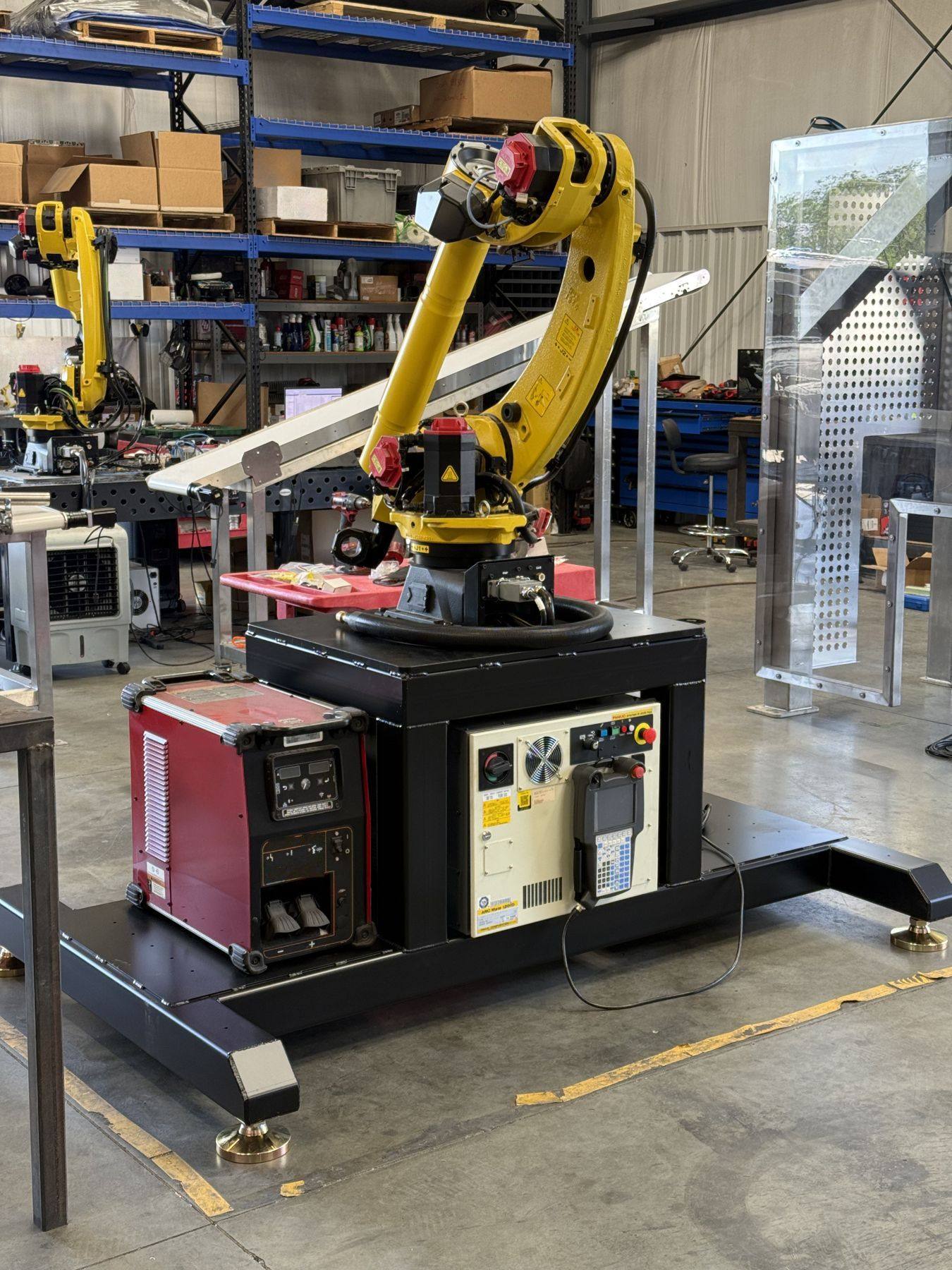
We come at it as fabricators. Our parent company, CalWest Manufacturing, runs tube laser cutting, CNC tube bending, plate laser cutting, press brake forming, welding and 5-axis CNC machining in the same Fontana building where our cells are built. The guarding, bases, risers, fixtures and grippers for every cell come off those machines.
In short
Where fab shop robots pay off
| Process | Robot job | What decides whether it works |
|---|---|---|
| Welding | Arc welding repeat weldments in a fixture, often on a positioner | Fit-up from part to part, fixtures, how many part numbers repeat |
| Machine tending | Loading and unloading CNC lathes, mills and other machines | The machine’s automation interface, how raw parts are presented, how long the cell runs unattended |
| Press brake | Holding a blank through each bend, regripping between bends | Repeat batch sizes, bend sequence, gripper changes |
| Part handling | Moving parts between cutting, forming, welding and packing | How parts arrive, how many different shapes share the cell |
| Drilling and routing | Carrying a spindle to features on 3D parts | Fixture accuracy, calibration to the part, checking the result |
| Grinding and deburring | Carrying the part to a tool, or a tool to the part | Consistent stock, dust, tool wear |
Welding, tending and drilling are jobs we have built cells for. Press brake tending, part sorting and grinding are covered here from general practice, not from cells on our project list.
Across all of them, part presentation sets the cost. A part that reaches the robot in a known position, on a fixture, a nest, a conveyor stop or a dunnage tray, is a simple pick. A part dumped loose in a bin needs a camera to find it and a gripper that can take it from several angles, which adds cost and risk. Changing how parts leave the step before the robot is often cheaper than teaching the robot to cope.
Robotic welding for fabricators
We have designed FANUC weld cells in CAD, then built and taught them in our shop. A weld robot repeats the same path every time and won’t adjust to a wider gap the way a welder does by eye, so most of the engineering goes into the parts and the fixture, not the robot.
- Fit-up. Parts cut on a laser and formed on a press brake are usually consistent enough to weld robotically. Hand-cut or sawn parts often aren’t. The robot can only be as repeatable as the parts it’s given.
- Fixtures. A fixture has to locate every part the same way, clamp it without blocking the torch, and let the operator load it quickly. It is often the piece that gets adjusted after the first parts run.
- Positioners. A positioner turns the part so more welds are made in flat or horizontal position and the robot can reach joints on every side.
- Finding the joint. Touch sensing uses the wire to find where a joint actually is before the arc starts, and seam tracking follows it during the weld. Both cover normal variation. Neither fixes parts that don’t fit.
A weld cell also has to deal with fume and arc light. OSHA’s general industry welding rules are in 29 CFR 1910 Subpart Q, and OSHA names welding on stainless and other chromium-bearing steels as a major source of hexavalent chromium exposure. Fume extraction at the torch or over the cell, and screens that block arc light from people walking past, are part of the cell design. Our robotic welding cells page covers torches, wire feed and power sources, and the robotic welding cost guide breaks down what drives the price.
Sheet metal automation and press brake tending
In a press brake cell, the robot picks a blank, squares it against the backgauge and holds it while the ram comes down. The part swings up as it bends, so the robot has to follow it. Between bends it may set the part on a regrip station to change its hold or flip it over. Each part number needs its own bend sequence, gripper setup and program.
That setup is why press brake tending suits repeat parts that run in decent batches. On the cutting side, lasers often come with their own load and unload towers, and the robot work is sorting cut parts off the sheet and stacking them for the next step.
We describe press brake tending from general practice; it is not a cell on our project list. If you are weighing one, the first numbers to pull are how many part numbers repeat and how many pieces each batch runs.
Machine tending on the machining side
Fab shops with machining departments have a second set of robot jobs: loading lathes and mills. Our lathe-to-forge cell uses two FANUC robots to carry parts from a Swiss lathe into a heater, then into a forge, with the output on two trays, and it supports lights-out operation. Multi-machine flow, machine interfaces and running unattended are covered on machine tending cells.
What a fab shop gets from a builder that fabricates
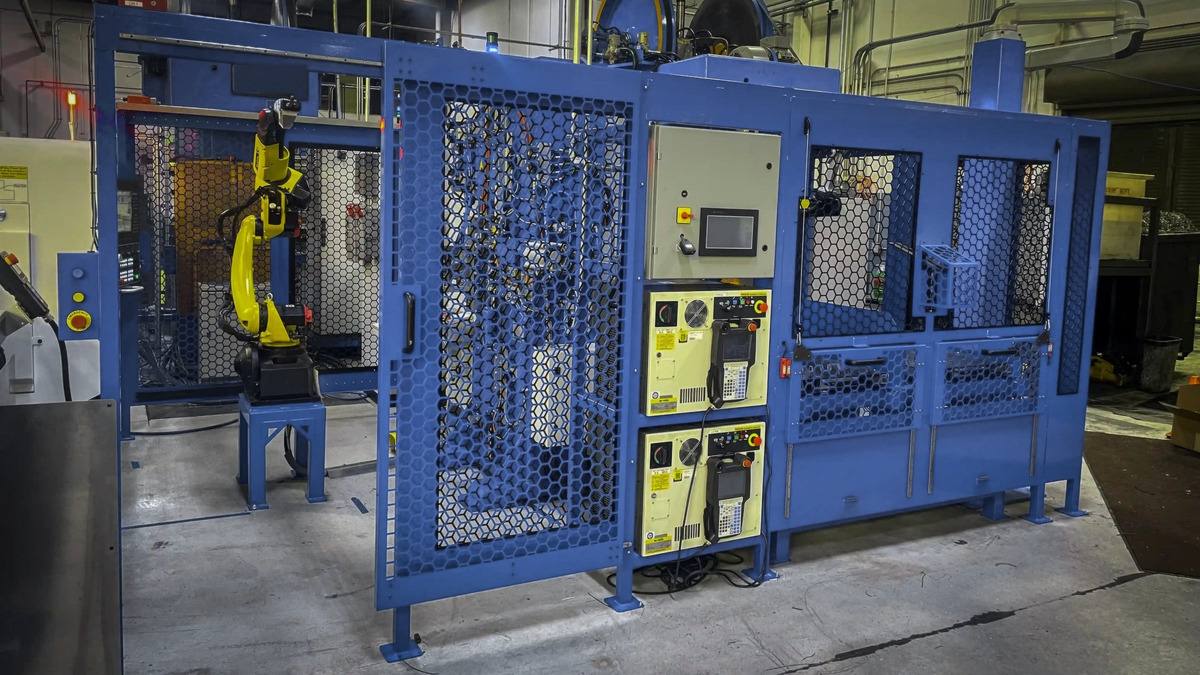
- Fixtures and grippers made here. Fixtures and grippers are designed and made in-house, and a finger or locator that needs to change after the first parts run can be machined on our 5-axis the same week. Our end-of-arm tooling page shows how we build them.
- Guarding, bases and risers made here. They are laser-cut, formed and welded in the same building (Fig. 2). How we lay out guarding is on robot cell guarding.
- Paths checked before they run. Robot paths are laid out and checked in FANUC ROBOGUIDE before they run on the real robot, and new motion is first stepped through slowly in T1 on the floor. More on that is on offline robot programming.
- Panels and code in-house. Control panels are built, wired and tested in our shop, and we write the PLC, safety and robot programs ourselves.
Can a high-mix fab shop use a robot?
Many fab shops run high-mix, low-volume work, and that is the hardest case for a robot. A few things make it workable. Group parts into families that share a fixture base and change only the locators. Program new parts offline so the cell keeps running while the next job is prepared. And pick the repeat work first: a part you run five times a year is rarely the place to start.
What to send us for a fab shop cell
- Drawings or models of the parts, or the family of parts, you want automated
- A phone video of the job done by hand, start to finish
- How many of each part you run per batch and per year
- For welding: the weld procedure, the process (MIG, TIG or other) and how parts are fixtured now
- For tending: the make, model and control of each machine
- A photo or sketch of the floor space and how parts arrive and leave
Every application we build is listed on robot cells by application, and the other plants we have built for are on industries. We build in Fontana and install at plants anywhere in the US.
Common questions
- Can a welding robot handle parts with poor fit-up?
- Only up to a point. A robot repeats its taught path, so a gap that moves from part to part shows up as a bad weld. Touch sensing can find where a joint actually is before the arc starts, and seam tracking can follow it during the weld, but neither fixes parts that don't fit. Consistent cutting and forming upstream, plus a fixture that locates every part the same way, do most of the work.
- Do you build the weld fixtures and positioner tooling?
- Yes. Fixtures, bases, risers, guarding and grippers for our cells are made in CalWest Manufacturing's shop, on the same lasers, press brakes, welders and 5-axis machines that run our contract work. If a locator needs to move after the first parts run, it can be remade in-house instead of waiting on an outside shop.
- Is press brake tending worth it for a job shop?
- It depends on the repeat work. A robot at a press brake needs a gripper, a program and a bend sequence for each part number, so it pays on parts that come back in batches large enough to cover that setup. A shop that bends a different part every hour usually gets more from faster setups than from a robot. Pull a year of bending jobs and see how many part numbers repeat.
- Which FANUC robot do you use for welding?
- It depends on the part size, the reach to every weld at the torch angle the procedure calls for, and whether a positioner turns the part. FANUC builds robots made specifically for arc welding as well as general-purpose arms. We choose the model from a CAD layout of the part, fixture and positioner, which shows whether every joint can be reached before anything is ordered.
- Can you automate around machines we already own?
- Usually. A robot can load a CNC lathe or mill if the machine can tell it when the door is open and the cycle is done, and take a start signal back. Many machines can be ordered or upgraded with that interface. Older ones may need a controls retrofit first. Send the make, model and control of each machine and a video of how parts move today.