
Robotic case packing cells that load product into cases and trays
A FANUC robot picks product off your line and loads it into cases or trays in the pattern each SKU needs. We build the cell in Fontana, CA and install it anywhere in the US.
- Robots
- FANUC delta robots and six-axis arms
- Packing style
- Top load into cases or trays
- Line tie-ins
- Case erector, sealer, palletizer
- Built in
- Fontana, CA
- Installed
- Anywhere in the US
Robotic case packing puts a robot between your product line and the case sealer. Product comes down a conveyor, and the robot picks it one piece or one group at a time and places it into an open case or tray in a set pattern. The full case moves on to the sealer, the labeler and the palletizer. CalWest Robotics builds packaging-line cells around FANUC robots, designed, fabricated, wired and programmed in our Fontana shop.
In short
How a robotic case packing cell works
A case packing robot is one station in a chain of machines. Each one has to hand off to the next without a person in between.
-
Case erected
Upstream, a case erector folds a flat blank into an open case and seals the bottom, then sends it down a conveyor.
-
Case located
The case stops at the pack station, where guides and a stop hold it square and a sensor tells the robot it is ready.
-
Product presented
Product arrives either collated into a fixed pick position or loose on a moving belt that the robot tracks.
-
Picked and packed
The robot picks one item or a group and places it to the pattern, layer by layer, with dividers or pads if the case needs them.
-
Case released
The full case goes on to the top sealer, the labeler and the palletizer.
FANUC describes the same scope for its case packing robots: grouping product, loading cartons or trays, inserting dividers, and preparing cases for sealing, labeling or palletizing. The packaging automation page covers the rest of the line around the packer.
Top-load case packing vs other styles
A top load case packer drops product into the case from above. That is the natural job for a pick and place packaging robot, since the robot can reach down into the case, place each item where the pattern says, and change patterns by changing data.
Two other styles usually belong to dedicated machines. A side-load packer pushes a group of product sideways into a case lying on its side. A wrap-around packer folds the case blank around a grouped load. When one product runs all day at a high, steady rate with no changeovers, a dedicated packer can be the simpler buy. A robotic packing system makes more sense when several SKUs, case sizes or patterns share the line, or when product is delicate and needs to be placed rather than pushed.
Which FANUC robot packs the case: delta or six-axis arm?
| Delta robot | Six-axis arm | |
|---|---|---|
| Suits | Light product, fast short picks from a belt | Heavier product, groups, deep cases |
| Mounting | Overhead, working in the space below it | On the floor or a riser beside the pack station |
| Reach into the case | Limited depth under the robot | Can reach down into a deep case and tilt the product |
| Also handles cases | No | Can, for some cells |
We build cells with FANUC delta robots and with six-axis arms such as the LR Mate and the M-20iD/25. Which one a job gets comes from the heaviest pick (product plus gripper), the rate, and how deep the case is. Our delta robot pick-and-place page covers where deltas fit best.
Grippers and pattern changes
The gripper decides what the cell can pack. Vacuum cups suit cartons, trays and closed packs with a flat face. Bags and pouches often need fingers or a scoop that supports the load from below. A multi-pick head picks a full row at once, which helps rate but adds weight and makes changeovers matter more.
Every gripper should tell the robot what it is holding: vacuum confirmed, fingers closed, product present. A dropped item inside a half-packed case is easier to catch at the gripper than at the checkweigher.
Pattern changes are where a robot has the edge over a fixed packer. Each pattern is data in the program: where each item goes, which way it faces, how many layers. The operator picks the SKU on the screen and the robot follows. If a new product needs a different gripper, a quick-change tool plate lets the crew swap it at changeover. Whether your crew adds new patterns from the screen or a programmer does is worth settling in the design review.
We design grippers in-house and machine them on our own 5-axis, so a finger or plate that needs to change can be changed the same week. More on that under end-of-arm tooling.
Picking product off a moving belt
When product comes down a belt at random positions, a camera has to find it and the robot has to pick it while it moves. On FANUC robots that is iRVision, which locates each piece, and iRPickTool, which uses a belt encoder to track it so the robot picks it where it is now rather than where the camera saw it. iRPickTool can also split the picks between more than one robot on the same belt. We set up and tune vision picks and tracking on our own floor before a cell ships. Our line tracking guide explains the setup.
Tying in the case erector, sealer and the rest of the line
Most of the trouble on a packaging line happens at the handoffs. The packer needs to know a case is in place and the sealer is ready to take the full one. The erector needs to know whether to send the next case. Every machine needs to know when the line stops and why. We write the PLC logic in-house on Allen-Bradley or Siemens, with EtherNet/IP between the PLC and the robot controller, and the signals between machines are settled before the build. More on that work is on our PLC programming page.
Many packaging plants standardize on PackML, which is published by ISA as ISA-TR88.00.02-2022. It defines a common set of machine states and a minimum set of tags for performance monitoring, so a case packer can report running, stopped and faulted the same way the other machines on the line do. If your plant uses it, tell us early and the cell’s logic can follow it.
Washdown builds for food plants
Case packing is usually secondary packaging, where the product is already sealed in its bag, tray or bottle. Some lines pack exposed food, and some packaging areas get washed down with the rest of the room. Either way, the cell has to be built for it.
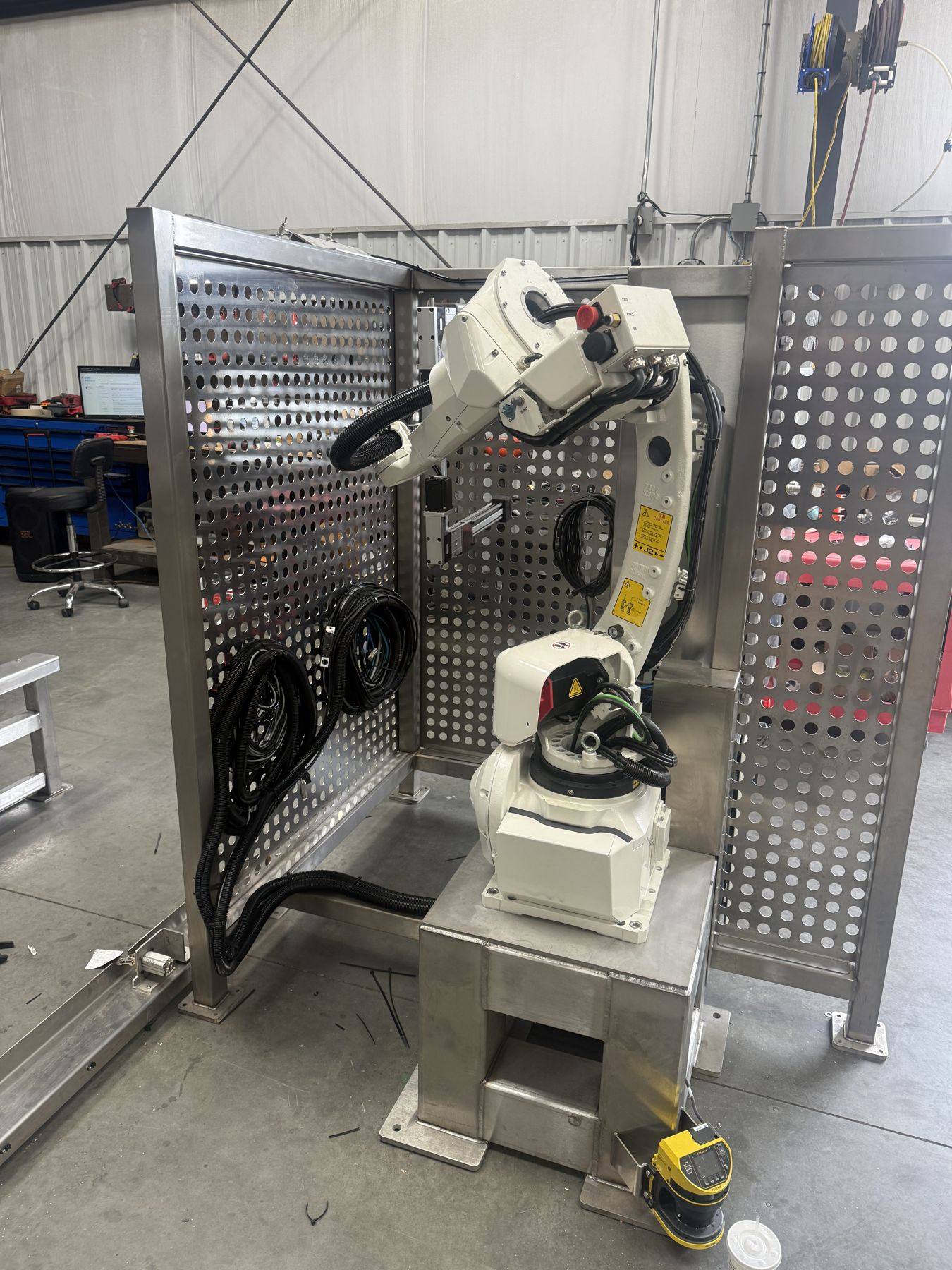
FANUC makes washdown-capable versions of some of its robots, with NSF H1 food-grade grease, and an IP69K-rated stainless delta robot. Ingress ratings and finishes differ by model, so check the spec sheet for the exact robot against how your crew cleans. We build food-grade cells with washdown-rated FANUC robots in stainless guarding, made in our own shop. Our food and beverage automation page covers food floors in more detail.
After the case is packed
A packed case usually goes through a sealer and a labeler, and then to the end of the line. If cases are still stacked by hand there, our robotic palletizing cells cover that step. We built FANUC palletizing cells for a national lawn and garden brand’s plant in Temecula, CA.
Every case packing cell goes through the same steps as every FANUC robot cell we build. It is modeled in SolidWorks with the product, cases and conveyors, robot paths are checked in FANUC ROBOGUIDE before they run on the real robot, and the cell is run off in our Fontana shop before it ships to your plant.
What to send us
- Samples or specs for every SKU: size, weight and packaging material
- Case and tray sizes, and a photo of a correctly packed case for each pattern
- Packs per minute at peak, not the average
- How product arrives today: loose on a belt, collated, or in rows
- Make and model of the case erector, sealer and anything else the cell ties into
- Whether the area gets washed down, and with what
- A floor sketch of the line with the space available
Call or text the robotics line at (818) 397-4809, or send your product list through the contact page.
Common questions
- Can one case packing cell run several products and case sizes?
- Usually, if the gripper can handle every product or can be swapped quickly, and the pack station can locate each case size. Each SKU gets its own packing pattern in the program, and the operator picks it on the screen. Where products are too different for one gripper, a quick-change tool plate lets the crew swap tools at changeover. Bring us the full SKU list, not just the main product, so the cell is designed for all of it.
- Should a case packing robot be a delta or a six-axis arm?
- A delta robot suits light product picked fast off a belt and placed nearby. A six-axis arm suits heavier product, multi-pick heads, deep cases and cells where the robot also handles the cases themselves. The product weight, the rate, and how far the robot has to reach into the case usually decide it. Some lines use both, each on the step it suits.
- Do you supply the case erector and sealer?
- Case erectors and sealers come from packaging machine makers, and many lines already have them. We design the robot cell around those machines, write the PLC logic for the signals between them, and run it all together during commissioning. Which machines are new, who supplies them and who wires each end of each signal is written into the quote, so nothing falls between two vendors.
- Can a case packing cell run in a washdown area?
- Yes, if it is built for it. FANUC makes washdown-capable versions of some of its robots, with NSF H1 food-grade grease, and ingress ratings differ by model. The guarding, frame and pedestal have to take the washdown too, so on food floors we build them in stainless. Tell us how your crew cleans and with what, because that sets the robot model and the materials.
- Do you install case packing cells outside California?
- Yes. Every cell is built and run off in our Fontana shop, then shipped and installed at plants anywhere in the United States. Southern California plants are a same-day drive. When you allow it, cells we install can be reached over a secure VPN connection for program changes and troubleshooting.