
Robotic palletizing cells, built and programmed in Fontana
We're a FANUC Authorized System Integrator. Each cell is sized from your case data, your stack patterns and the floor space at the end of your line.
- Robots
- FANUC
- Where it sits
- End of the packaging line
- Built in
- Fontana, CA
- Scope
- Design, guarding, panel, code, install
- Robots
- FANUC
- Where it sits
- End of the packaging line
- Built in
- Fontana, CA
- Scope
- Design, guarding, panel, code, install
A robotic palletizing cell sits where a packaging line ends. Sealed cases come down the last conveyor, and a FANUC robot picks each one, turns it the way the pattern calls for and sets it on the pallet, layer by layer, until the load is finished and the pallet can be pulled. Around the robot sit the case gripper, the pallet stations, guarding with safety sensors at each opening, and the control panel. CalWest Robotics builds the guarding and the panel and programs the robot. The reverse job, taking cases off inbound pallets, is covered under depalletizing cells.
What happens to each case in the cell
In a typical end-of-line palletizing robot cell, each case goes through four moves:
- Pick. The case reaches the end of the infeed conveyor and stops at a fixed pick point. A sensor tells the robot a case is there, and the gripper takes hold of it.
- Turn. Many patterns need some cases rotated 90 degrees so the layers tie together. The robot turns the case in the air on its way over, so the conveyor doesn’t need a turning device.
- Swing. The arm carries the case to the pallet station, high enough to clear the cases already placed.
- Place. The robot sets the case down at its spot in the current layer. The program tracks which layer it is on and where the next case goes, and signals when the pallet is full.
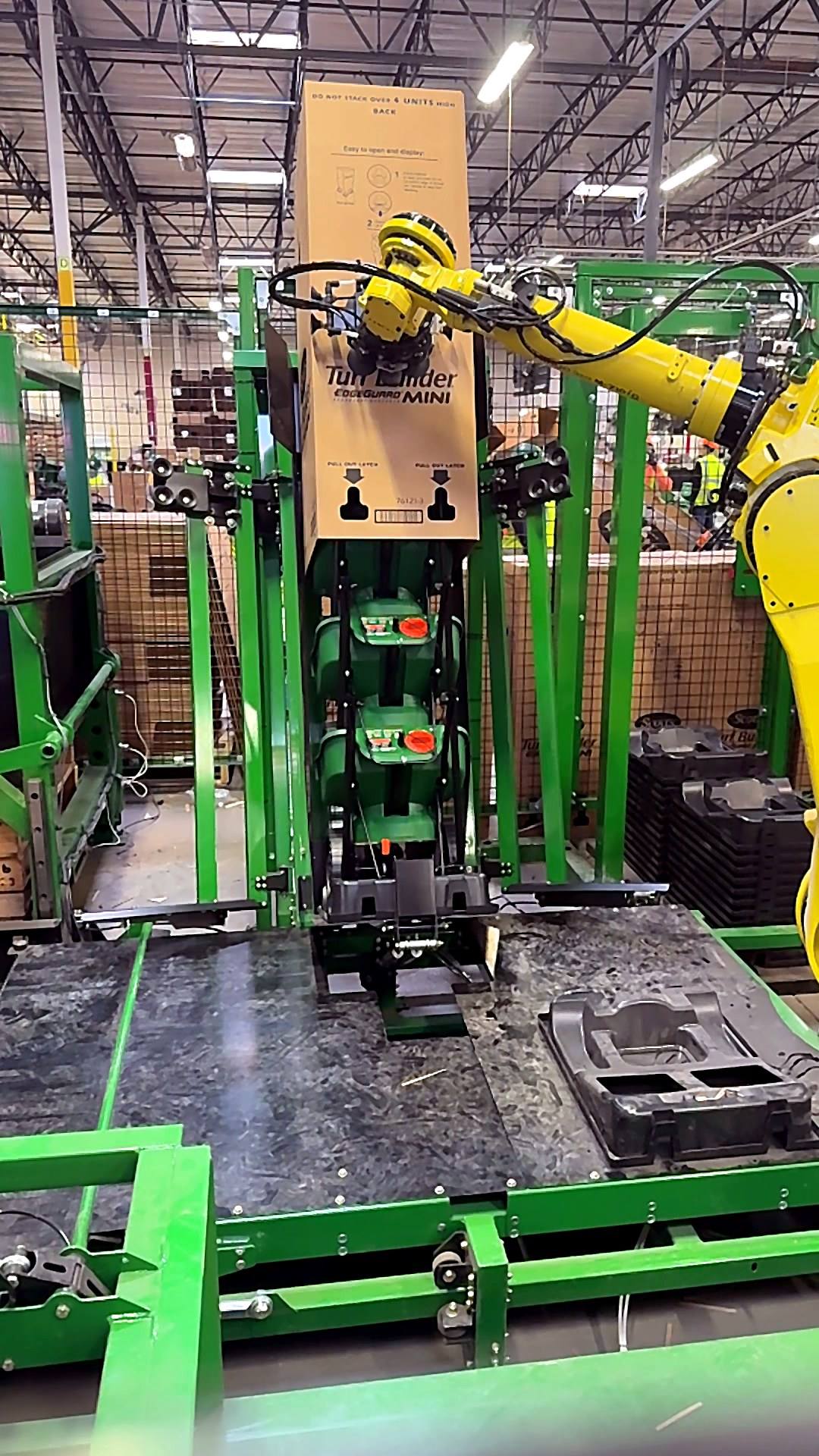
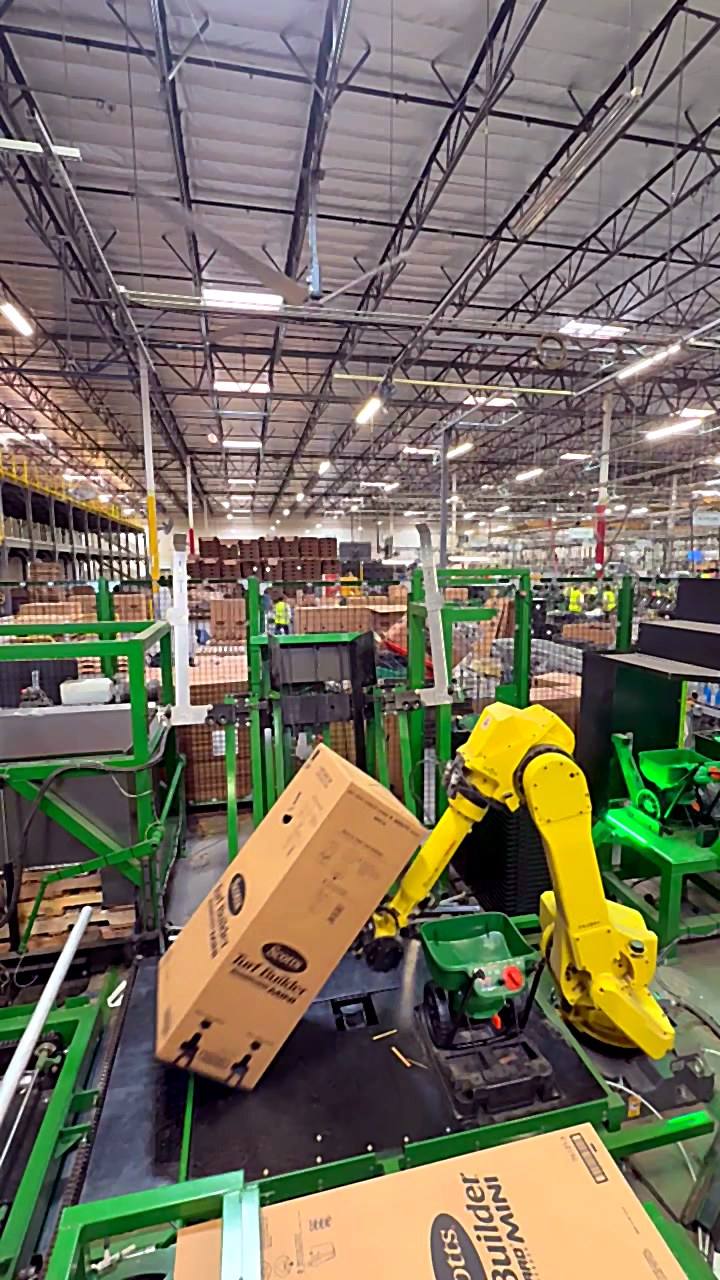
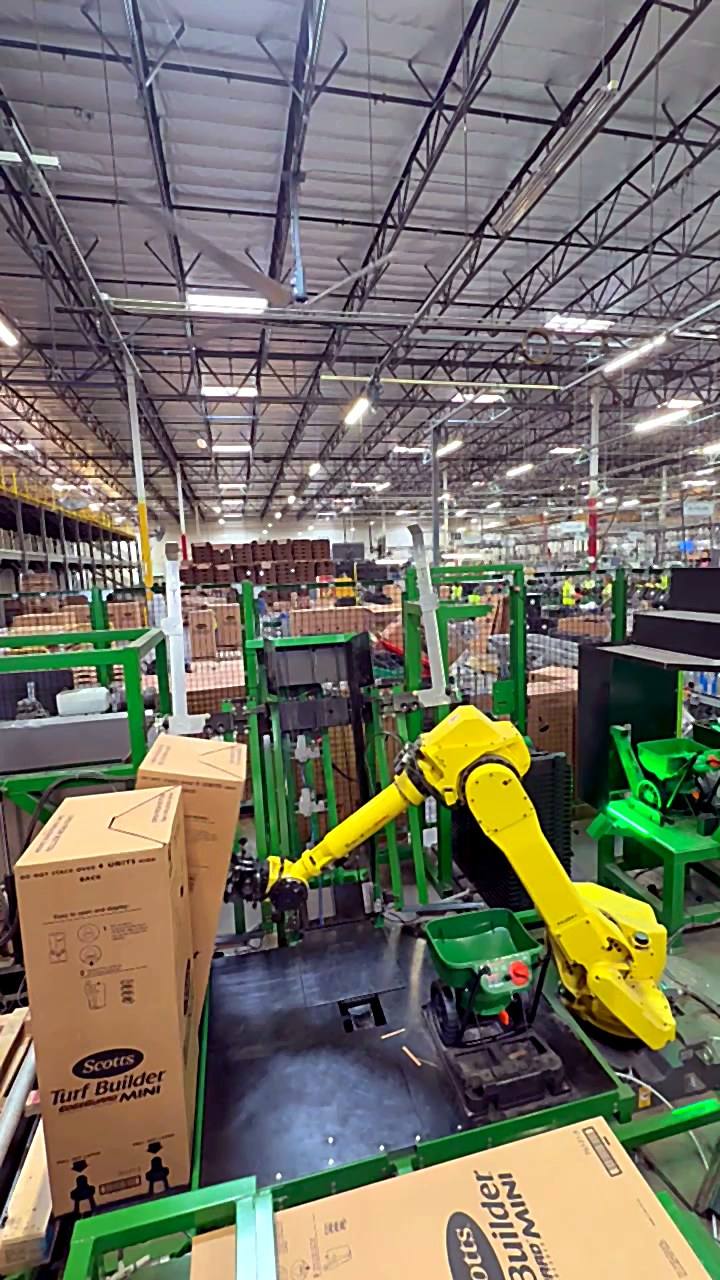
Whether a cell keeps up usually comes down to small details: how far a case can drift on the conveyor before the pick misses, whether a case bulges or sags when it is gripped, how the robot reaches the top layer of the tallest pattern, and what it does when a case arrives crooked or damaged. We work those out during design and the run-off in our shop, before the cell ships.
Which packaging lines suit a palletizing robot
A case palletizing robot works best when product arrives in closed, reasonably square cases at a steady rate. Corrugated cases, trays and shrink-wrapped bundles are all common. Bags can be palletized too, but they need a different gripper and more testing. If the rest of the line is still done by hand, packaging automation covers the jobs upstream of the palletizer, such as loading trays.
Before we propose a cell, we want to know the largest, smallest and heaviest case on the line, how many SKUs share it, and how many stack patterns you run now. For rate, give us the line’s best hour, not its average. We also need to know the space around the end of the line: the robot has to reach every corner of each pallet, and someone has to get a forklift or pallet jack to the pallet stations from outside the guarding. Last, tell us whether pallets and slip sheets are placed by hand or need a dispenser.
What to send us
- A phone video of the end of the line running at normal speed
- Dimensions and weights for each case, or at least the largest, smallest and heaviest
- A photo or drawing of a finished pallet for each stack pattern
- Cases per minute at peak
- A floor sketch showing columns, doors and forklift paths near the end of the line
- How full pallets leave the area today
Case grippers for palletizing
In a palletizing robot cell the gripper matters as much as the robot. It decides how securely a case is held at speed, whether the robot can set a case tight against the one beside it, and which cases the cell can run.
| Gripper type | Suits | Watch for |
|---|---|---|
| Vacuum (foam pad or cups) | Sealed cases with a flat top, film-wrapped trays | Porous or dusty board, loose flaps, heavy cases with weak tops |
| Clamp (side grip) | Heavy or tall cases, cases with weak tops | The jaws need room beside the case, which affects the place sequence |
| Fork or fingers | Bags, bundles, loads that sag | The fingers need a way to slide under the product |
A tool can also pick more than one case at a time or handle slip sheets if the job needs it. Each feature adds weight, and the robot has to carry the tool plus the heaviest load within its rated payload and within FANUC’s limits for wrist moment and inertia. With tall cases or wide multi-case tools, the wrist limits can decide the robot model before payload does. Where a job needs custom plates, fingers or brackets, we design them and machine them in our own shop. There’s more on that on our end-of-arm tooling page.
Guarding and safety at the pallet stations
The pallet station is where people get closest to the robot. Someone has to take away full pallets and bring empty ones, often by forklift, while the line keeps running. A common layout uses two pallet stations so the robot builds on one while the other is swapped.
Each opening in the guarding gets a light curtain or an area scanner. Once a person or forklift enters a station, the safety logic keeps the robot out of it. A light curtain only sees someone cross it, not someone standing inside, so the lockout holds until the station is clear and reset from outside the guarding. On a FANUC robot, Dual Check Safety (DCS) zones can hold the robot out of that station while it keeps building on the other.
Where each curtain or scanner sits is worked out from ISO 13855, from how fast a person approaches and how long the whole system takes to stop the robot once the device trips. Our robot safety standards guide covers the current US and ISO editions. Have your own safety professional review the final layout.
The guarding, posts and station frames are laser cut, formed and welded in our shop, and we design them around a risk assessment for the cell. Our page on robot cell guarding covers how we lay it out.
Controls, the crew’s screen and pattern changes
The control panel is built, wired and tested in our shop. We write the PLC and safety logic in-house on Allen-Bradley or Siemens, and the robot program is ours as well, so a fault between the conveyor, the safety circuit and the robot gets traced by one team. See FANUC robot programming for how we set up and tune robot programs.
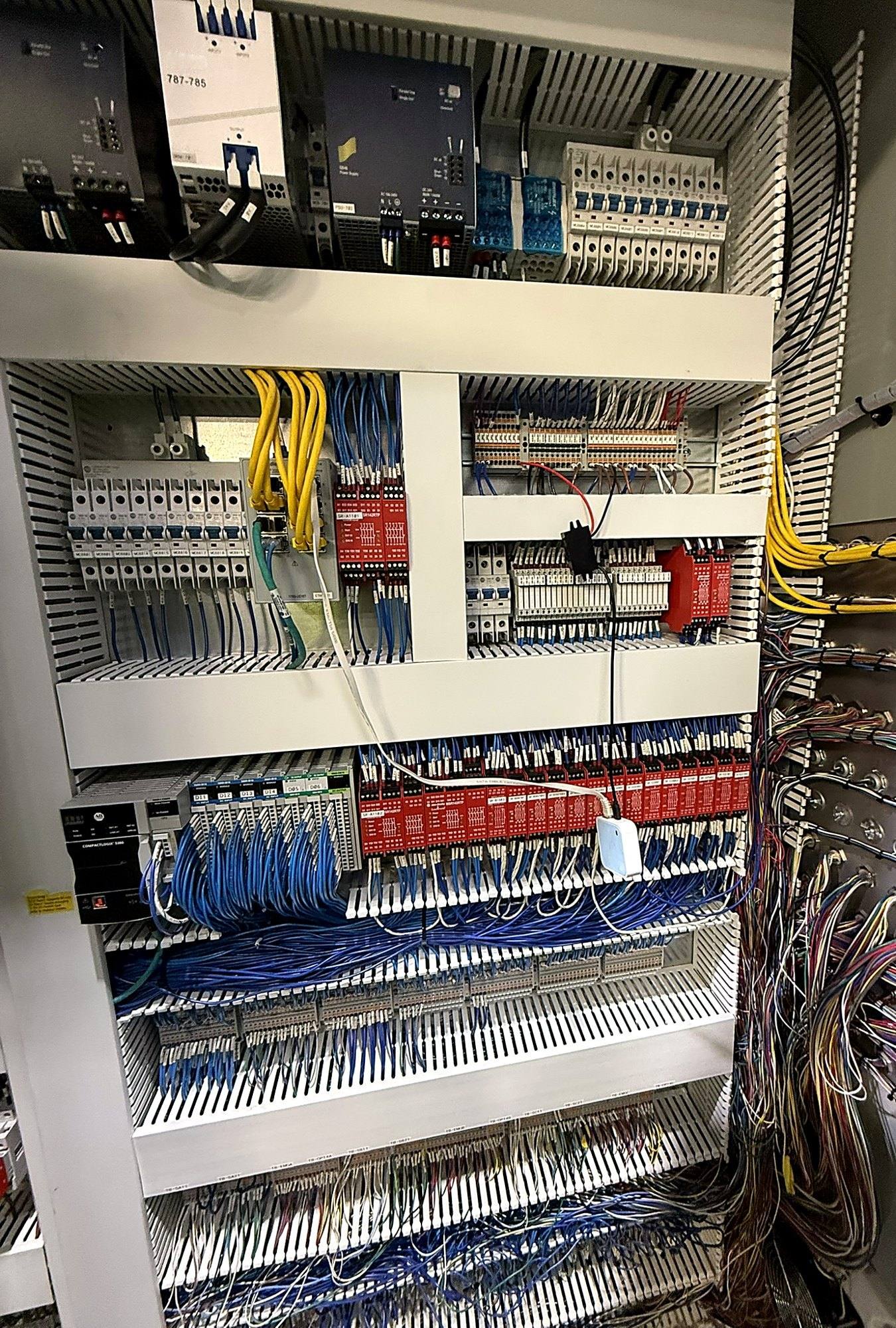
A palletizer screen should show which station is building, how far along the pallet is, when a pallet is ready to pull, and a fault message that says what happened and where, in the words the operators use. We design custom HMI screens around the crew that runs them rather than from a template.
Stack patterns are data in the robot program: the layer layout, the orientation of each case and the number of layers. FANUC’s PalletTool 3 software, for example, lets operators create and edit patterns on the Tablet TP, FANUC’s tablet teach pendant. Whether your crew adds patterns from a screen or calls a programmer depends on how often your SKUs change, and it’s worth deciding in the design review because it shapes both the screens and the program. Our guide to FANUC palletizing programming goes into the program structure.
How we build a turnkey palletizing cell
One team does every step, so there is no handoff between a frame builder, a panel shop and a programmer.
The cell is modeled in SolidWorks, the frame and guarding are cut and welded in our Fontana shop, and it runs off here before it is commissioned on your floor. How we design and build a robot cell goes through each step.
What drives the cost of a robotic palletizer
We don’t publish prices, because each cell is quoted from the line data. These are the parts of a palletizing job that move the number most. Our palletizing robot cost guide goes through each one in more detail.
| What moves it | Pushes it up | Keeps it down |
|---|---|---|
| Robot size | A heavy case plus its gripper, or a tall pattern where the robot has to reach the far top corner of the load | Lighter cases and a lower stack |
| Pallet stations | Two stations, so the robot keeps building while a full pallet is pulled; full pallets that leave on a conveyor, which needs a muted light curtain at the exit | One station, if the line can wait during a pallet change; forklift pickup at the station |
| Empty pallets and slip sheets | An empty-pallet dispenser, and slip sheets the robot places | Pallets and slip sheets set by hand |
| Infeeds | Several lines into one cell, or new conveyor and accumulation ahead of the pick point | One line that already ends at a fixed pick point |
| Run-off and install | Many SKUs and patterns to prove out, or an install that has to fit a short shutdown | A few patterns, and clear floor space when the cell arrives |
The gripper, the guarding and the number of stack patterns, covered above, move it too. When you compare quotes, check whether each one includes the work around the cell: a stretch wrapper or labeler, changes to the floor or forklift lanes, and power and compressed air run to the cell.
The robot cell cost breakdown walks through each line item, and the robot ROI calculator lets you check payback against your own labor figures.
Palletizing cells at a Temecula, CA plant
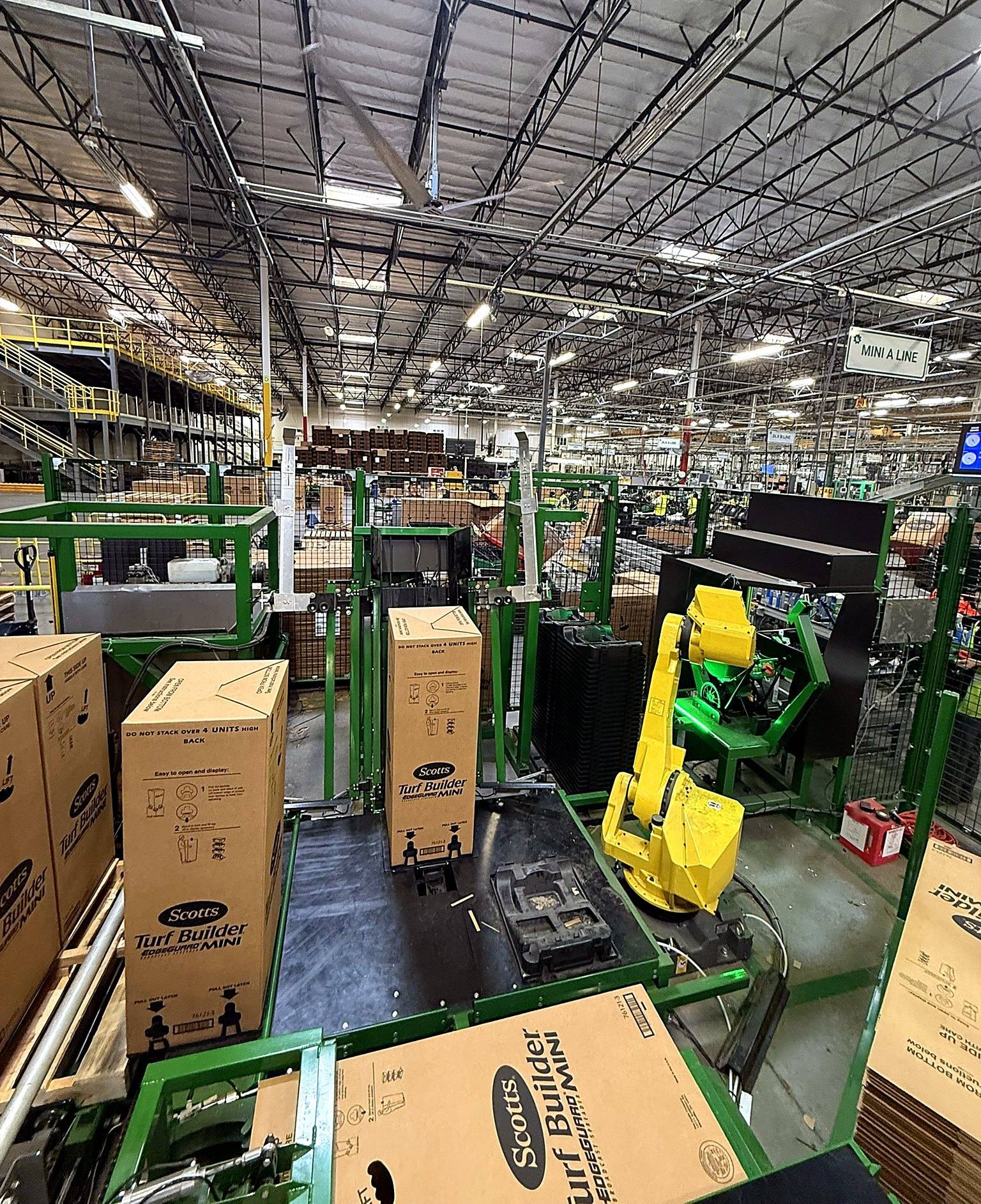
Fig. 1 and Fig. 2 are from palletizing cells we built for a national lawn and garden brand’s plant in Temecula, CA, where they stack finished cases at the end of each packaging line. The full write-up is on the Temecula palletizing cells project page.
For a palletizing job, a phone video of the end of your line and a photo of a finished pallet are enough for a first look.
Common questions
- What does a palletizing cell need from our packaging line?
- Cases need to arrive at a fixed pick point at the end of a conveyor, with a sensor or signal that tells the robot a case is ready. The cell also needs floor space for the robot and its pallet stations, forklift or pallet jack access to those stations, power, and compressed air if the gripper uses it. A video of the line end and your list of cases tell us most of what we need to start.
- Do you build the guarding and control panel too?
- Yes. The frame and guarding are laser cut, formed and welded in our Fontana shop, and the control panel is built, wired and tested here. We write the PLC and safety logic and the FANUC robot program ourselves, so one team is responsible for the whole cell. The cell is run off in our shop before it ships, then commissioned on your floor.
- Can we add new stack patterns later?
- Usually, as long as the new case fits the gripper and the robot's payload. A new pattern means a new layer layout, case orientation and layer count in the program. FANUC's PalletTool 3 software lets operators create and edit patterns on the Tablet TP. Whether your crew adds them or a programmer does is settled during design, so tell us how often your SKUs change and we'll plan the screens and program around it.
- Which FANUC robot is used for palletizing?
- It depends on the heaviest case plus the gripper, the reach to the far corner of each pallet at full stack height, and the case rate. FANUC makes robots built specifically for palletizing as well as general six-axis arms that are used for it. We choose the model once we have your case data and a floor layout, since those two things decide it.
- Can one robot palletize more than one line?
- Sometimes. It works when the combined case rate of the lines is within what one robot can place, the lines end close enough for the robot to reach both pick points, and there is room for the pallet stations. If the lines run fast or end far apart, a robot per line is usually simpler. Line rates and a floor sketch are enough for us to tell which way it goes.
- Can you install on a running production floor?
- Yes. The palletizing cells at the Temecula plant were installed and commissioned on the customer's live production floor. Every cell is run off in our Fontana shop before it ships, so the work on your floor is setting the cell in place, connecting it to the end of your line and commissioning it.
Sources
- ISO 13855:2024, Safety of machinery — Positioning of safeguards with respect to the approach of the human body
- FANUC America — PalletTool 3
- FANUC America — Palletizing and depalletizing robots
- FANUC America — M-410 series palletizing robots
- FANUC America — Dual Check Safety (DCS) Position and Speed Check