
Delta robot pick-and-place cells
We build cells around FANUC delta robots that take light product off a moving belt and put it into trays. The frame, guarding, controls and programs are done in our Fontana shop.
- Robots
- FANUC delta robots
- Vision
- FANUC iRVision
- Line tracking
- FANUC iRPickTool
- Built in
- Fontana, CA
- Robots
- FANUC delta robots
- Vision
- FANUC iRVision
- Line tracking
- FANUC iRPickTool
- Built in
- Fontana, CA
Delta robot pick and place means taking light product off a moving belt and setting it down somewhere else: into a tray, a carton or a thermoform, or onto a second conveyor. At CalWest Robotics, delta cells are one of several robot cell types we build in our shop in Fontana, CA.
The robot comes from FANUC. The rest of the cell is where most of the engineering goes: the camera and belt tracking, the gripper, the frame the robot hangs from, the guarding, and the controls that tie the cell to the rest of your line.
In short
When is a delta robot the right arm for the job?
A delta robot’s motors sit in the base above the work, and the arms hanging from that base are light parallel links. Very little mass moves with the tool, so it can accelerate hard and change direction quickly. That is why a delta is the usual choice for a high speed pick and place robot on a packaging line or a food line.
The trade-offs come from the same design. Payloads are small: FANUC’s M-1iA series carries up to 1 kg, the DR-3iB/8L 8 kg and the M-3iA/12H 12 kg, and the gripper counts against that number. The work area is wide and shallow. FANUC lists the DR-3iB/8L at 1,600 mm of horizontal reach but only 500 mm vertically. A typical delta moves the tool in X, Y and Z, and a fourth axis rotates it, which suits flat picks. FANUC also makes 6-axis deltas with a wrist, such as the M-3iA/6A, that can place a part at an angle, but the payload stays in the same small range.
| Your job | Delta robot | Look at a 6-axis arm |
|---|---|---|
| Part weight | Light, inside the rated payload with the gripper included | Heavier parts or heavy tooling |
| Motion | Short, shallow moves between belt and tray | Long reach, boxes deeper than a delta’s stroke, tilting or turning heavier parts |
| Mounting | Overhead, above the belt | Floor, pedestal or wall |
| Picks | Many small, repetitive picks | Fewer, heavier picks |
For a longer comparison, including SCARA robots, see our delta vs SCARA vs 6-axis guide. When the product goes into deep cases, our page on case packing robots compares a delta with a six-axis arm for that job.
How does a delta robot pick parts off a moving belt?
On many delta lines, product lands at random places and angles on the belt. A fixed camera looks at the belt upstream of the robot, and FANUC iRVision finds each part’s position and rotation. An encoder on the conveyor tells the robot controller how far the belt has moved since the picture was taken, so the robot meets the part where it is now, not where it was.
FANUC’s iRPickTool software runs that line tracking and keeps the queue of parts for each robot. iRVision runs inside the robot controller, so there is no separate vision PC to maintain. We cover encoders, tracking frames and calibration in our FANUC iRPickTool line tracking guide, and cameras mounted on the arm on the vision-guided robotics page.
If product already arrives spaced and in fixed positions, a camera may not be needed at all. We work out which case you have from a video of your line.
Why put two delta robots on one line?
One delta can only make so many picks a minute. When the line runs faster than one robot can keep up with, a second robot goes downstream on the same belt and the two share the work. iRPickTool supports load balancing across multiple robots, so each robot knows which parts are its own and they don’t reach for the same one.
Our twin-delta tray loading line runs this way. Vision finds every part on the moving belt, and two FANUC delta robots pick them and place them into trays, sharing the load. Each robot tracks the belt with its own encoder, and both controllers hold the full line map. The project page walks through how that line works.
Grippers for food and other light product
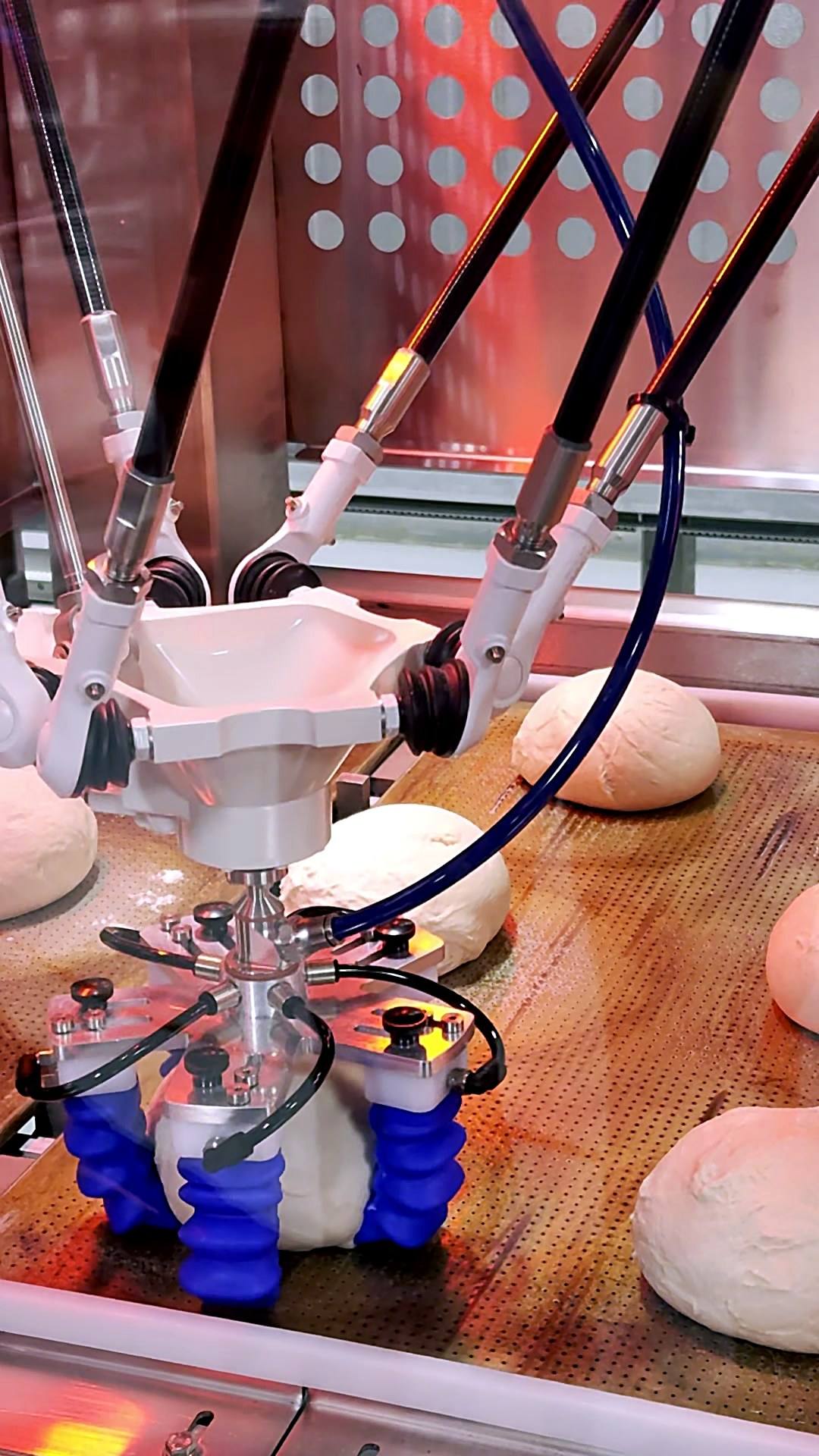
On a delta, the gripper eats into a small payload, so it has to be light as well as right for the product. For flat, smooth product, a multi-cup vacuum gripper picks from the top face of the product. For raw dough, soft fingers like the ones in Fig. 1 close around it instead.
Raw dough is a different problem. For delta dough handling in our bakery work, soft-touch grippers move raw dough without marking it, and the bakery automation page covers that work.
We select the gripper for the product and integrate it with the robot, the vacuum or air supply, and the controls. If a tool needs modifying later, the machined parts can be made on our in-house 5-axis. More on tooling is on our end-of-arm tooling page.
What does a complete delta cell include?
A delta robot hangs from a frame, and that frame has to be stiff enough that a fast robot doesn’t shake it. We model the full cell in SolidWorks, then cut, form and weld the frame and guarding in the same Fontana shop that builds the control panel.
| Robots | FANUC delta robots |
|---|---|
| Vision | FANUC iRVision, with a camera and lighting over the belt |
| Line tracking | FANUC iRPickTool with an encoder on the conveyor |
| Gripper | Multi-cup vacuum or soft-touch, selected for the product |
| Frame and guarding | Modeled in SolidWorks, fabricated in Fontana; stainless for food floors |
| Controls | Panel built, wired and tested in-house; Allen-Bradley or Siemens PLC |
| Operator screen | Custom HMI written around your crew |
| Programs | Robot and PLC code written in-house and tuned on our floor |
We write the robot paths, vision picks and tracking ourselves and tune them on our floor. The cell is run off in our shop before it ships, then commissioned on yours. The FANUC robot programming page covers that side of the work.
Delta robots on food packaging lines
Food lines are a common home for delta robots, and FANUC builds deltas for them. According to FANUC, both the DR-3iB/6 STAINLESS and the DR-3iB/8L in its DR series are IP69K rated and use NSF H1 food-grade lubricant. Which food grade delta robot suits your line depends on whether it touches bare product, how the area is washed down, and what your sanitation program requires.
For food and bakery floors we build cells around washdown-rated FANUC robots, with stainless guarding. Settle the sanitation requirements with your food safety team before the design is frozen, and we design the cell around them.
What drives the cost of a delta pick-and-place cell?
Every delta cell is quoted to the job. These are the things that move the number:
- How many robots the line rate needs, one or two on the belt
- Whether parts need vision or arrive in fixed positions
- The gripper, and whether you run more than one product
- Stainless, washdown construction versus a standard frame
- Conveyors, tray handling and other hardware that comes with the cell
- How the cell connects to your existing line controls
What to send us
- A video of the product on the line today, or of the manual process
- Product samples or a drawing, with weight and size
- Belt speed, and whether product lands at random or arrives spaced
- The rate you need to hit
- Where product goes: tray, carton or conveyor, and the pattern
- Any sanitation or washdown requirements
- Floor space, with a photo of the area
Common questions
- Do you build the frame and guarding for delta cells?
- Yes. The frame and guarding are modeled in SolidWorks along with the rest of the cell, then laser cut, formed and welded in our Fontana shop. On our finished twin-delta cell the robot controllers are mounted on top of the frame. Because the frame is built here, a change found during run-off is made here too, without waiting on an outside fabricator.
- Does a delta robot always need a camera?
- No. If product arrives at known positions, for example in pockets or fixed nests, a sensor on the conveyor triggers on each part or pocket and the robot follows the belt with an encoder. A camera is needed when product lands at random places and angles on the belt, which is common on food lines. A short video of your line usually settles it.
- How much weight can a delta robot pick?
- Not much by robot standards. FANUC rates the M-1iA series at 1 kg or less and the M-3iA/12H at 12 kg, with the DR-3iB/8L in between at 8 kg. The gripper's weight comes off that rating, so if the product plus a suitable gripper gets close to the limit, or the part has to be turned on edge, a 6-axis FANUC arm is usually the better fit.