
Custom control panels for robot cells, wired and tested in Fontana
We build the control panel for every CalWest cell and run it with the cell's own code on our floor before anything ships.
- Built in
- Fontana, CA
- PLCs
- Allen-Bradley, Siemens
- Robot controllers
- FANUC R-30iB
- Tested
- With the cell's own code at run-off
- Built in
- Fontana, CA
- PLCs
- Allen-Bradley, Siemens
- Robot controllers
- FANUC R-30iB
- Tested
- With the cell's own code at run-off
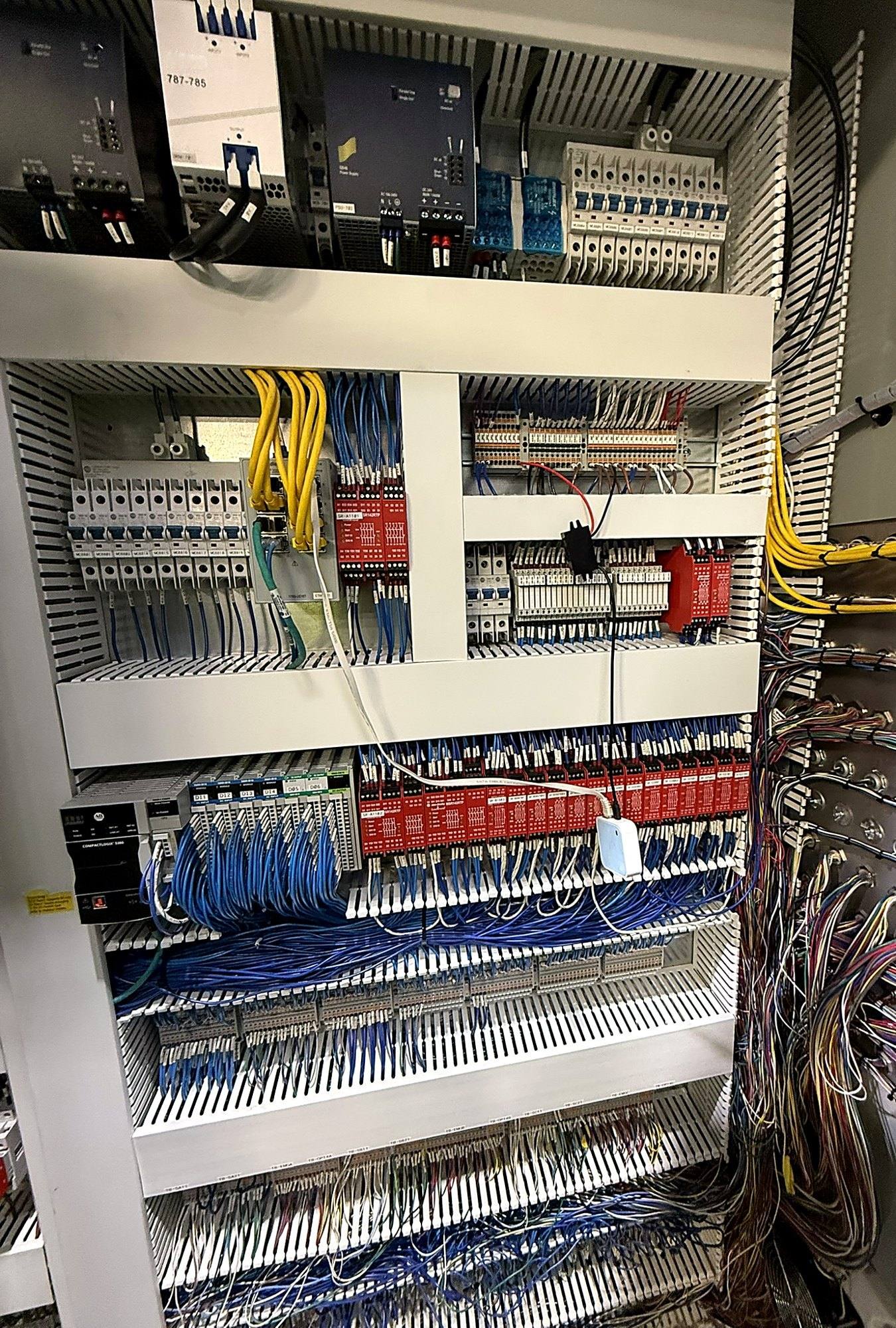
The control panel is where a robot cell’s power, PLC and safety circuit live. CalWest Robotics builds custom control panels for its cells in the same building where the cell’s logic is written. When an input is wired wrong, it is usually found and fixed here, not on your production floor.
What goes in a PLC control panel for a robot cell?
The parts list changes with the cell, but the same sections turn up in almost every panel.
| Section | What it does |
|---|---|
| Main disconnect and branch protection | Shuts off incoming power and protects each circuit with breakers or fuses |
| DC power supplies | Feed 24 VDC to the PLC, sensors, valves and safety devices |
| PLC and I/O | Run the cell sequence: conveyors, feeders, clamps, part-present sensors, stack lights |
| Safety relays or safety PLC | Monitor E-stops, door switches and light curtains, and stop the robot and machinery when one trips |
| Network switch | Connects the PLC, robot controllers, operator screen, remote I/O blocks and any drives |
| Motor drives or starters | Run conveyors and other motors, where the cell has them |
| Terminal strips | Where the field wiring from the cell’s sensors, valves and safety devices lands |
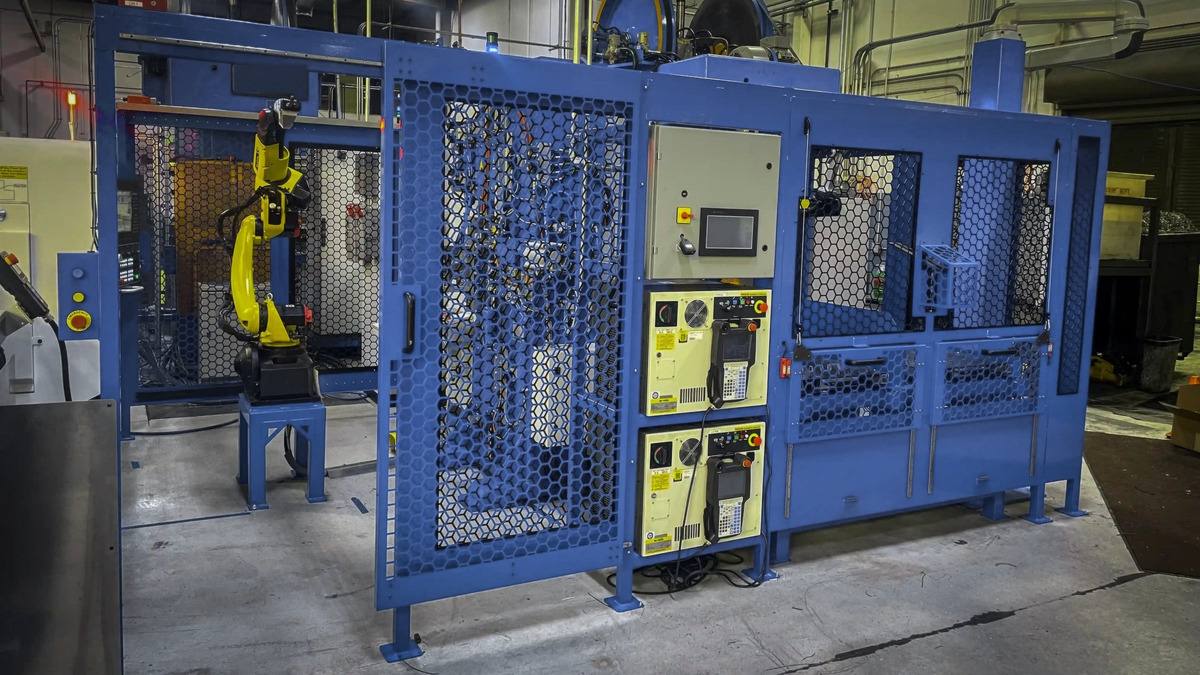
Most cells also have an operator station with a touch screen and push buttons, on the panel door (Fig. 1), the cell frame or the load station. We write those screens too, as the custom HMI page shows.
We program Allen-Bradley and Siemens, and if your maintenance team already stocks one of those families, the panel is designed around it. The logic that runs inside it is covered on the PLC programming page.
Built in the same shop as the cell frame
The panel is put together in the same shop where the cell frame is laser cut, bent and welded. The whole cell is modeled and proven in SolidWorks before anything is cut (see robot cell design), and the panel is wired and tested by the team that writes the cell’s controls and software. On a new cell, it ships as part of the complete robot cell; panels for retrofits and custom machines are covered further down.
Tested with the cell’s code before it ships
A bench check shows the panel’s wiring matches the drawing, but not that the cell works. That is what run-off in our shop is for.
-
Build and test the panel
Laid out and wired in Fontana, then tested on the bench.
-
Run off with the cell
The finished cell runs on our floor under its own robot and PLC programs, with the robot-to-PLC handshake signals (part present, robot clear, cycle complete, fault) live.
-
Commission on your floor
The cell ships with its panel and is commissioned in your plant.
A cell can’t finish a cycle unless its sensors, valves and robot handshake signals are wired and mapped correctly. That is why run-off finds the sensor landed on the wrong input or the I/O point mapped to the wrong address, which a bench check of the panel alone misses.
A finished cycle does not prove the safety circuit, though, because a miswired or jumpered door switch can still let the cell run. Each E-stop, door switch and light curtain has to be tripped on purpose to show that it stops the robot and machinery. Our FAT and SAT checklist lists what to test at run-off and again on your floor.
On the spray nozzle assembly cells we built for a national lawn and garden brand, the panels for three interlocked, light-curtained tables were built, wired and programmed here, then commissioned on the customer’s live production floor.
Control panels for machine retrofits and custom machines
Not every panel goes on a new robot cell. When a machine is mechanically sound and its controls are the problem, a controls retrofit replaces the PLC, the HMI and the wiring that goes with them. One of these jobs moved a legacy process machine to an AutomationDirect Do-more/BRX PLC with a C-more touch screen. The controls retrofit page has more on that work.
Custom machines need a panel too. The automated tapping machine we built for an aerospace supplier has PLC control of every mechanical function, including its feeder and tapping mechanism, and an HMI for real-time monitoring.
What to tell us about the panel up front
Panel details worth sending early
- The PLC family your plant standardizes on, if there is one
- The incoming power available where the cell or machine will sit
- Where operators stand, and where the screen and buttons should go
- Your plant's electrical or panel spec, if you have one
- What the cell has to talk to: other machines, a line PLC or your ERP
- For a retrofit, the existing drawings and photos of the current panel
Common questions
- Which PLC brands go in your panels?
- Allen-Bradley and Siemens, for both the cell logic and the safety logic, programmed and tested in our shop. We have also paired an Allen-Bradley CompactLogix with Kinetix servo motion, and moved a legacy machine to an AutomationDirect Do-more/BRX PLC with a C-more touch screen. If your maintenance team stocks spares and trains on one family, tell us at the start so the panel is designed around it.
- How are panels tested before they ship?
- Each cell panel is built, wired and tested in our Fontana shop, then connected to its cell and powered up with the cell's own robot and PLC programs during the run-off here. A full cycle only runs when the sensors, valves and robot handshake signals are wired and mapped correctly, so most wiring and I/O mapping mistakes turn up in our building rather than on your floor. A completed cycle does not prove the safety circuit, though. That takes tripping each E-stop, door switch and light curtain.
- Do you build control panels without a robot cell?
- We build panels as part of the robot cells we design and program. We also do controls work on custom machines, such as the tapping machine we built for an aerospace supplier, and on retrofits that replace a legacy PLC and HMI. For a panel built to someone else's drawings with no other work from us, call or text (818) 397-4809 and we'll tell you whether it fits our shop.
- Does the FANUC robot controller go inside the control panel?
- Usually not. A FANUC R-30iB controller is its own cabinet with its own teach pendant, and the cell panel sits beside it or mounts on the cell frame with it. The two are connected by hard-wired safety and I/O signals or by an industrial network such as EtherNet/IP. On our twin-delta cell, for example, the controllers mount on top of the frame.
- What documents should come with a control panel?
- Put the list in your RFQ so it is quoted up front. A sensible list is the electrical schematics, the panel layout, the I/O list, a bill of materials with part numbers, and the PLC and HMI source files. With those, your maintenance team can trace a fault to a terminal, order spares and make program changes later without going back to whoever built the panel.