
Robotic welding cells with fixtures built in our own weld shop
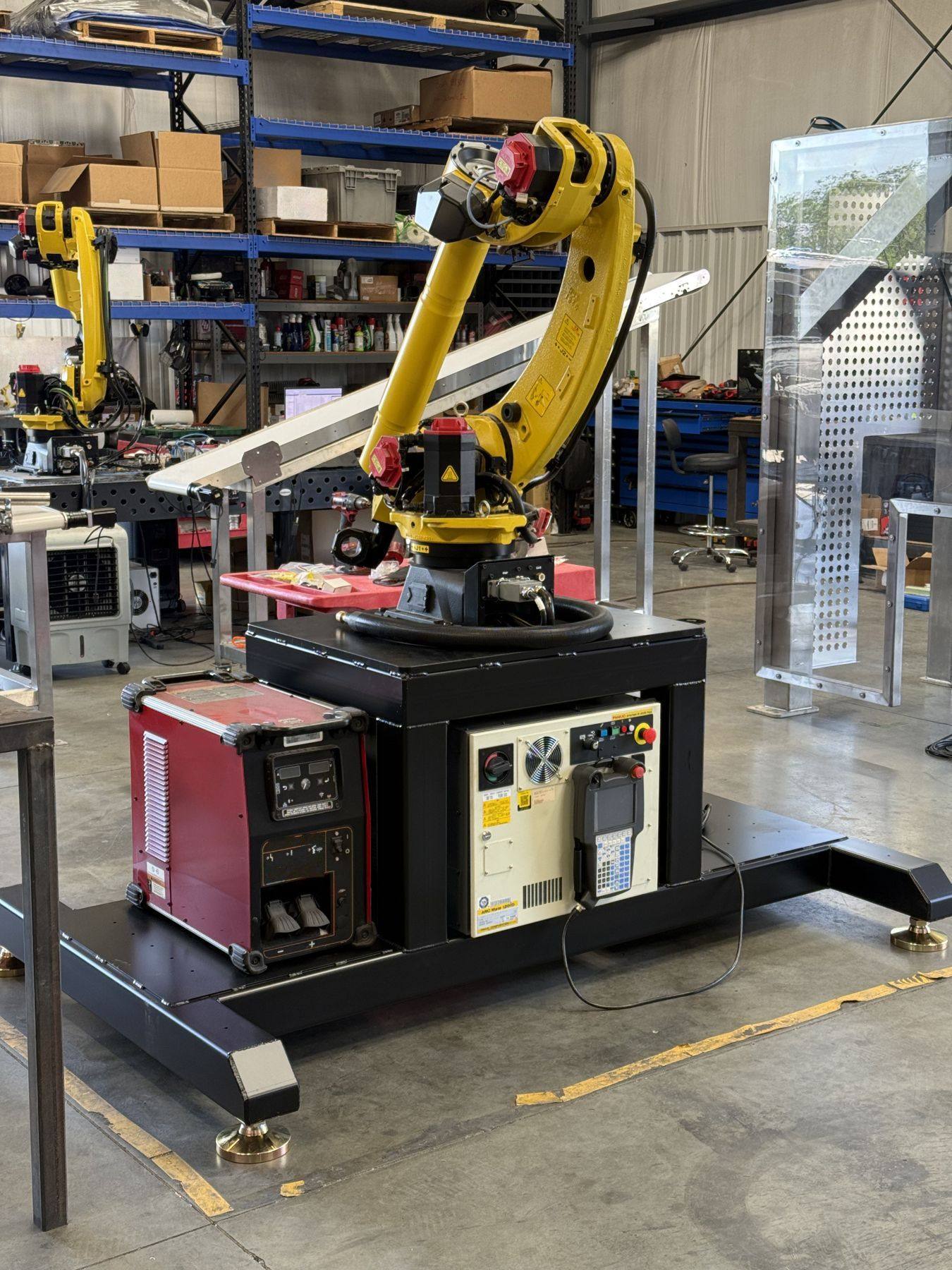
We build FANUC weld cells in Fontana, CA. Each one is designed in CAD, built and taught in our shop, then installed at your plant, anywhere in the United States.
- Robots
- FANUC arc welding robots
- Fixtures
- Designed and built in-house
- Paths
- Checked in ROBOGUIDE, taught in our shop
- Built in
- Fontana, CA
- Installed
- Anywhere in the US
- Robots
- FANUC arc welding robots
- Fixtures
- Designed and built in-house
- Paths
- Checked in ROBOGUIDE, taught in our shop
- Built in
- Fontana, CA
- Installed
- Anywhere in the US
A robotic welding cell is a FANUC arc welding robot with its torch, wire feeder and welding power source, plus the fixtures that hold your parts and the guarding around the whole thing. CalWest Robotics builds FANUC weld cells that are designed in CAD, then built and taught in our Fontana shop. We are the robotics division of CalWest Manufacturing, and welding is one of the parent company’s core trades, so the fixtures, robot bases and guarding come out of a working weld shop.
In short
What’s in a robotic welding cell
Every robotic welding system has the same core pieces. What changes from job to job is how they are sized and arranged around your parts.
| Part | What it does | What gets decided |
|---|---|---|
| FANUC arc welding robot and controller | Carries the torch along each joint. FANUC’s ArcTool software handles arc start and stop, wire feed, voltage and current along with the robot’s motion | Reach to every joint, and whether the torch cable runs through the arm or outside it |
| Torch, wire feeder and power source | Delivers wire, shielding gas and current to the arc | Air- or water-cooled torch, wire size, spool or bulk drum |
| Torch cleaning station | Reams spatter out of the nozzle, sprays anti-spatter and trims the wire so each arc starts the same way | Where it sits so the robot can reach it between parts |
| Fixtures | Locate and clamp each part in the same place every cycle | Locating points, clamps, torch access, how the operator loads it |
| Positioner, when needed | Turns or tilts the part so the robot welds in a better position and reaches every side | One axis or two, one station or two |
| Guarding and screens | Block arc light, hold in spatter and keep people out of the robot’s reach | Wall materials, doors, safeguards at the load station |
| Fume extraction | Pulls weld fume away from the cell and the people near it | A hood over the cell, extraction at the torch, or both |
| Control panel and operator station | PLC, safety circuit, start buttons and the operator screen | Allen-Bradley or Siemens, how the operator picks the part number |
Robotic MIG welding (GMAW) is the usual choice for steel because the wire feeds continuously and the robot can hold a steady travel speed. FANUC lists MIG, TIG, plasma and laser welding among the processes its arc welding robots run, depending on the equipment fitted.
Why does fixturing make or break robotic welding?
A welder looks at the joint and adjusts. A FANUC welding robot goes back to the points it was taught. If the joint isn’t where the program expects it, the wire lands off the seam and the weld comes out undersized or misses one side.
Lincoln Electric’s guidance for robotic fixtures is that the joint location should repeat within about plus or minus half the welding wire’s diameter, and that gaps should stay consistent from part to part. With 0.045 in. wire, that is roughly ±0.022 in. That tolerance covers everything together: the part, the fixture and the robot.
That is why the fixture gets as much design time as the robot program. On our fixtures we work through these points:
- Locate each part from the features its drawing is dimensioned from, so the joint lands where the program expects it.
- Clamp close to the joint to resist heat distortion, without blocking the torch’s path or angle.
- Keep locators out of the spatter path, or make them easy to clean and replace.
- Make loading obvious. Each part should fit only one way, and sensors should confirm every part is present and clamped before the robot starts.
- Plan the weld sequence, since the part moves as it heats and the last weld sees a different part than the first.
Fit-up starts before the fixture. Laser-cut and press-brake-formed parts usually repeat much better than saw-cut or torch-cut parts, and a robot shows that difference on every part.
Touch sensing and seam tracking
Sensing handles the variation you can’t fixture out. FANUC offers two common methods through ArcTool:
- Touch sensing. Before welding, the robot touches the part with the welding wire to find where it actually sits, then shifts the weld path to match.
- Through-arc seam tracking (TAST). While welding, the robot measures the welding current and adjusts its path up, down and sideways to stay in the center of the joint. FANUC notes that TAST is often paired with touch sensing, which finds the start of the joint.
Neither one is free. Each touch search adds time to the cycle, and seam tracking only corrects within a limited range. Sensing is how a good cell copes with normal part-to-part variation. It doesn’t substitute for parts that fit up consistently.
Positioners and two-station layouts
A positioner rotates or tilts the part so the robot can weld in the flat or horizontal position and reach every side without the operator re-clamping it. FANUC positioners can move on their own or in coordinated motion with the robot, so the torch keeps a steady angle and speed while the part turns under it.
Many weld cells use two stations. The operator unloads and reloads one fixture while the robot welds at the other, so the arc isn’t waiting on loading. The stations can sit on a turntable that swaps them, or side by side with the robot working between them. The load station is where people come closest to the robot, so it gets a light curtain, an area scanner or an interlocked door, chosen from the risk assessment.
Guarding for arc light, spatter and fume
A weld cell has to protect people from the arc as well as from the robot. OSHA’s welding rule, 29 CFR 1910.252, requires that people near welding areas be protected from the arc’s rays, and that booths and screens let air circulate at floor level. In practice the cell walls block the arc at eye level, the doors are interlocked, and the load station is safeguarded. We laser-cut, form and weld the guarding in our own shop, and our page on robot cell guarding covers how we lay it out.
Fume needs its own plan. OSHA’s welding fume fact sheet notes that chromium in stainless steel is converted to hexavalent chromium during welding, and that local exhaust works best when the hood or nozzle sits close to the plume. A weld cell usually gets either a hood over the cell or extraction at the torch, and the duct run and extraction unit get laid out along with the cell.
The American Welding Society publishes D16.1, a safety specification for robotic arc welding, and D16.3, a risk assessment guide for robotic arc welding. They sit alongside the general robot safety standards in our robot safety standards guide. We do a risk assessment for each cell and choose the safeguards from it. Have your own safety professional review it.
When is a weld job a good robot job?
| Usually a good fit | Usually a harder fit |
|---|---|
| The same parts or part families come back batch after batch | One-off parts that change every job |
| Parts cut and formed to a repeatable size | Gaps that change from part to part |
| Joints the torch can reach at a good angle | Joints buried inside the part or behind other members |
| Most of the cycle is arc time | Lots of tacking, grinding or handling between welds |
| The part locates from features that repeat | Parts that only fit after clamping by feel |
A harder fit doesn’t always mean no. Sometimes the answer is a better fixture, a change to how the parts are cut, or welding part of the assembly by robot and leaving the awkward joints to a welder. If you weld for a fabrication shop, our page on metal fabrication automation covers the other jobs around the weld cell.
What drives the price of a weld cell is covered in our robotic welding cost guide. We quote each cell from the parts, so we don’t publish prices.
How we build and teach a weld cell
As a robotic welding integrator, we do each step in one building: the design, the fixtures, the frame, the panel and the code. It is the same process behind every robot cell we build.
-
Design
The cell, your parts, the fixtures and any positioner are modeled in SolidWorks, with torch reach and angle checked at every joint before steel is cut.
-
Check paths offline
Weld paths are laid out and checked in FANUC ROBOGUIDE, offline simulation software, before they run on the real robot.
-
Fabricate
The robot base, fixtures and guarding are cut, formed and welded in CalWest Manufacturing's shop. Locators and fixture details are machined on our 5-axis.
-
Wire
The control panel is built, wired and tested in our shop.
-
Teach
The cell is built and taught here with your parts. New motion is stepped through slowly in T1 before anything runs at speed, then the weld settings are dialed in on real parts.
-
Install
The cell is run off in Fontana, then shipped, installed and commissioned at your plant, wherever it is in the US.
More on simulating paths before the robot moves is on our robot offline programming page.
What to send us
- Part drawings or 3D models with the welds marked
- A few sample parts, ideally from different batches, so we see the real variation
- A phone video of the part being welded by hand today
- Material, thickness, wire and shielding gas you use now, and any weld procedure the part has to meet
- Batch sizes and how often each part number comes back
- Photos of the floor space, and the power available there
Already have a FANUC weld robot?
We also service and reprogram FANUC robots that other companies installed, including teaching a new part on an existing weld cell. When you allow it, cells we install can be reached over a secure VPN connection for program changes and troubleshooting.
Call or text the robotics line at (818) 397-4809, or send your drawings through the contact page.
Common questions
- Can a robot weld our parts if the fit-up varies?
- Some variation, yes. Touch sensing finds where the part actually sits before the weld starts, and through-arc seam tracking shifts the path as the joint moves during the weld. Both have limits and both add time. If gaps change a lot from part to part, the better fix is usually upstream: cut and form the parts more consistently, or build a fixture that pulls them into place. Sample parts from a few different batches show us which case you are in.
- Should a robotic welding cell run MIG or TIG?
- FANUC arc welding robots can run MIG, TIG, plasma and laser welding with the right equipment. MIG is the usual choice for steel because the wire feeds continuously from a spool or drum and travel speeds are high. TIG suits thin material and welds where looks matter, but it is slower and less forgiving of fit-up. Send us the material, thickness and what the weld has to pass, and the process follows from that.
- Do you build the weld fixtures yourselves?
- Yes. Fixtures are designed with the rest of the cell in SolidWorks and built in CalWest Manufacturing's shop, which runs laser cutting, press brakes, welding and 5-axis machining under the same roof. When a locator has to move after the first parts run, it gets cut, welded or machined here instead of being sent out to another shop.
- Can you add a new part to a FANUC weld robot we already have?
- Yes. We service and reprogram FANUC robots that other companies installed, not only our own cells. A new part usually means a new fixture or fixture plate plus new weld paths and settings. Send the robot model, photos of the cell, the part drawing and a sample part if you can, or call or text (818) 397-4809.
- Do you install weld cells outside California?
- Yes. Every cell is built and run off in our Fontana shop, then shipped and installed at plants anywhere in the United States. Southern California plants are a same-day drive. When you allow it, cells we install can be reached over a secure VPN connection for program changes and troubleshooting.
- What does a robotic welding cell cost?
- We don't publish prices, because each cell is quoted from the parts. The robot is only one line. The number of fixtures, whether you need a positioner or two stations, guarding and fume extraction, seam finding, and how many part numbers have to be programmed and proven usually move the price more. Our robotic welding cost guide walks through each line item.
Sources
- FANUC America: ArcTool arc welding software
- FANUC America: Thru-Arc Seam Tracking (TAST)
- FANUC America: arc welding robots (processes, positioners, ROBOGUIDE WeldPRO)
- Lincoln Electric: Fixturing for Robotic Welding
- OSHA: 29 CFR 1910.252, Welding, cutting and brazing, general requirements
- OSHA Fact Sheet FS-3647: Controlling Hazardous Fume and Gases during Welding
- American Welding Society: D16 Committee on Robotic and Automatic Welding (D16.1 and D16.3)