
Robot cell guarding, laser cut in our shop
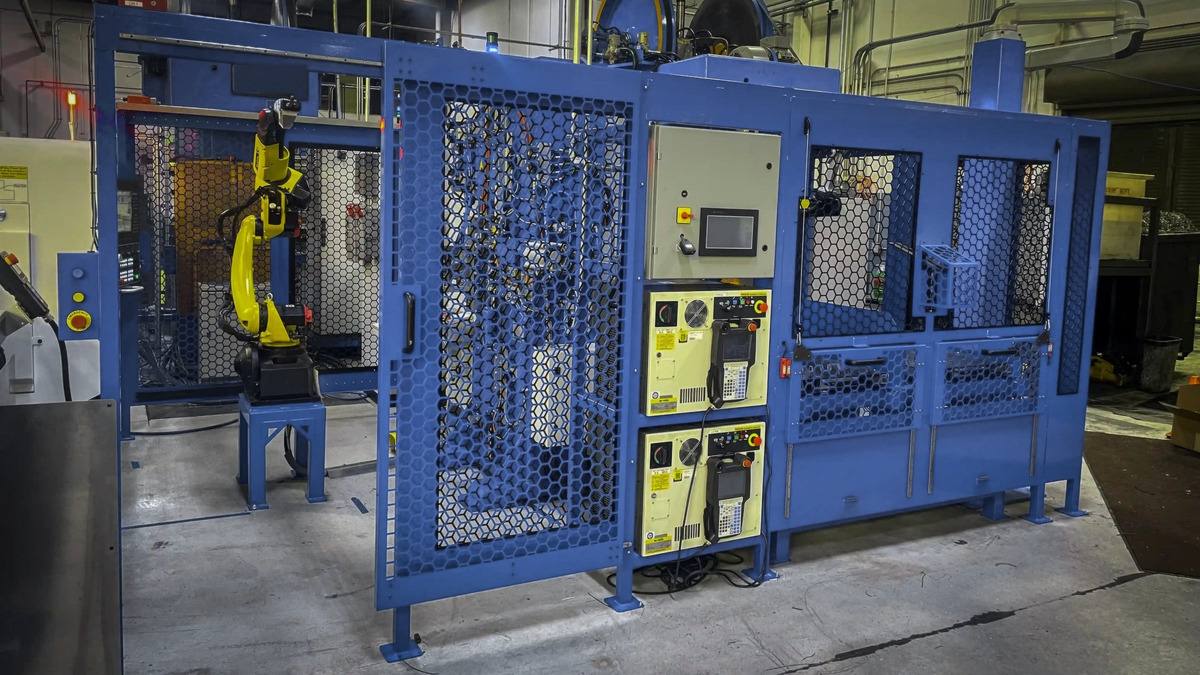
We design the guarding with the rest of the cell, cut and weld it in our Fontana shop, and write the safety logic that ties the doors and light curtains to the robot.
- Designed in
- SolidWorks, as part of the full cell model
- Fabricated
- Laser-cut, formed and welded in Fontana
- Access
- Interlocked doors, light-curtained load stations
- Safety logic
- Allen-Bradley or Siemens, written in-house
- Food floors
- Stainless guarding, washdown-rated FANUC robots
- Designed in
- SolidWorks, as part of the full cell model
- Fabricated
- Laser-cut, formed and welded in Fontana
- Access
- Interlocked doors, light-curtained load stations
- Safety logic
- Allen-Bradley or Siemens, written in-house
- Food floors
- Stainless guarding, washdown-rated FANUC robots
Robot cell guarding keeps people out of the robot’s reach while it runs and stops the robot if someone gets in. That means fixed panels nobody can reach over, under or through, interlocked doors for maintenance, and light curtains where operators load parts. CalWest Robotics lays out each door and curtain from a risk assessment of the work people do at the cell.
Laser-cut guarding, designed with the cell
We draw the guarding in SolidWorks as part of the full cell model, next to the robot, the conveyors and whatever machine the robot serves. Doors and openings go where people load parts, clear jams, change tooling or walk past. Fixed panels close off everything else. Where the fence sits also depends on reach, part flow and forklift paths, covered in our guide to laying out a robot cell.
The usual robot safety fence is wire-mesh panels on posts, sold in standard widths. Our safety fencing is cut for one cell. The panels are laser-cut from the model, formed on the press brake and welded into frames in our Fontana shop, the same shop that builds the rest of the cell. They fit around the controllers, the control panel and the conveyors, and the finished cell has a clean, OEM-style finish instead of looking like a fence dropped around a machine. Our page on robot cell design covers the rest of that model.
Most guarding you will see quoted is one of three kinds: laser-cut formed steel like ours, a wire-mesh panel kit, or aluminum extrusion framing with clear polycarbonate panels.
| Laser-cut formed steel | Wire-mesh panel kit | Aluminum extrusion with polycarbonate | |
|---|---|---|---|
| Fit to odd footprints | Cut from the cell model, so panels fit around controllers, conveyors and machine tools | Standard panel widths and posts, with filler panels for the odd gaps | Profiles cut to length, so frames can be sized closely, but panels stay rectangular |
| Visibility into the cell | Through perforations or cut patterns | Good, through the mesh | Clearest, though polycarbonate scratches over time |
| Washdown and stainless | Can be cut and formed from stainless, which is how we build guarding for food floors | Usually powder-coated steel; some makers offer stainless mesh | Open T-slots hold water and residue, so standard profiles suit dry floors better |
| Reconfiguring later | Moving an opening means cutting new panels | Easiest: panels and posts unbolt and move | Easy: profiles unbolt and can be re-cut to length |
If the layout is likely to change, a kit or extrusion is easier to live with, because panels unbolt and move. Laser-cut guarding earns its place when the cell has to fit tightly around other equipment, or when the finish matters.
Perforated and patterned panels let the crew watch the robot work, but the openings have to be sized against distance. ISO 13857 sets how far a guard must sit from a hazard for a given opening size, so bigger holes push the panel farther from the robot. Fence height and the gap at the floor come from the same standard: how far a person can reach over the top, and how far a foot or leg can reach in through a gap of a given height. OSHA’s machine guarding rule, 29 CFR 1910.212, gives no fence height or mesh size. The numbers come from ISO 13857 and the risk assessment, as the robot cell guarding requirements section of our safety standards guide explains. We work them out in the model, before any steel is cut. On FANUC robots, Dual Check Safety can hold the arm inside a smaller, safety-rated space, which sometimes lets the fence sit tighter than the arm’s full reach.
On machine tending cells, the guarding usually closes against the machine tool, so the machine’s own doors and interlocks become part of the perimeter.
Robot cell door interlocks and light curtains
Each opening in the fence gets one of three treatments, depending on how often people need to go through it.
| Opening | How it protects | Where it fits |
|---|---|---|
| Fixed panel | Held on with fasteners that need a tool to remove | Anywhere nobody needs routine access |
| Interlocked door | A safety switch on the door stops the robot when it opens | Maintenance, changeovers, clearing jams |
| Light curtain | Breaking any beam across the opening stops the robot | Load stations where an operator hands parts in and out all shift |
If the robot can’t stop before someone could reach it through an open door, the door also gets a guard lock that holds it shut until motion stops.
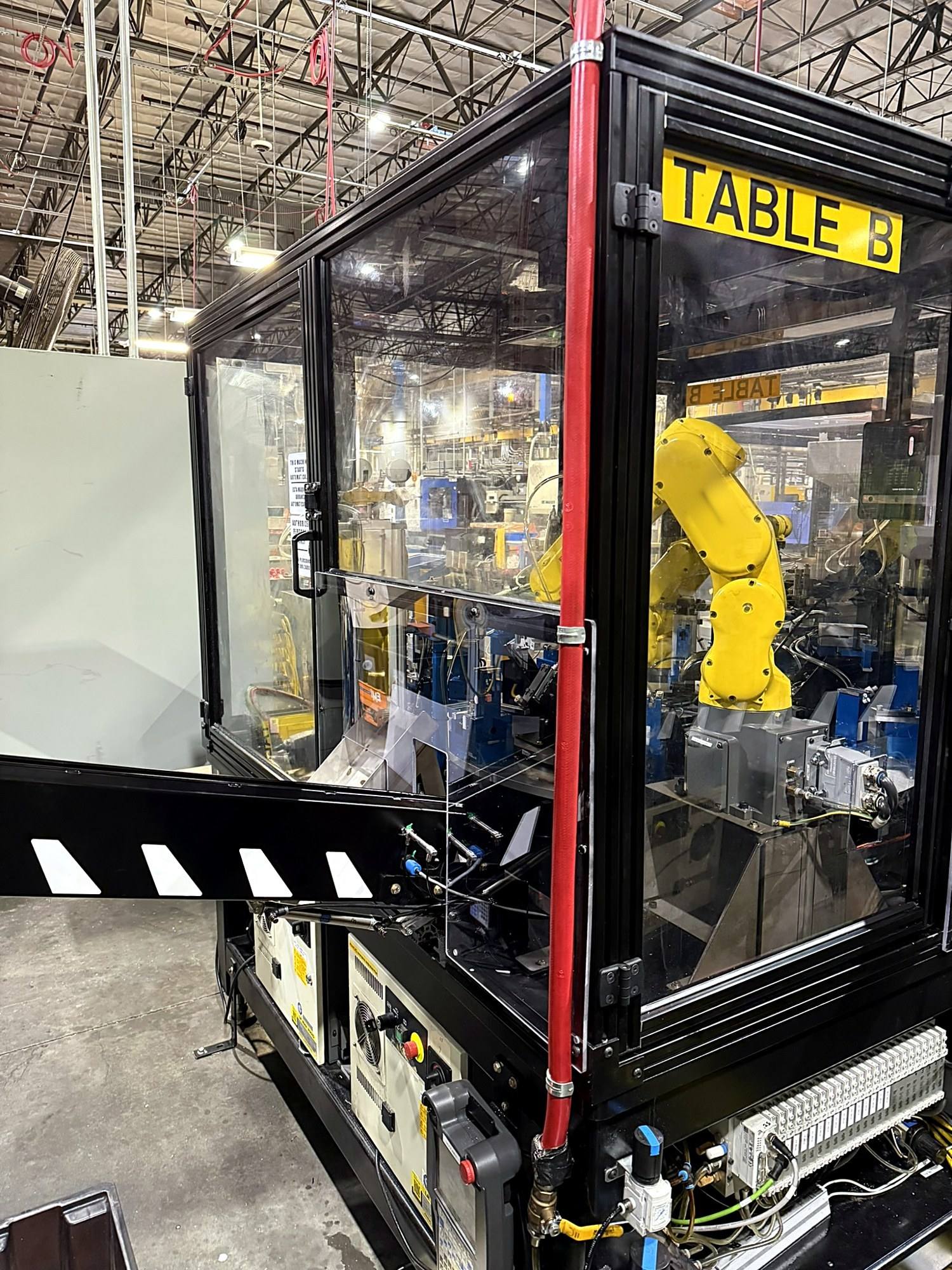
A light curtain at a load station saves the operator from opening and closing a door every cycle, which is how door switches end up taped over. The catch is distance. ISO 13855 sets how far the curtain must sit from the hazard.
The distance comes from how fast a hand or body approaches, how small an object the curtain can detect, and the total time to stop: the curtain’s response, the safety controller’s response and the robot’s stopping time. A robot that takes longer to stop needs the curtain farther out, which changes the footprint, so it gets settled in the design, not at install.
Where a person could be inside the fence without being detected, closing a door or clearing a curtain should not restart the robot on its own. Restart then takes a deliberate reset from outside the fence, at a spot where the person pressing it can see into the cell.
The 2024 edition of ISO 14119 spells this out for doors a person can walk through: where the machine could start unexpectedly, a manual reset or presence detection is required. Where the reset spot can’t see the whole cell, a scanner or safety mat inside keeps the robot stopped while anyone is in there. Our light curtain vs area scanner guide covers when a walk-in cell needs one.
On the spray nozzle assembly cells we built for a national lawn and garden brand, all three LR Mate tables are interlocked and light-curtained.
Who writes the robot cell safety logic?
When a switch or curtain trips, the safety logic decides which motion stops and how, what the HMI tells the operator, and what it takes to get running again. We write that PLC and safety logic in-house, on Allen-Bradley or Siemens, and test it in our shop. Our safety PLC programming page covers GuardLogix and safety relay circuits in more detail.
The door switches, light curtains and e-stops wire into a control panel we build and test here as well. With one team on the guarding, the panel and the program, a door that moves in the model gets its switch moved in the wiring and in the program by the same people.
Stainless guarding for food and bakery floors
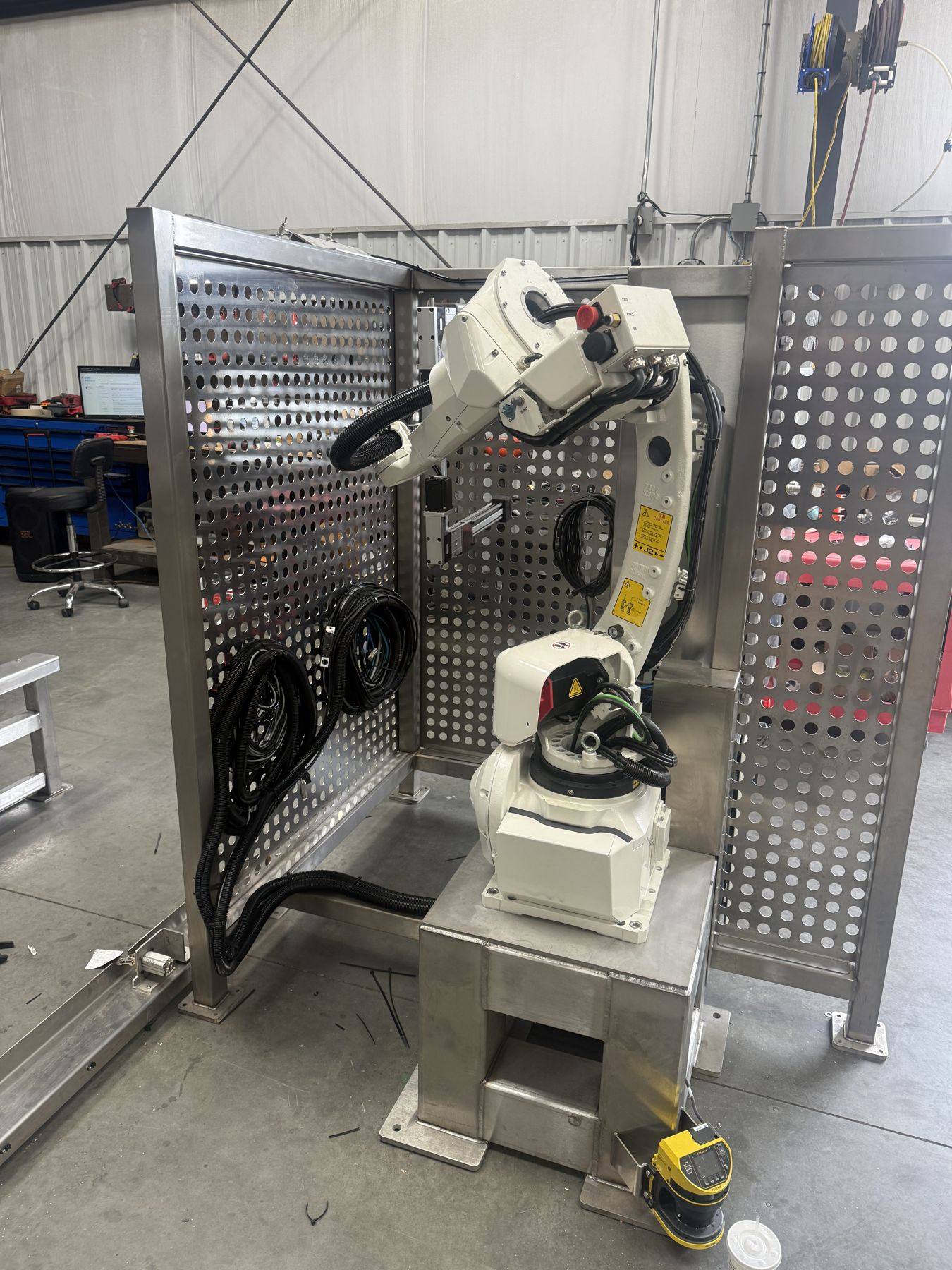
For food and bakery floors we build cells with washdown-rated FANUC robots inside stainless guarding. Painted steel does poorly in a room that gets washed down. Stainless takes the water and the cleaning chemicals and has no coating to flake off near product. We design the panels and pedestal around how your sanitation crew cleans and which chemicals they use.
Our bakery automation page covers the delta robots and soft-touch grippers we use to move raw dough.
Which standard edition will the cell be built to?
Agree on that in writing before the fence is drawn, along with who signs off on the guarding. OSHA has no standard written specifically for robots. Its general machine guarding rule, 29 CFR 1910.212, applies, and OSHA lists the robot consensus standards alongside it.
In the US the main one is ANSI/A3 R15.06-2025. Its Parts 1 and 2 adopt ISO 10218-1 and ISO 10218-2 in their 2025 editions and replace R15.06-2012. Part 3, ANSI/A3 R15.06-3-2025, is a US addition covering the plants that use robot cells. None of this replaces a risk assessment of your own cell or a review by your own safety professional.
What to send us
Guarding is part of our complete cells: frame, guarding, controls and robots, built and run off in our shop, then commissioned on yours.
To start a guarded cell
- A video of the process as it runs today, or a drawing of the part
- Photos or a floor plan of the space, with aisles, columns and forklift traffic marked
- Where operators need to load parts, clear jams or change tooling, and roughly how often
- Your plant's safety requirements, including any standard edition your safety lead or insurer specifies
- Washdown and sanitation requirements if the cell goes on a food floor
Common questions
- When does a load station get a light curtain instead of a door?
- When an operator hands parts in and out many times a shift. Opening and closing a door every cycle slows the work and tempts people to defeat the switch. Doors suit maintenance, changeovers and clearing jams. The curtain's distance from the hazard comes from ISO 13855 and depends on the robot's stopping time, so it has to be settled in the design, not added at install.
- Who reviews the guarding design?
- Your safety lead or an outside safety professional should review it against your plant's requirements, and it is worth agreeing in writing who signs off before the fence is drawn. The run-off in our Fontana shop, before the cell ships, is a good time for them to see the doors, curtains and resets working and raise anything they want changed.
Sources
- OSHA — Robotics: Standards
- OSHA — 29 CFR 1910.212, General requirements for all machines
- ANSI Webstore — ANSI/A3 R15.06-2025, Industrial robots and robot systems, safety requirements
- The Robot Report — Updated ANSI/A3 standards address industrial robot safety
- The Robot Report — A3 releases full three-part national safety standard for industrial robots
- ISO 13857:2019 — Safety distances to prevent hazard zones being reached by upper and lower limbs
- ISO 13855:2024 — Positioning of safeguards with respect to the approach of the human body
- Drives & Control Solutions — Safety standard EN ISO 13855 for the positioning of safeguards
- ISO 14119:2024 — Interlocking devices associated with guards
- All About Industries — New edition of ISO 14119, safety of machinery, interlocking devices