
What to check at a robot cell factory acceptance test and on site
Checklists for both test sheets. Copy them, cross out what doesn't apply to your cell and add what your process needs.
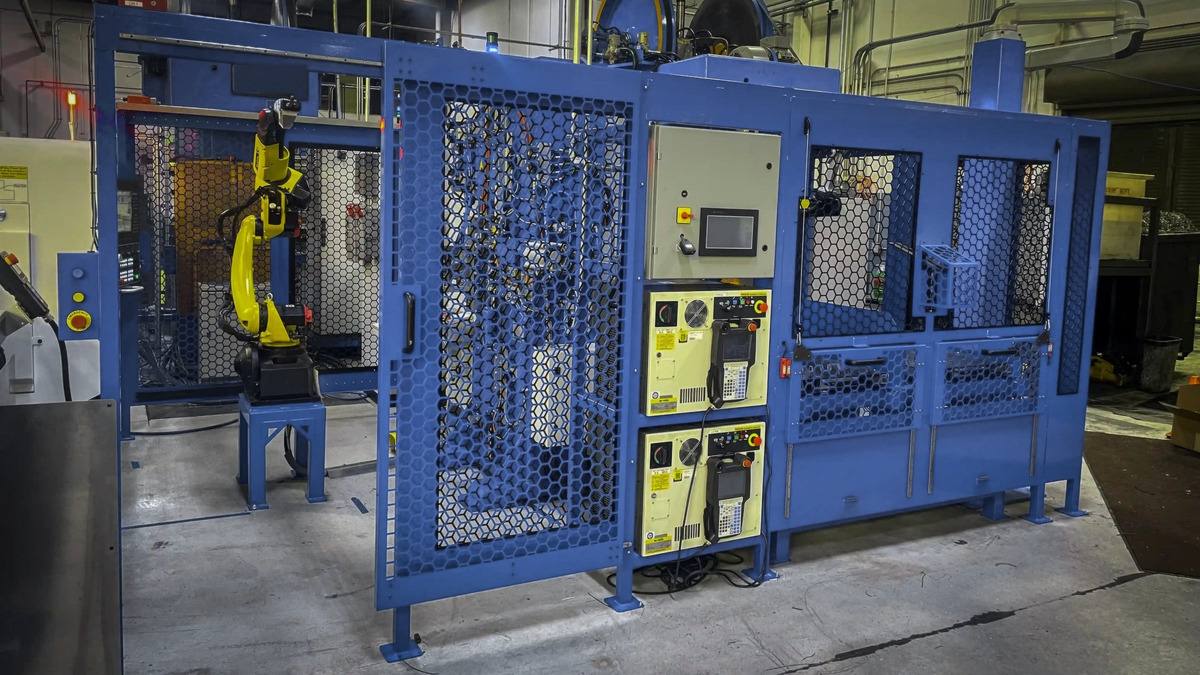
A robot cell factory acceptance test (FAT) is the run-off in the integrator’s shop. The finished cell runs your production parts against the agreed spec, and your people try to upset it before it ships, while problems are still cheap to fix. The site acceptance test (SAT) repeats the important checks after install, once the cell is on your plant’s power, air and network and wired to the machines around it.
FAT vs SAT in automation: what each test can prove
The two tests check the same cell, but they can’t prove the same things. In the builder’s shop the machines upstream and downstream are usually simulated, the power and air are the shop’s, and the people running the cell are the people who built it. On your floor all of that is real.
| Check | At FAT, in the builder’s shop | At SAT, on your floor |
|---|---|---|
| E-stops, door switches, light curtains, resets | Every device tested | Every device tested again after shipping |
| Cycle with production parts | Parts you send | Live production |
| Changeover between part variants | Every variant | Every variant, run by your operators |
| Handshake with the machines on either side | Simulated signals | Real machines, real timing |
| Utilities | The shop’s power and air | Your voltage, air pressure and network |
| Stopping performance behind guard distances | Checked against the design | Re-checked in the final position |
| Training | Your leads watch and try it | Your crew runs it, builder on hand |
There is a standard that defines these tests, though not for robots. IEC 62381, written for automation systems in the process industry and revised in 2024, covers the factory acceptance test, site acceptance test and site integration test, and the 2024 edition adds an optional factory integration test. The idea carries over to a robot cell: buyer and builder agree in advance what gets tested where, and what counts as a pass.
The safety side has its own standard. ISO 10218-2:2025, adopted in the US as part of ANSI/A3 R15.06-2025, requires a cell’s safeguards and safety functions to be verified and validated. Acceptance tests are a natural place to collect that evidence. They don’t replace the risk assessment behind it.
Agree on the pass criteria before the build starts
A FAT goes badly when nobody wrote down what passing means. Settle these in the spec or the purchase order, before steel is cut:
- The rate, and how it’s measured: which parts, over how long a run, and whether waiting on material counts against the cell.
- Which part variants, changeovers and faults get tested.
- What parts you will send, how many, and by when, including rejects and borderline parts.
- Who attends from your side, and who can sign.
- Which documents and program backups must be in hand before the cell ships.
- Which open items block shipping, and which can close at SAT.
Our guide on how to choose a robot integrator has more questions worth settling at the quote stage.
What to test at a robot cell factory acceptance test
Split the FAT into two kinds of time: a long stretch of normal production, and a session where you upset the cell on purpose. The second one tells you more about what your crew will live with.
E-stops, doors and light curtains
Test every safety device, not a sample, with the robot moving. After every trip the cell should stay stopped until someone resets it deliberately from outside the guarding, and the reset alone shouldn’t restart motion. If the cell uses FANUC Dual Check Safety (DCS) to keep the robot inside set zones, jog toward each zone boundary and note where the robot actually stops. If DCS also monitors speed, run a test program that tries to exceed each speed limit and confirm the robot stops.
Under ISO 13855, the minimum distance from a light curtain to the hazard starts with an assumed approach speed multiplied by the time the whole system takes to stop. Allowances are added for how far a hand can reach in before the curtain sees it, which depends on the curtain’s resolution, and for things like measurement uncertainty. The robot’s share of the stopping time grows with speed, payload and how far the arm is extended, so ask how it was measured and check that the curtain sits at least as far out as the calculation requires. The layout side is covered on robot cell guarding.
FAT: safety devices
- Each E-stop pressed mid-move, in automatic and in teach mode
- Each guard door opened mid-cycle; the robot stops and the cell stays stopped until reset
- Each light curtain broken with the robot moving toward it
- Resets sit outside the guarding with a view into the cell, and never restart motion on their own
- Teach pendant enabling switch: releasing it and squeezing it fully both stop motion
- DCS zones tried by jogging to each boundary, speed checks tried with a test program, and the settings recorded
- Light curtain distances measured and compared with the ISO 13855 minimum distance
Fault recovery
A cell that runs clean for an hour hasn’t shown you much. Cause each fault on purpose and watch what the operator has to do to get running again. Good recovery means the screen says what happened and where, the fix doesn’t need a teach pendant, and the cell returns to a known state without scrapping good product. If clearing a missed pick means someone jogs the robot out of a fixture, that goes on the punch list.
FAT: faults to cause on purpose
- A missed pick or a dropped part
- An empty feeder, conveyor or infeed
- A full outfeed, pallet or tray
- A part out of position, or the wrong part
- Low air pressure, or lost vacuum at the gripper
- Power to the panel cycled mid-cycle; nothing moves when power returns until someone deliberately restarts the cell
- A jam at the tightest point in the cell
Changeover and the operator screen
Run every part variant the cell is quoted for. Do each changeover the way your crew will, from the HMI with your operator at the screen, and time it yourself. Then select the wrong recipe for the part on the line and see what the cell does.
Walk every screen. Alarm text should name the device and the fix, and the counts and fault history should be the ones your crew needs on a shift. On the spray nozzle assembly cells we built for a national lawn and garden brand, the custom HMI shows cycle time per table, color changeover and fault status, because that is what the crew watches.
Real parts at the agreed rate
Run production parts, and enough of them for the cell to settle in, because a rate measured over a handful of cycles says very little. Mix in the bad ones: the burr, the crushed case corner, the batch that came in slightly off. Afterwards, check the handled parts for marks or scuffs from the gripper.
If a finger marks the part or a vacuum cup won’t seal on a textured surface, this is the cheapest point to change it. We design and machine end-of-arm tooling in-house on our 5-axis, so a new finger can be made and swapped the same week while the cell is still in our shop. If the cell logs every cycle and fault with a time stamp, keep the FAT log as the baseline for SAT.
What to collect before the cell ships
- The signed FAT record, listing every open item with an owner and whether it blocks shipping
- Backups of the robot, PLC and HMI programs as they ran at FAT
- As-built electrical schematics and the I/O list
- The safety settings as tested, including DCS and any safety PLC settings
- The spare parts list, with the parts that wear marked
- The cycle and fault log from the FAT run, if the cell keeps one
What gets re-verified at the site acceptance test?
A cell gets unbolted and unplugged to ship, then put back together on your floor, so every safety device counts as untested until it has been tried again on site. The rest of the SAT covers what the builder’s shop couldn’t provide.
The robot is also bolted to a new floor. Taught points that reference a fixture, conveyor or pallet need checking, and if a camera or its mount was disturbed in shipping, so does the vision calibration. Our iRVision calibration guide covers that on a FANUC cell.
Lockout belongs to your plant. OSHA’s lockout/tagout rule, 29 CFR 1910.147, requires the employer to develop and document procedures for controlling hazardous energy during servicing and maintenance. Walk the cell’s energy sources with your safety lead during SAT: the electrical disconnect, the air dump, anything held by air or vacuum, and anything that can drop under gravity once power is off. The 2025 US robot standard also added a Part 3 for companies that use robot cells, worth reading for whoever will own this one.
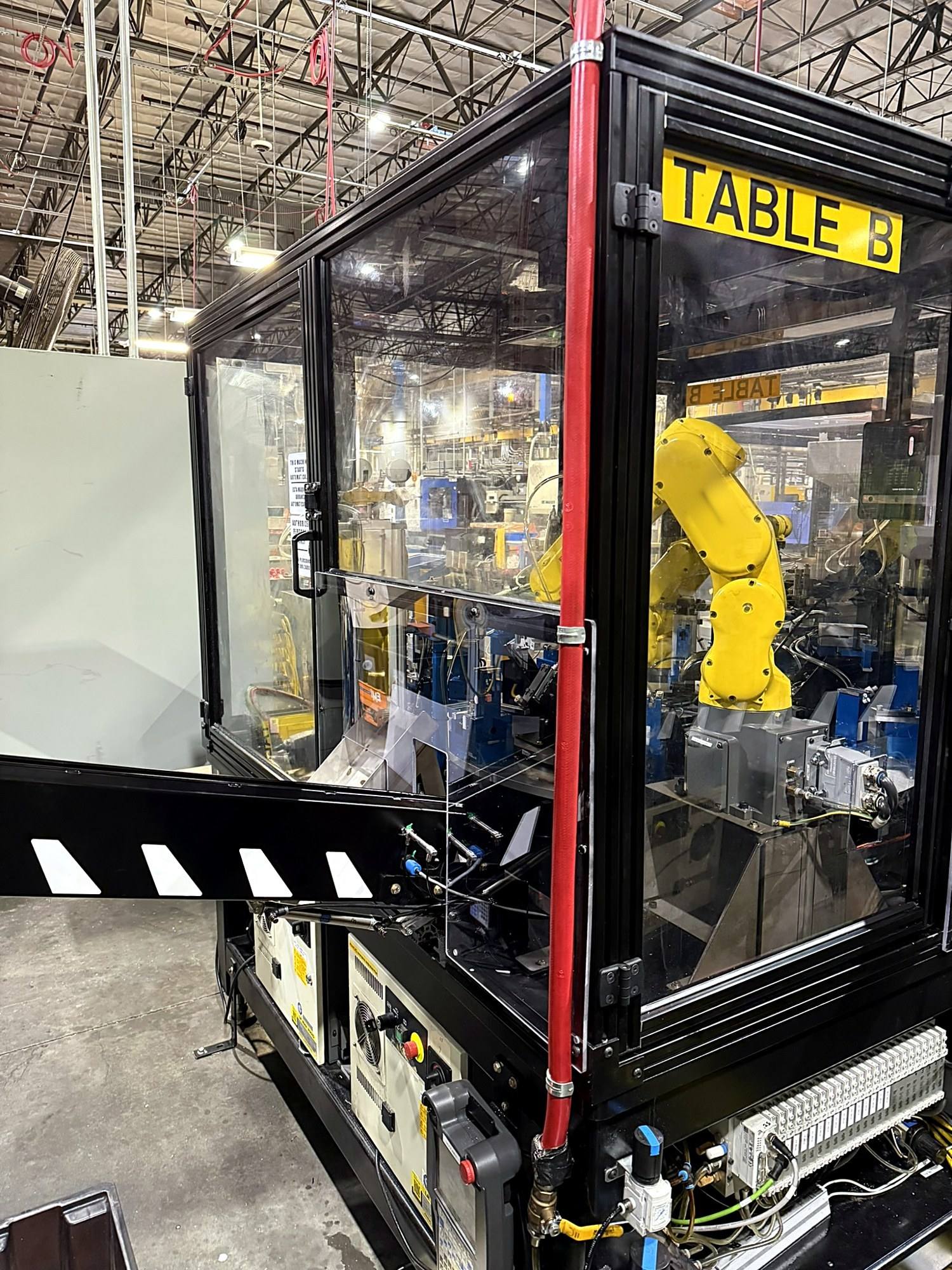
SAT: re-verify on your floor
- Every E-stop, door switch, light curtain and reset, tested again
- Stopping performance re-checked wherever guard distances depend on it, and safety settings compared with the FAT record
- Anchoring, level, and clearance to aisles, columns and forklift traffic
- Voltage and air pressure at the cell while it runs
- Handshake with the machines upstream and downstream, including a fault on each side
- Network and data connections, if the cell reports counts or faults to your systems
- Taught points, frames and vision calibration touched up for the final position
- A production run at the agreed rate on live product
- A changeover by your operators and a fault recovery by your maintenance tech
- Final program backups taken after any changes made during SAT
Open items and sign-off
Open items at FAT are normal. What matters is that each one is written down with an owner and a date, and that both sides agree which ones block shipping. A guard panel that needs a new cable slot can close on site. A light curtain that doesn’t stop the robot can’t.
Sign against the criteria agreed before the build. New ideas that come up while watching the cell run are worth raising, but log them as changes rather than failures, so cost and schedule get discussed in the open.
How acceptance works on a CalWest cell
Every cell we build is run off in our Fontana shop before it ships, then installed and commissioned on your floor. That is the last of the five steps we do under one roof, after design, fabrication, wiring and code. The frame, panel, gripper and code are made in the same building by one team, so a punch item found at the run-off goes back to the people who built that part. The build is described on robot cell design and build.
We do a risk assessment for each cell, and the run-off is a good time for your safety lead to see the doors, curtains and resets working. A passed test is not a compliance certificate, though. The robot safety standards guide explains what the 2025 standards ask for.
The stages around both tests, from the first video to handover, are on how we work. To talk through acceptance on a cell you’re planning, call or text (818) 397-4809, or send a video of the process to sales@calwestmfg.com.
Common questions
- Should we attend the FAT?
- Yes, if you can. Send the operator lead and the maintenance tech who will own the cell, plus whoever signs the acceptance. Watching the cell fault and recover teaches them more than a manual will, and asking for a change is cheapest while the cell is still in the builder's shop. For a cell we build, that means a trip to our Fontana shop before it ships.
- Can a cell pass FAT and still fail SAT?
- Yes. The usual causes are things the builder's shop couldn't reproduce: real signals from the machines on either side, the plant's incoming power, air and network, parts that vary more than the samples did, or connections loosened in shipping. That is why the SAT repeats every safety check and runs live production instead of leaning on the FAT result.
- Who writes the FAT and SAT procedures?
- Usually the builder drafts them from the agreed spec, and the buyer reviews and approves them before the build is finished. Who types the document matters less than when it is agreed. The pass criteria, the parts to run and the faults to cause should all be settled before test day, not negotiated in front of the cell.
- What parts should we send for the FAT?
- Production parts, enough for a proper run, and from more than one batch if you can. Include every variant the cell will handle and the parts your crew would call bad: burrs, crushed corners, slightly off dimensions, labels on the wrong side. A cell that only sees perfect samples in the builder's shop will meet the rest on your floor.
- What happens if something fails at the FAT?
- It gets fixed, and the failed items are tested again before the cell ships. On our cells the frame, panel, grippers and code are all made in our Fontana shop, so a failed item goes back to the people who built that part. A gripper finger that marks the part, for example, can be remachined on our own 5-axis and swapped the same week.
- Does passing FAT and SAT mean the cell meets the safety standards?
- No. Acceptance tests show the cell does what the spec says. Whether it is safe on your floor comes from a risk assessment of that cell, the safeguards chosen from it, and verification that they work, as ISO 10218-2:2025 and ANSI/A3 R15.06-2025 describe. We do a risk assessment for each cell we build, and your own safety professional should review it.
Sources
- IEC 62381:2024, Automation systems in the process industry: factory acceptance test (FAT), site acceptance test (SAT) and site integration test (SIT)
- ISO 10218-2:2025, Robotics, safety requirements, Part 2: Industrial robot applications and robot cells
- The Robot Report, A3 releases full three-part national safety standard for industrial robots
- ISO 13855:2024, Safety of machinery: positioning of safeguards with respect to the approach of the human body
- Drives & Control Solutions, Safety standard EN ISO 13855 for the positioning of safeguards
- OSHA, 29 CFR 1910.147, The control of hazardous energy (lockout/tagout)
- FANUC America, Dual Check Safety (DCS)