
Choosing between a delta robot, a SCARA and a 6-axis arm
Delta, SCARA and 6-axis robots do most light pick, place and assembly work. They move differently, and the part usually decides which one fits.
The choice usually comes up over one part at one station, with a delta robot and a SCARA as the first two candidates and a 6-axis arm often the third. The answer comes from the job: what the part weighs, where it comes from, where it goes and whether it has to be tilted on the way.
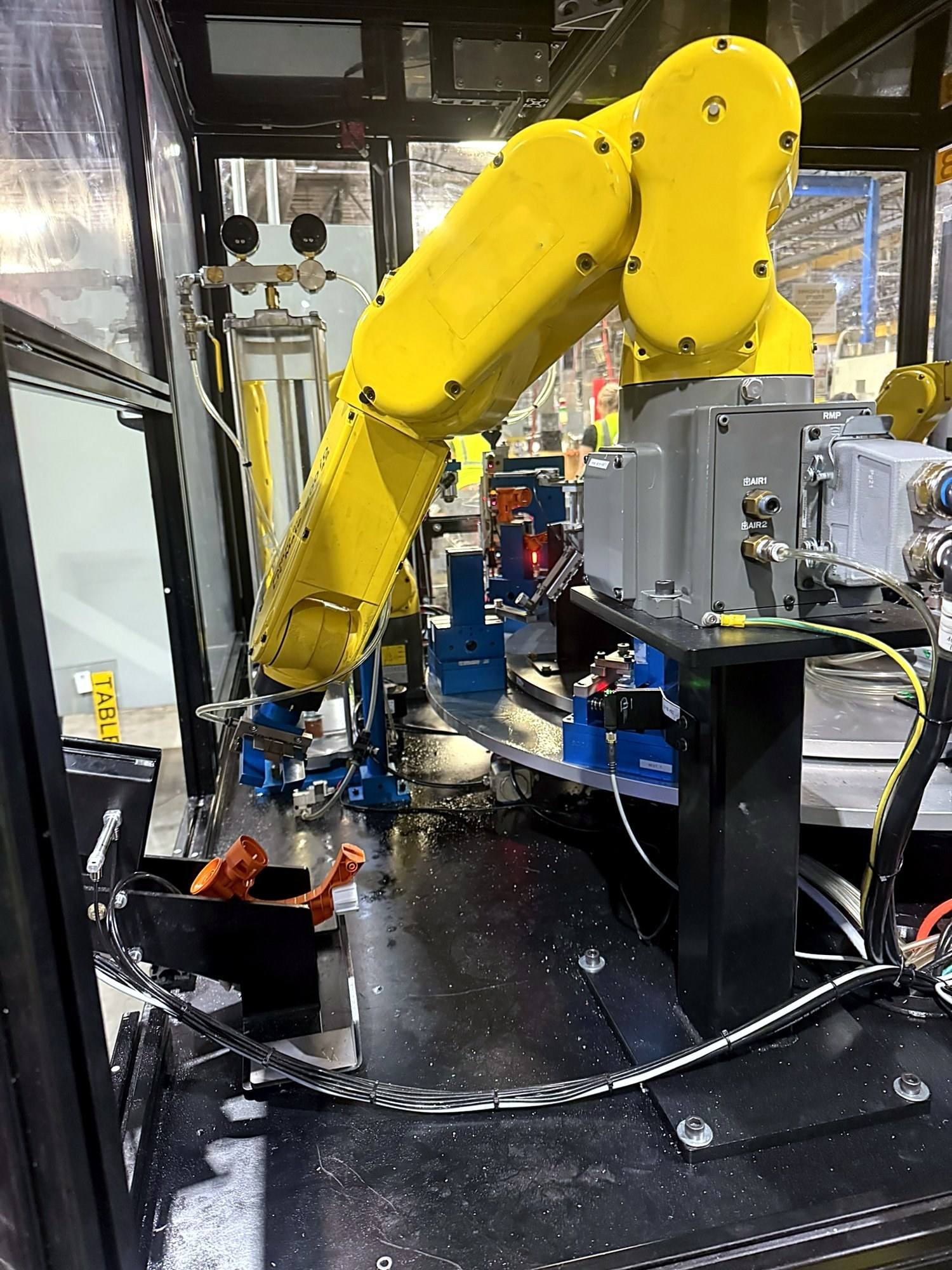
The cells shown here use FANUC delta robots and FANUC 6-axis arms, designed, built and programmed in our Fontana shop. FANUC is the only robot brand we integrate, and it makes all three types.
In short
How do delta, SCARA and 6-axis robots differ?
The difference is where the motors sit and how the links are joined. A delta keeps its motors in a base overhead and moves the tool with light parallel arms. A SCARA swings two arm links in a horizontal plane and moves the tool up and down on a vertical axis. A 6-axis arm is a chain of six rotary joints, with the motors carried along the arm. That layout decides what each robot can lift, how far it reaches and whether it can tilt the part.
| Delta | SCARA | 6-axis arm | |
|---|---|---|---|
| Axes | 3 or 4 on most models; FANUC also makes 6-axis deltas | 4 on most models; FANUC also makes 3-axis versions | 6 |
| Mounting | Hangs from a frame over the work | Floor, pedestal or wall beside the work; FANUC also makes an upside-down model (SR-3iA/U) | Floor, angled or upside down |
| Work area | Wide and shallow, under the robot | A ring around the base, with short vertical travel | Most of the space around the base, at any height in reach |
| Tilts the part | Not on 3- and 4-axis models | No | Yes |
| FANUC payload examples | Up to 1 kg (M-1iA), 8 kg (DR-3iB/8L), 12 kg (M-3iA/12H) | 3 to 20 kg (SR series) | 7 kg (LR Mate 200iD), 12 kg (M-10iD/12), 25 kg (M-20iD/25) and much larger arms |
| Usual jobs | Light picks off a moving belt into trays or cartons | Inserting, placing and short pick-and-place at a station | Machine loading, assembly that turns the part, heavy handling, drilling, welding |
The payloads are FANUC’s published ratings for the models named, and the gripper’s weight counts against them. A 1 kg product on a 0.6 kg gripper is a 1.6 kg load as far as the robot is concerned. Where that mass sits counts too. FANUC’s specs for arms such as the LR Mate 200iD also cap the moment and inertia at the wrist, so a long or offset gripper can overload it while still under the kg rating.
What are delta robots used for?
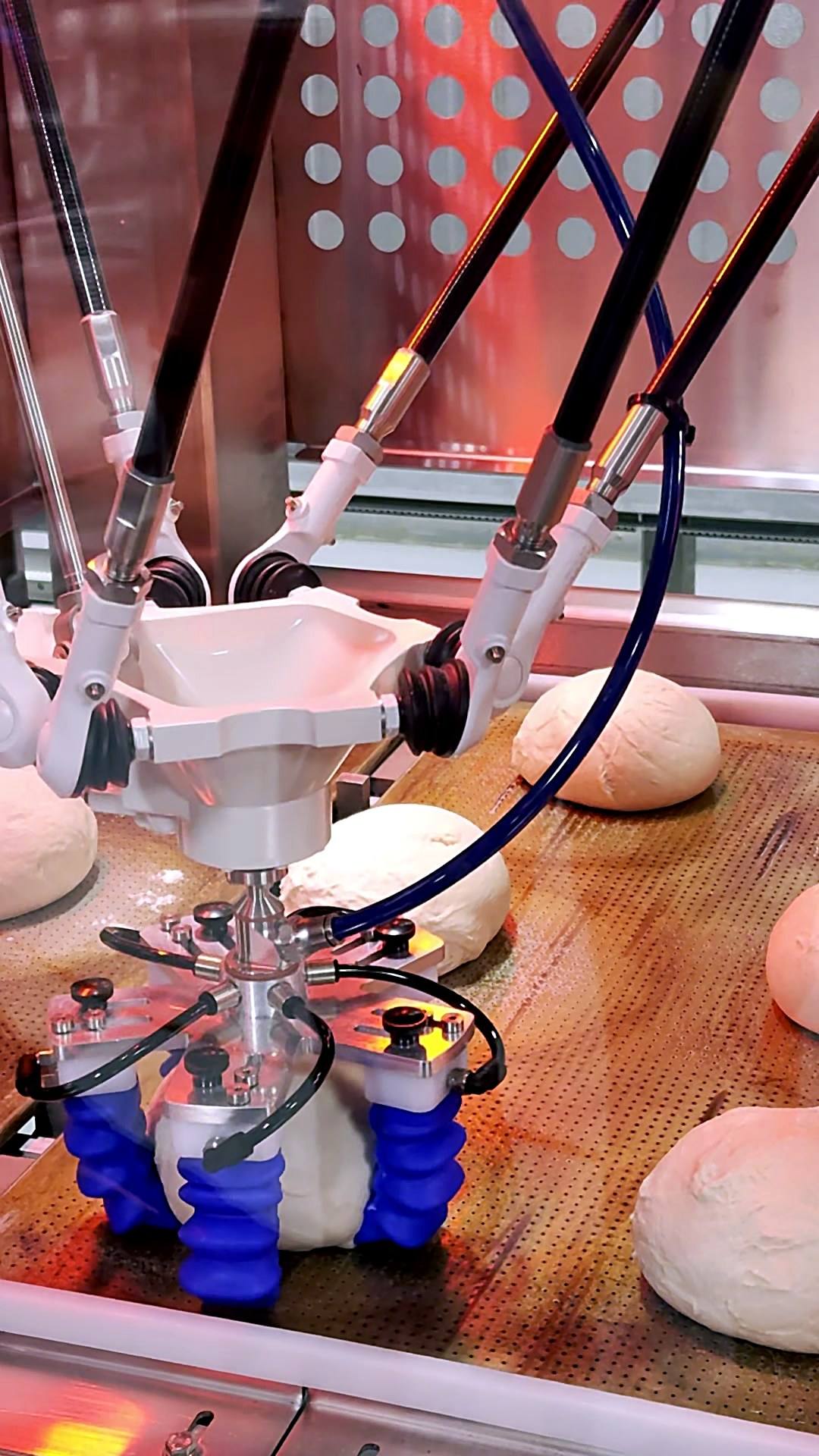
A delta robot has three arms hanging from a base. Each arm ends in a parallelogram of thin rods joined to a small platform under the robot, and the parallelograms keep that platform level as it moves in X, Y and Z. On most deltas a fourth motor turns a shaft down the middle to spin the tool. Reymond Clavel developed the design at EPFL in Switzerland in the 1980s, and it is built for fast, short moves with very little mass in motion.
That makes deltas the usual choice for picking light product off a moving belt and placing it into trays, cartons or thermoforms, or onto another conveyor. FANUC aims its small deltas at electronics, food, medical device and pharmaceutical work.
Our delta jobs are that kind of work. On a vision-guided tray loading line, a camera finds every part on a moving belt and two FANUC delta robots pick them and place them into trays, sharing the load. In our bakery automation work, deltas with soft-touch grippers move raw dough without marking it. The belt tracking behind that kind of line is covered step by step in our FANUC iRPickTool line tracking guide.
Delta robot disadvantages
Where deltas fall short:
- Small payloads. FANUC rates the M-1iA at up to 1 kg, the DR-3iB/8L at 8 kg and the M-3iA/12H at 12 kg, and the gripper’s weight comes out of each figure.
- A shallow work area. FANUC lists the DR-3iB/8L at 1,600 mm of horizontal reach and only 500 mm vertically. A tall carton or a stack of product is out of reach.
- Little control over orientation. A 4-axis delta can spin a part about the vertical axis and nothing else. FANUC does make deltas with a three-axis wrist, such as the 6 kg M-3iA/6A, for parts that need tilting.
- It needs a frame overhead. The robot hangs from a structure that has to be stiff enough that fast moves don’t shake it. That frame and the guarding around it are a real part of the build, which is why we fabricate them in the same shop as the rest of the cell.
- Random product needs vision. If parts land anywhere on the belt, the cell needs a camera, lighting, a belt encoder and tracking software to find and follow them, all calibrated to each other.
If you already know a delta fits, our delta robot pick and place page covers what goes into the cell.
When does a SCARA robot make sense?
None of the projects on this site use a SCARA, so this section sticks to how SCARAs work and where they tend to fit.
SCARA stands for Selective Compliance Assembly Robot Arm. The type came out of Yamanashi University in Japan in the late 1970s, for electronics assembly. It has two arm links that swing in a horizontal plane, like a shoulder and an elbow, a vertical axis that moves the tool up and down, and a fourth axis that spins the tool. The arm is stiff vertically and gives slightly sideways, so a pin being pressed into a hole can nudge itself into line instead of jamming.
The work area is a ring around the base with short vertical travel. A3 puts typical Z stroke at 100 to 300 mm. FANUC’s SR series runs from 3 to 20 kg of payload, with reach from 350 mm on the upside-down SR-3iA/U to 1,100 mm on the SR-20iA. The SR-6iA, for example, carries 6 kg at 650 mm on four axes, and FANUC offers iRVision and iRPickTool on it, the same FANUC vision and tracking software we set up on our vision-guided delta tray loading line.
SCARAs suit fixed-station work where the product comes to the robot in known spots: pressing pins or inserts, placing parts into nests or onto boards, and moving parts from a feeder to a fixture. They don’t suit parts that must be tilted, deep reaches into boxes or machines, or loads past the 20 kg of FANUC’s SR-20iA.
Delta robot vs SCARA on the same job
A delta hangs over the work and covers a wide belt. A SCARA usually stands beside the work and reaches in. When light product is spread across a moving belt and the job is pick and drop, the delta’s low moving mass tends to make it the better fit. A SCARA swings heavier links but is stiff up and down. When the work is at a fixed station, involves pressing a part down into place, or the building leaves no room for an overhead frame, a SCARA is the simpler machine. Either way, the number that counts is whether the robot keeps up with your line while carrying the gripper you need, not its top speed on a data sheet.
When do you need a 6-axis robot?
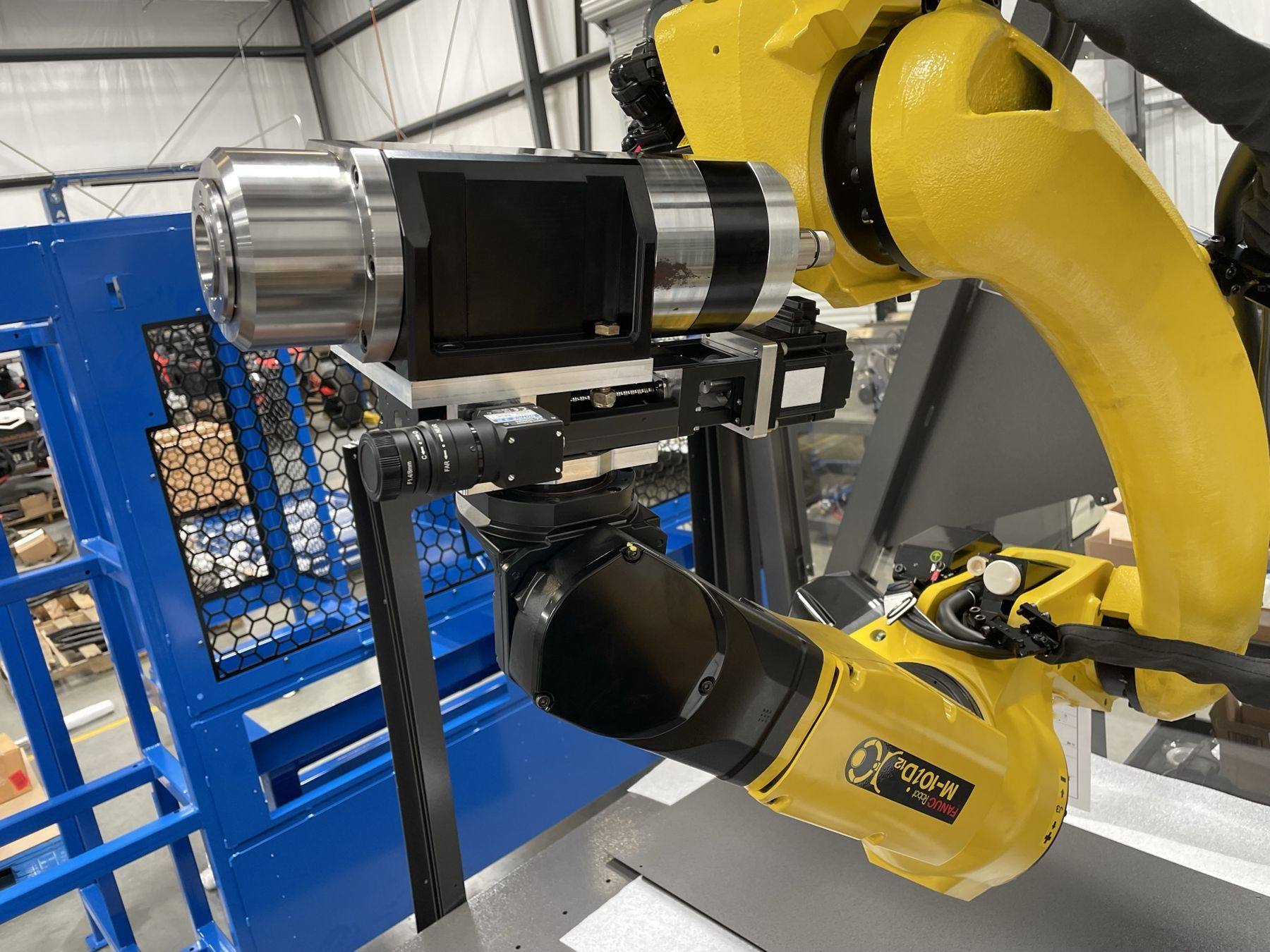
A 6-axis arm has a base that turns, a shoulder and elbow that reach, and a wrist with three more joints that roll, pitch and turn the tool. With all six working together, it can reach the same point from different angles. That lets it tip a part, turn a case over, load a machine through its door or come at a fixture from the side.
FANUC’s range starts small. The LR Mate 200iD carries 7 kg at 717 mm, the M-10iD/12 carries 12 kg at 1,441 mm and the M-20iD/25 carries 25 kg at 1,831 mm. All three can be mounted on the floor, at an angle or upside down, and far larger FANUC arms sit above them. Our 6-axis work covers that spread:
- LR Mate robots assembling spray nozzles at three guarded tables, fed by bowl feeders, with fingers machined in-house. The robotic assembly page covers that kind of cell.
- A robotic drilling cell that puts hundreds of holes in complex 3D parts, with a router head and tool changing, described on our robotic drilling and milling page. The robot in our build photos is a FANUC M-10iD/12.
- Larger FANUC arms on heavier work: palletizing robots at the end of packaging lines that pick, turn and place every case to the stack pattern. Our robotic palletizing page covers the case work.
That reach has costs of its own:
- Clear space around the arm. A 6-axis arm can reach up, down and behind itself, and the layout and guarding have to allow for everywhere the arm can go.
- Heavier moving parts. The arm carries its own motors, so on short, flat, light picks off a belt it usually falls behind a delta.
- Path programming. With six joints there is more than one way to reach a point, and paths have to avoid wrist singularities, positions where two wrist axes line up and the robot can’t move smoothly through. We write and tune these paths on our own floor before a cell ships.
SCARA vs 6-axis robot at an assembly station
If every move at the station is straight down, a SCARA covers it with fewer joints to program and maintain. If any step needs the part tipped, turned over or reached around a fixture, a 6-axis arm does it with one robot instead of adding a second mechanism. At the small end, payload rarely settles this one: FANUC’s SR-6iA and LR Mate 200iD are rated at 6 kg and 7 kg. The motion the part needs decides it. The fingers matter as much as the arm on these jobs, and our end-of-arm tooling page covers how we design them. When people will work right beside the arm, cobot vs industrial robot is the next question.
Which robot type does my job need?
Work through these questions in order. They narrow a job to a class of robot. The model comes later, from the payload and reach once the gripper is designed, and the price comes from the whole cell. Our robot cell cost breakdown explains what goes into that number.
-
Does the part have to tilt, turn over or go in from the side?
If yes, start with a 6-axis arm. Loading a machine through its door, setting a part into a fixture at an angle, or reaching into a box past its walls all need a wrist.
-
What do the part and the gripper weigh together?
The FANUC deltas named in this guide are rated from up to 1 kg (M-1iA) to 12 kg (M-3iA/12H), and FANUC's SCARAs from 3 to 20 kg. If the total comes close to the rating of the robot you have in mind, or goes over it, look at a 6-axis arm.
-
Is the product spread across a moving belt?
Light product arriving at random on a conveyor and going into trays or cartons, all in a flat, shallow area, points to a delta hung over the line.
-
Is the work at a fixed station, pressing or placing straight down?
Pins, inserts, parts into nests, feeder to fixture: that is SCARA work, as long as the vertical travel fits inside its short stroke.
-
How much room is there?
A delta needs headroom and a stiff frame over the line. A SCARA usually needs a solid pedestal, table or wall mount beside the work. A 6-axis arm needs the most clear space around it.
-
Does the cell get washed down?
FANUC sells food-grade or washproof versions of all three types, but their ratings differ, so this question narrows the model more than the class.
If a job doesn’t sort cleanly into one class, the answers to those six questions, the rate you need to hit and a photo of the area, ceiling included, are what we would ask for first.
Common questions
- Can a 6-axis robot do a delta robot's job?
- Often it can. A small 6-axis arm such as a FANUC LR Mate can follow a belt and pick light product off it. It moves more mass to do it, so on fast, flat, light picks it usually falls behind a delta, and it usually stands beside the line on the floor or a pedestal, where a delta hangs above it. A 6-axis arm makes sense on that job when the same robot also has to tilt parts or handle a second task.
- Do you build SCARA robot cells?
- FANUC is the only robot brand we integrate, and FANUC makes SCARA robots, the SR series. The cells shown on this site use FANUC delta robots and FANUC 6-axis arms, and none of the projects here uses a SCARA. If your job looks like SCARA work, we will still tell you which class of robot we would start with and why.
Sources
- A3 Automation Glossary: What are SCARA robots?
- A3 Automation Glossary: Delta robots
- A3 Automation Glossary: What is a six-axis robot?
- FANUC America: SCARA robots (SR series)
- FANUC America: SR-3iA/H 3-axis SCARA robot
- FANUC America: SR-3iA/U upside-down SCARA robot
- FANUC America: SR-6iA 4-axis SCARA robot
- FANUC America: SR-6iA/C food grade SCARA robot
- FANUC America: SR-20iA SCARA robot
- FANUC America: M-1iA series delta robots
- FANUC America: M-3iA/6A 6-axis delta robot
- FANUC America: M-3iA/12H 3-axis delta robot
- FANUC America: DR series food grade delta robots
- FANUC America: LR Mate 200iD
- FANUC America: LR Mate 200iD/7WP washproof robot
- FANUC America: M-10iD/12
- FANUC America: M-20iD/25