
FANUC robot models: how the families compare and which one fits
FANUC's lineup is easier to read by family than by model number. This guide groups the common ones, gives payload and reach from FANUC's own spec pages, and walks through how we pick a robot for a cell.
FANUC robot models come in families, and the family tells you more than the model number. An LR Mate is a small arm for bench-sized parts. An M-20iD is a mid-size arm that carries a real gripper across a cell. An M-410 is built to stack pallets. A delta hangs over a belt and picks light product fast. Once the family is right, picking the model inside it comes down to payload, reach and the wrist.
We build FANUC robot cells in Fontana, install them at plants across the US, and service and reprogram FANUC robots we didn’t build. FANUC is the only robot brand we integrate. The payload and reach figures here come from FANUC’s own product pages, which we checked in November 2026. Specs change, so confirm them on FANUC’s site before you design to them.
In short
How are FANUC robot models organized?
| Family | Type | What it’s built for |
|---|---|---|
| LR Mate | Six-axis, small | Small parts, machine loading, assembly, lab and bench work |
| M-10 | Six-axis, light to mid | Handling and assembly with a bigger gripper or longer reach than an LR Mate |
| M-20 | Six-axis, mid | Mid-size handling, machine tending, case handling |
| M-710 | Six-axis, mid to heavy | Heavier grippers and parts |
| R-2000 | Six-axis, heavy | Heavy handling and spot welding; FANUC lists the series at 100 to 270 kg |
| M-410 | Four- or five-axis parallel link | Palletizing; FANUC calls it a series designed specifically for palletizing |
| M-1, M-2, M-3, DR | Delta | Fast picking of light product, mounted overhead |
| ARC Mate | Six-axis, welding | Arc welding, with the torch cable run through the arm |
FANUC also makes SCARA, collaborative and very large robots that this guide leaves out.
FANUC robot comparison: payload and reach
Each model name links to the FANUC America page the figures come from.
| Model | Family | Max payload | Reach | Axes |
|---|---|---|---|---|
| LR Mate 200iD/4S | LR Mate | 4 kg | 550 mm | 6 |
| LR Mate 200iD | LR Mate | 7 kg | 717 mm | 6 |
| LR Mate 200iD/7L | LR Mate | 7 kg | 911 mm | 6 |
| M-10iD/12 | M-10 | 12 kg | 1441 mm | 6 |
| ARC Mate 100iD | ARC Mate | 12 kg | 1441 mm | 6 |
| M-20iD/25 | M-20 | 25 kg | 1831 mm | 6 |
| M-710iC/50 | M-710 | 50 kg | 2050 mm | 6 |
| M-410iC/110 | M-410 | 110 kg | 2403 mm | 4 |
| R-2000iC/165F | R-2000 | 165 kg | 2655 mm | 6 |
| M-410iC/185 | M-410 | 185 kg | 3143 mm | 4 |
| M-1iA series | Delta | Up to 1 kg | Work area up to 420 mm | 3, 4 or 6 |
| M-2iA series | Delta | Up to 6 kg | Up to 1130 mm | 3, 4 or 6 |
| M-3iA/12H | Delta | 12 kg | 1350 mm | 3 |
| DR-3iB/6 Stainless | Delta, washdown | 6 kg | 1200 mm | 4 |
For the delta robots, FANUC’s 2026 catalog gives the reach figure as the diameter of the work area (φ1350 mm for the 12 kg model, for example), not a radius from the base like the arms above it. The DR-3iB/6 axis count is from that catalog; the other figures are from FANUC America’s pages.
LR Mate vs M-10iA and M-10iD
The LR Mate 200iD and the M-10 series are the two lines people most often weigh against each other. FANUC lists the LR Mate 200iD at 7 kg, 717 mm and ±0.01 mm repeatability, with a 25 kg arm, an IP67 body and an IP69K option. It suits small parts: assembly at a bench, loading a small machine, picking from a feeder.
The M-10iD/12 carries 12 kg to 1441 mm, with ±0.02 mm repeatability and a 145 kg arm. That covers a bigger gripper, a longer reach into a machine, or a part that’s too heavy for an LR Mate once the gripper is counted. FANUC’s page for the older M-10iA/12 calls it a legacy product no longer in production, listed at 12 kg, 1420 mm and ±0.08 mm. Plenty are still running and can be serviced, but a new cell starts from a current model.
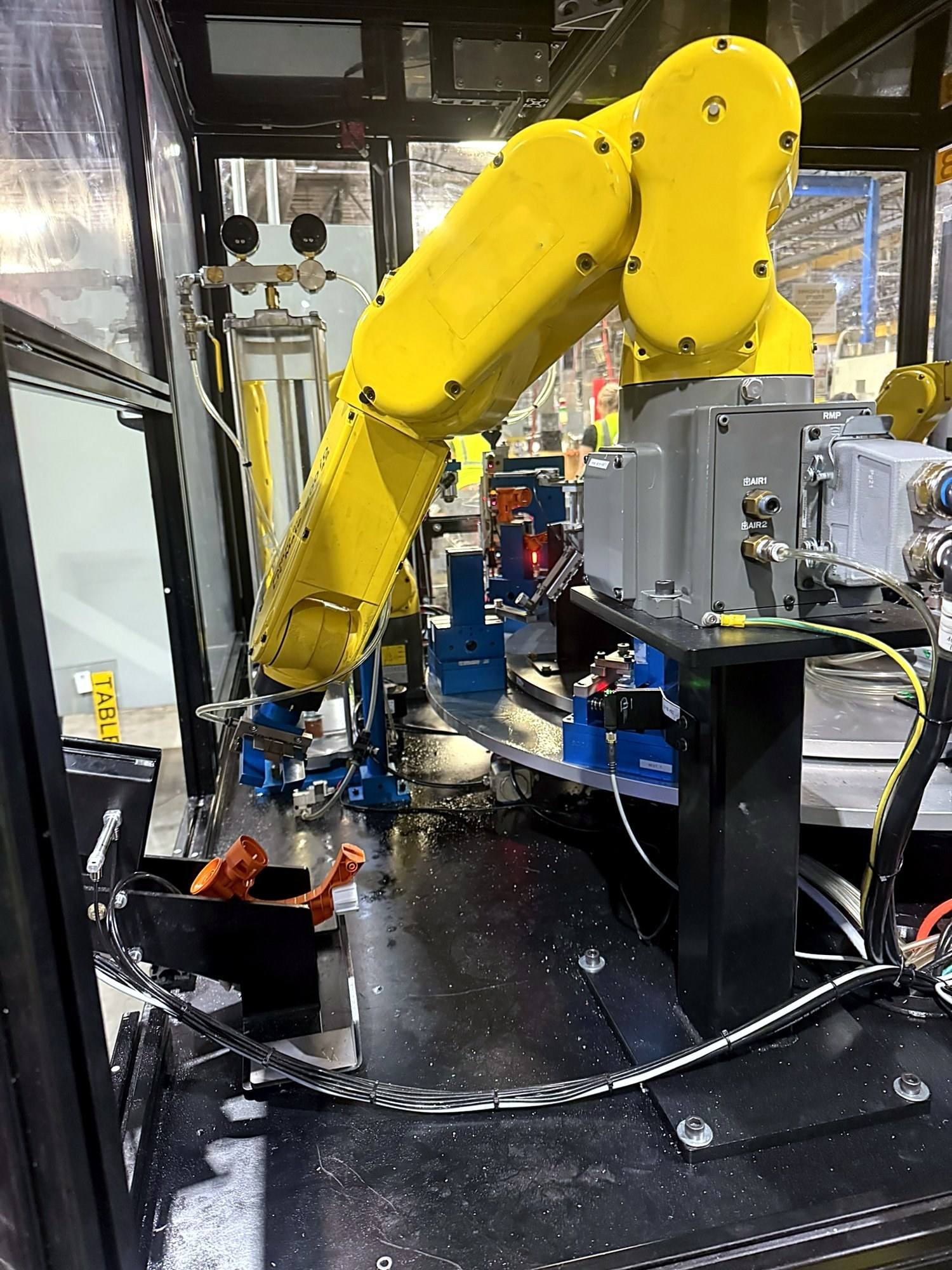
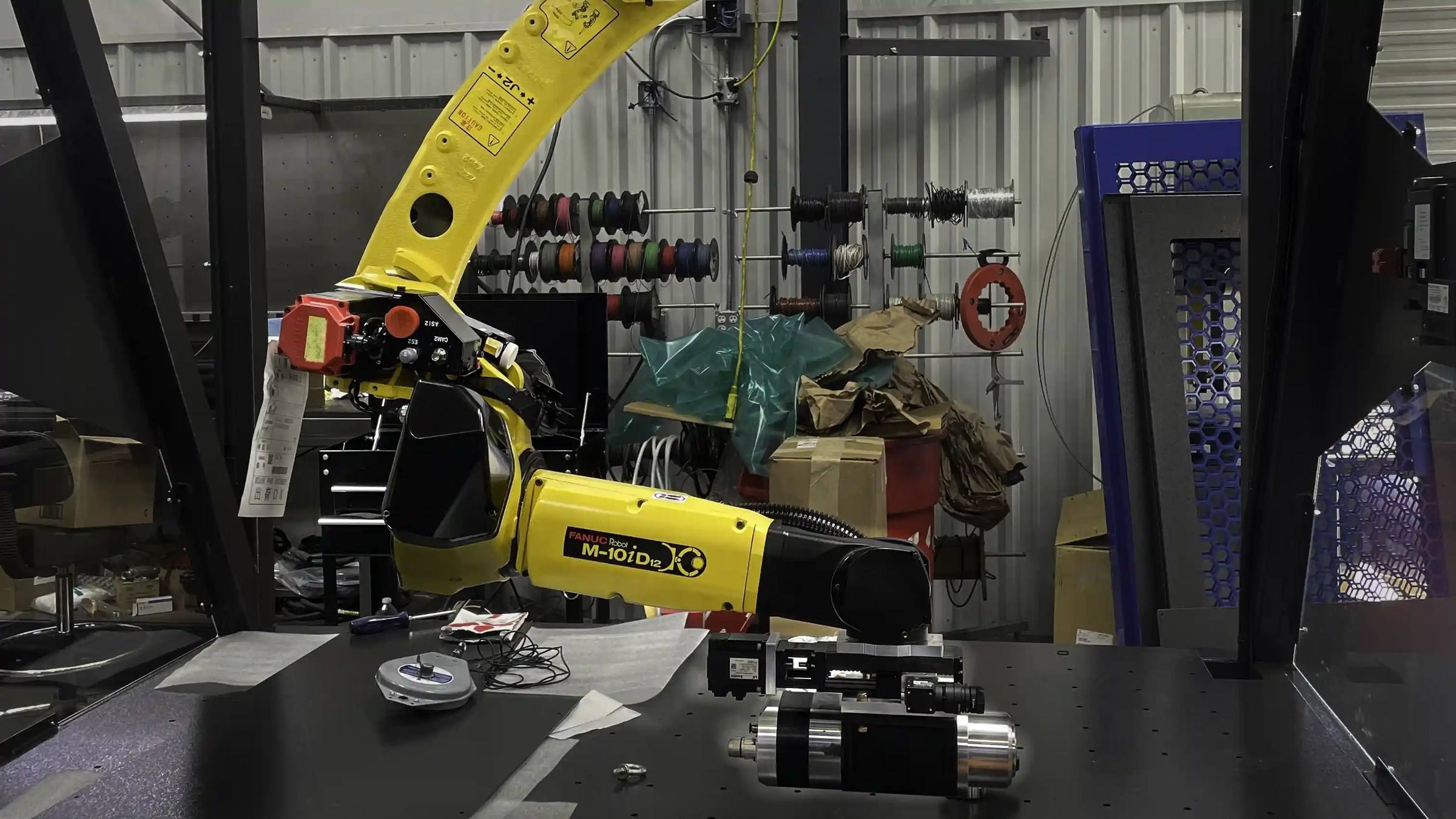
FANUC M-20iD specs and when to step up
FANUC lists the M-20iD/25 at 25 kg, 1831 mm and ±0.02 mm, with a 250 kg arm, floor, angle or inverted mounting, an IP54 body (IP65 optional) and an IP67 wrist. Its page also lists the wrist limits: 52 N·m and 2.4 kg·m² on J4 and J5, and 32 N·m and 1.2 kg·m² on J6. J1 turns through 340 degrees.
The M-20iD is where many handling jobs land, because 25 kg leaves room for a gripper that holds a real part. When the gripper and part together pass that, or the part sits far out from the wrist, the next steps are the M-710iC, listed at 50 kg and 2050 mm for the /50, and then the R-2000iC, listed at 165 kg and 2655 mm for the /165F.
Palletizing robots: M-410 or a six-axis arm
FANUC describes the M-410 as a four- or five-axis parallel link series designed specifically for palletizing, with reach up to 3.1 m on its series page. With four axes, the tool turns about a vertical axis but doesn’t tilt, which suits picking cases from above and setting them on a pallet. The M-410iC/110 is listed at 110 kg and 2403 mm, the M-410iC/185 at 185 kg and 3143 mm.
A six-axis arm can also palletize, and it’s the better choice when the case has to be tipped on the way, or the same robot does other work in the cell. The palletizing cells we built for a plant in Temecula use FANUC robots that grip each case off the line, turn it and swing it onto the pallet. Our robotic palletizing page covers those cells, and the FANUC palletizing programming guide covers the program side.
FANUC delta robots
Delta robots hang from a frame over the work and move the tool on light parallel arms. FANUC’s M-1iA series carries up to 1 kg over a work area up to 420 mm across. The M-2iA series carries up to 6 kg with a reach up to 1.13 m. The M-3iA/12H, a three-axis model for ceiling mounting, is listed at 12 kg and 1350 mm. For food plants, FANUC lists the DR-3iB/6 Stainless at 6 kg and 1200 mm, rated IP69K, with an NSF H1 food grade lubricant.
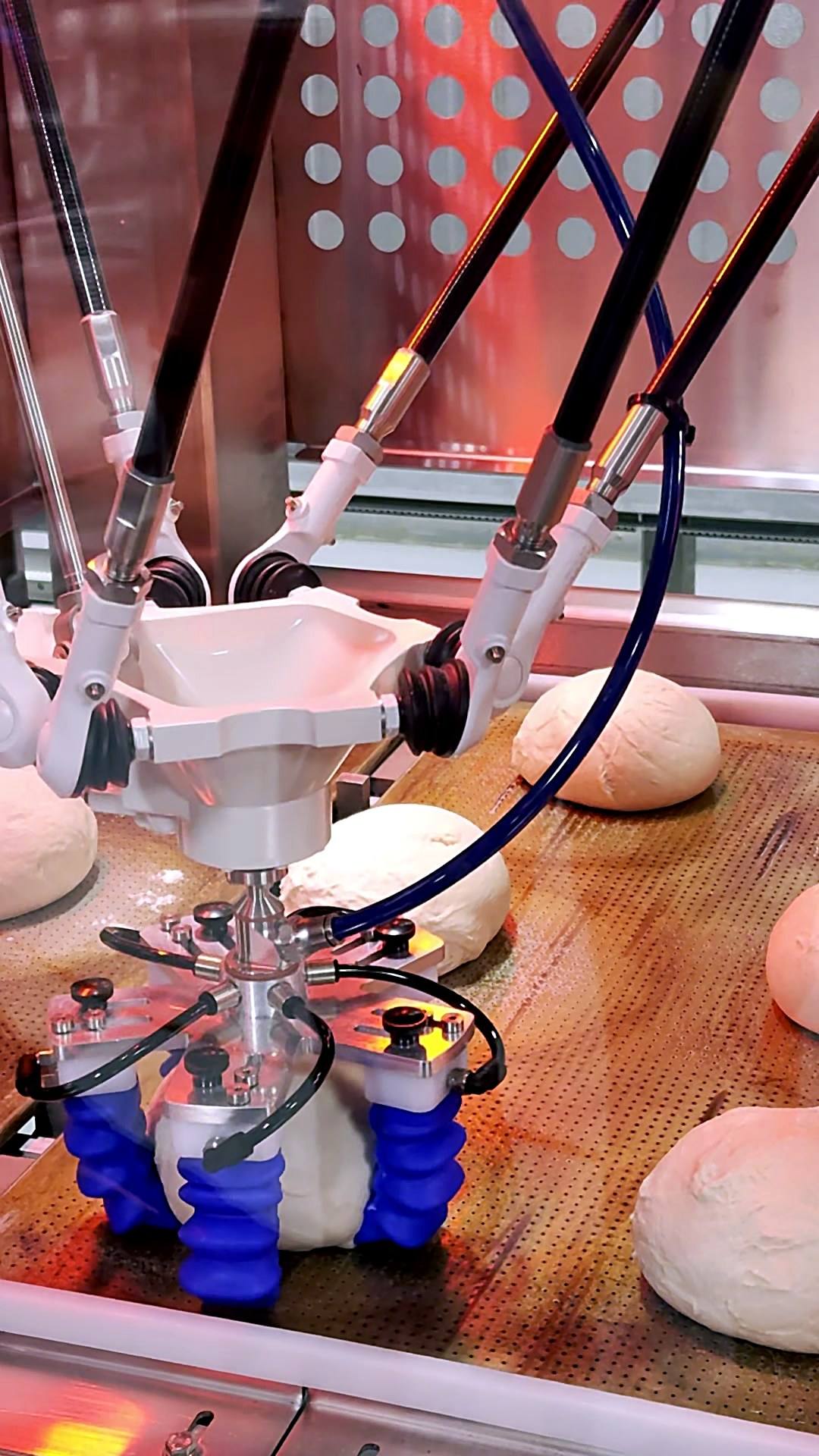
Our guide on delta vs SCARA vs six-axis robots covers when a delta is the right class at all, and delta robot pick and place covers the vision-guided lines we build.
ARC Mate for welding
The ARC Mate 100iD shares the M-10iD/12’s payload and reach, 12 kg and 1441 mm, but it’s built around the welding torch. FANUC lists a 57 mm hollow wrist and a 108 mm hollow J1 reducer, so the torch hose pack and sensor cables run inside the arm instead of hanging off it. Our robotic welding cells page covers the FANUC weld cells we design and teach in our shop.
New FANUC model names with the R-50iA controller
FANUC introduced a new naming format with its R-50iA controller. According to FANUC’s Tech Transfer, the new names show payload, mount type, reach, generation and application. FANUC’s 2026 general catalog uses it throughout: a 25 kg M-20 with 1831 mm of reach appears as M-20/25-18D, the same payload and reach as the M-20iD/25, and a 12 kg, 1441 mm M-10 appears as M-10/12-14D. If a quote or a nameplate shows a name in the new format, match it to the older name by payload and reach.
IP ratings: which FANUC robots handle dust and washdown?
FANUC lists the body and the wrist separately, because the wrist and J3 arm sit closest to the work and often carry a higher rating than the base. From the same product pages:
| Model | Body | Wrist and J3 arm |
|---|---|---|
| LR Mate 200iD | IP67, IP69K optional | IP67, IP69K optional |
| M-10iD/12 | IP54, IP65 optional | IP67 |
| ARC Mate 100iD | IP54, IP55 optional | IP67 |
| M-20iD/25 | IP54, IP65 optional | IP67 |
| M-710iC/50 | IP54, IP67 optional | IP67 |
| R-2000iC/165F | IP54, IP56 optional | IP67 |
| M-410iC/110 and /185 | IP54 | IP54 |
| DR-3iB/6 Stainless | IP69K rated | Not listed separately |
An IP rating describes the robot’s sealing, not whether it’s suitable for food contact. Food plants also care about lubricant, surface finish and what the cell around the robot is made of. Our food-grade cells use washdown-rated FANUC robots in stainless guarding; the food and beverage automation page covers what else changes on those cells.
Which controller comes with a FANUC robot?
FANUC America’s pages for the arms, palletizers and the M-3iA/12H in the table list the R-30iB Plus controller, in different cabinets. The LR Mate 200iD pairs with the compact R-30iB Plus Mate cabinet or its open-air version. The M-410iC and R-2000iC/165F list the larger A-cabinet and B-cabinet. The M-3iA/12H can run on a Mate, open-air Mate or A-cabinet. The cabinet affects floor space, room for extra I/O and where the controller can sit in the cell.
FANUC’s newer controller line is the R-50iA. Its page lists Mate, A and B cabinets, Python scripting, software PLC functions and third-party certification to the IEC 62443-4-1 and 4-2 cybersecurity standards, and FANUC’s 2026 catalog lists it as the matching controller for the models under the new names. Whichever controller a robot comes with, the options loaded on it, such as iRVision, line tracking or Dual Check Safety, matter as much as the arm. Our FANUC DCS guide covers the safety option.
Which FANUC robot do I need?
This is the order we work through when we choose a robot for a cell:
-
Weigh everything at the wrist
The heaviest part plus the gripper, adapter plate, tool changer, valves and anything else on the faceplate. That total, not the part weight, goes against the rated payload, with margin.
-
Check the wrist limits
Allowable moment and inertia on J4, J5 and J6. A long gripper or a part held far off the flange can exceed them well under the rated payload.
-
Check reach to every point
Measure to the tool center point, not the flange, at every pick, place and approach point, including the top layer of a pallet and the far side of a fixture.
-
Fix the mounting
Floor, angle, inverted or overhead, and the base or riser height. FANUC lists the allowed mountings per model.
-
Match the environment
IP rating, washdown, food grade lubricant and coolant or dust exposure. FANUC lists body and wrist ratings separately.
-
Choose the axes
Four axes for flat stacking, a delta for fast light picks from above, six when the part has to tilt or reach into something from the side.
-
Prove it in simulation
We lay out and check robot paths in FANUC ROBOGUIDE before they run on a real robot, which shows reach problems and tight spots before steel is cut.
Our FANUC payload setup guide covers the wrist arithmetic in more detail, and our end-of-arm tooling page covers the grippers that usually decide it.
FANUC models we’ve worked with
On the cells shown on this site we’ve used LR Mate robots in a multi-robot assembly cell, an M-10iD/12 in a robotic drilling cell, the M-20iD/25, FANUC delta robots for vision-guided picking and soft-touch dough handling, and washdown-rated FANUC robots in stainless food-grade cells, with R-30iB controllers, iRVision and iRPickTool. We design, fabricate, wire and program those cells in Fontana, ship them, and install them on the customer’s floor.
If you’re choosing a robot for a new cell, send us the part weight, a drawing or photo of the gripper idea and the layout through our contact page. If you already own a FANUC robot, our FANUC robot service and FANUC robot programming pages cover work on robots we didn’t build.
Common questions
- What is the difference between the LR Mate and the M-10iD?
- Size and load. FANUC lists the LR Mate 200iD at 7 kg and 717 mm of reach with ±0.01 mm repeatability, and the M-10iD/12 at 12 kg, 1441 mm and ±0.02 mm. The LR Mate suits small parts at a bench or machine. The M-10iD covers a larger area and heavier grippers. Both are six-axis arms that FANUC lists for floor, angle or inverted mounting.
- Is the FANUC M-10iA still made?
- FANUC America's page for the M-10iA/12 says it is a legacy product no longer in production. It lists 12 kg of payload and 1420 mm of reach. The current M-10iD/12 has the same rated payload, 1441 mm of reach and tighter listed repeatability. Existing M-10iA robots can still be serviced and reprogrammed, but a new cell would normally start from a current model.
- What do the numbers in a FANUC model name mean?
- On most current models the number after the slash is the rated payload in kilograms: an M-10iD/12 is a 12 kg robot and an M-410iC/185 a 185 kg palletizer. Letters after it mark variants, such as the longer-reach LR Mate 200iD/7L. With the R-50iA controller FANUC introduced a new format that also carries reach; its 2026 catalog lists a 25 kg, 1831 mm M-20 as M-20/25-18D.
- Which FANUC robots has CalWest worked with?
- The cells on this site use LR Mate robots in a multi-robot assembly cell, an M-10iD/12 in a robotic drilling cell, the M-20iD/25, FANUC delta robots for picking and dough handling, and washdown-rated FANUC robots in food-grade cells, along with R-30iB controllers, iRVision and iRPickTool. We also service and reprogram FANUC robots in cells we didn't build.
- Where do I find my FANUC robot's model and specs?
- The model name is printed on the arm and on the robot's nameplate. FANUC's product pages list payload, reach, repeatability, mounting, IP rating and, for many models, allowable wrist moment and inertia. The mechanical unit operator's manual for the exact model has the wrist load diagram and the full motion ranges.
Sources
- FANUC America: LR Mate 200iD/4S
- FANUC America: LR Mate 200iD
- FANUC America: LR Mate 200iD/7L
- FANUC America: M-10iD/12
- FANUC America: M-10iA/12 (legacy product)
- FANUC America: ARC Mate 100iD
- FANUC America: M-20iD/25
- FANUC America: M-710iC/50
- FANUC America: R-2000iC/165F
- FANUC America: M-410iC/110
- FANUC America: M-410iC/185
- FANUC America: M-410 palletizing series
- FANUC America: M-1iA series delta robots
- FANUC America: M-2iA series delta robots
- FANUC America: M-3iA/12H delta robot
- FANUC America: DR series food grade delta robots (DR-3iB/6 Stainless)
- FANUC: Robot General catalog, Robot_General(E)-05, 2026.4 (new model names, delta work area diameters, DR series axes)
- FANUC Tech Transfer: New Naming Convention for R-50iA FANUC Robots
- FANUC America: R-50iA robot controller series