
PLC vs robot controller: which one should run the cell
Every robot cell has a robot controller, and most have a PLC too. Deciding which one runs the sequence shapes how the cell is programmed, how it grows, and who can fix it at 2 a.m.
PLC vs robot controller is the first architecture decision in a robot cell. The FANUC controller always runs the robot’s motion. The open question is which device runs everything else: the sequence, the conveyors and feeders, the other machines, the operator screen and the fault handling. We write robot programs, PLC and safety logic and HMIs in-house for the FANUC cells we build in Fontana, CA, and this is how we think the decision through.
In short
What each controller is good at
The two devices overlap, but each was built for a different job.
| FANUC robot controller | PLC | |
|---|---|---|
| Built for | Motion: paths, frames, speed, payload, collision detection | Sequencing many devices and lots of I/O |
| Strong at | Vision picks, conveyor tracking, palletizing patterns, DCS position and speed limits | Conveyors, feeders, other machines, recipes, HMI screens, plant network |
| Programmed in | Teach pendant (TP) programs, background logic, KAREL | Ladder, structured text, function blocks |
| Who usually knows it | Robot programmers and robot-trained techs | Many plant maintenance and controls techs |
| Online troubleshooting | Pendant screens, I/O status, alarm history | Live logic view in the PLC software |
Neither column is the better controller. The question is which one should own the parts of the cell that aren’t robot motion.
Robot-centric cells: the robot as master
In a robot-centric cell, the FANUC controller runs the sequence. The TP program waits on sensors, opens and closes the gripper, signals a machine tool, and decides what to do next. Simple status and I/O mapping can run in FANUC background logic, which scans alongside the main program.
FANUC also offers options that move more of the cell into the robot controller. Integrated PMC adds sequence control inside the controller, programmed in ladder, step sequence or function blocks, and FANUC says it removes the need for separate PLC hardware. The EtherNet/IP scanner option lets the robot control remote I/O blocks and other devices on the network. On the new R-50iA controller, FANUC adds a software PLC function based on CODESYS that runs alongside the built-in PMC.
This works well for a single robot tending one machine, a pick and place with a few sensors, or a cell where the robot is the only thing that moves. It gets harder when:
- Conveyors, feeders and other machines join the cell, each with its own faults and timing.
- A second robot needs to share work or space with the first.
- Your maintenance crew knows ladder logic but not TP programs or PMC.
- The plant wants the cell on its network with an HMI matching the other lines.
PLC-centric cells: the PLC as master
In a PLC-centric cell, the PLC runs the sequence and treats the robot as one more device. It tells the robot which task to run, starts it, and waits for a done signal. The robot handles the motion and reports its state: ready, running, paused, faulted, at a safe position.
A FANUC robot does this as an EtherNet/IP adapter. FANUC describes the adapter option as letting the controller act as a standard EtherNet/IP device for PLCs, HMIs and cell controllers. The PLC reads and writes a block of robot I/O every cycle, including the UOP signals for enabling, selecting and starting programs. Our guide to FANUC EtherNet/IP with Allen-Bradley walks through the setup.
This is the common layout for cells with conveyors, feeders, more than one robot, or signals to the rest of a line. Its costs are more hardware and two programs that have to agree with each other. The handshake design matters more than in a robot-only cell.
How the PLC and robot should talk
A handshake is a short agreement for each step. A typical one goes like this:
- The PLC checks that the robot is ready and in a safe position, and that the part is present.
- The PLC sends a task number and a request bit.
- The robot acknowledges, runs the task, and sets a done bit, plus any result such as part picked or part missed.
- The PLC sees done, clears the request, and the robot clears done.
A few rules keep this from becoming a troubleshooting job later. Only one side decides each thing: the PLC decides what happens next, and the robot decides how to move. Every wait has a timeout with a fault message the operator can read. Signal names and comments match on both sides, and the I/O list is written down. The safety signals are never part of this exchange.
Where safety logic lives: safety PLC, relays and DCS
Safety functions are separate from the sequence, whichever device runs the cell. They come out of a risk assessment, and each one has to meet the performance level the assessment calls for. In the US, ANSI/A3 R15.06-2025 sets the requirements for robot cells.
- Safety relays or a safety PLC handle the cell’s E-stops, door interlocks, light curtains and area scanners. A safety PLC, such as an Allen-Bradley GuardLogix, runs certified safety logic next to the standard program in one controller.
- The robot controller has its own E-stop and safety inputs, which the cell’s safety circuit drives.
- FANUC DCS watches the robot’s position and speed on redundant safety processors and removes motor power if a programmed limit is crossed. It limits where the robot can go, which a door switch can’t do.
The safety PLC and the robot can be tied together with hardwired safety signals, or over CIP Safety on EtherNet/IP. FANUC’s walkthrough for connecting an R-30iB Plus to a Rockwell safety PLC lists software option R713, which includes DCS Safe I/O Connect. We write and test safety PLC programs in-house. Your own safety professional should review the risk assessment.
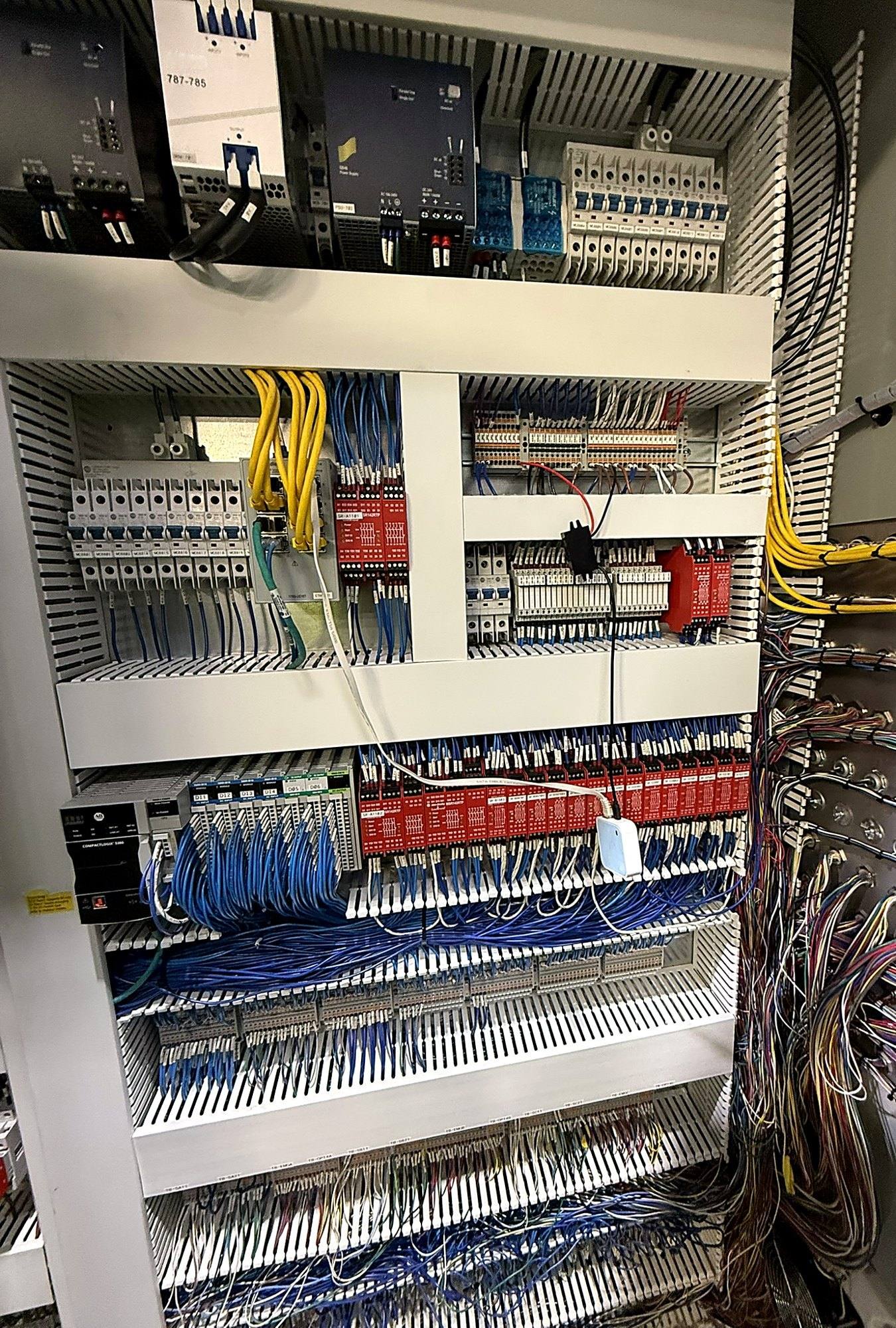
Which design is easier for your crew to maintain?
The cell will be fixed by whoever is on shift when it stops. If your maintenance team lives in Studio 5000 or TIA Portal, a PLC-centric cell lets them watch the sequence live in software they know, and the robot becomes one device with a clear set of signals. If the plant has robot-trained techs and few PLCs, a robot-centric cell may be the simpler machine to own.
Match the plant’s standard. A cell on an Allen-Bradley PLC in an Allen-Bradley plant, or a Siemens PLC in a Siemens plant, uses spare parts and software the crew already has. Put fault text on the HMI in plain words, and say on each fault which device raised it.
A rule of thumb
| The cell | Usually runs the sequence |
|---|---|
| One robot, one machine, a few sensors | Robot controller |
| One robot plus conveyors or feeders | PLC |
| Two or more robots sharing work | PLC |
| A cell tied into a line, MES or ERP | PLC |
| The plant has a PLC standard and a controls team | PLC |
| A robot-trained crew and no PLC standard | Either, by the crew’s skills |
These are starting points, not rules. A palletizer with one robot, its own conveyors and a pattern library might run on the robot for one plant and on a PLC for another.
On the turnkey robot cells we build, we write the robot program, the PLC and safety logic and the HMI in-house, so both sides of every handshake are designed together, on Allen-Bradley or Siemens to match your plant. If you’re weighing the two for a cell of your own, send the process through our contact page.
Common questions
- Can a FANUC robot run a cell without a PLC?
- Yes, for simpler cells. The robot program can handle the sequence, the controller has its own I/O, and FANUC offers options such as Integrated PMC, which adds ladder, step sequence and function block programming inside the robot controller, and an EtherNet/IP scanner option to control remote I/O. Safety devices still need a safety circuit designed from a risk assessment. As the cell adds machines, a separate PLC usually becomes easier to maintain.
- Should the PLC or the robot be the master?
- In most cells with conveyors, feeders, other machines or more than one robot, the PLC runs the sequence and the robot is told which task to run and reports when it is done. With a single robot and a handful of sensors, the robot can run the cell itself. Your maintenance crew's skills and your plant's PLC standard should weigh as much as the technical fit.
- Does FANUC DCS replace a safety PLC?
- No. They do different jobs. DCS watches the robot's own position and speed and removes motor power if a limit is crossed. A safety PLC or safety relay handles the cell's E-stops, door switches, light curtains and other safety devices. Many cells use both, connected by hardwired safety signals or by CIP Safety over EtherNet/IP. The risk assessment decides which safety functions each one carries.
- How do a FANUC robot and an Allen-Bradley PLC communicate?
- Usually over EtherNet/IP, with the robot as an adapter to the PLC's scanner. The robot's digital inputs and outputs and its UOP signals are mapped to a block of data the PLC reads and writes every cycle. The PLC selects and starts programs through UOP, and the two exchange handshake bits for each step. Safety signals travel separately, hardwired or over CIP Safety.
Sources
- FANUC America: EtherNet/IP Adapter and Scanner options
- FANUC America: FANUC-powered Integrated PMC
- FANUC Corporation: Software PLC function for the R-50iA controller (CODESYS, IEC 61131-3) alongside the built-in PMC
- FANUC America: Dual Check Safety (DCS), Position and Speed Check
- FANUC Tech Transfer: Configure R-30iB Plus EtherNet/IP Safety to a Rockwell Automation PLC using the Add-On Profile (option R713)
- The Robot Report: A3 releases full three-part national safety standard for industrial robots (ANSI/A3 R15.06-2025)