
What robotic integrators do, and how to choose one
The questions to ask before you sign, in the order a cell gets built, and what a complete answer sounds like. We build FANUC cells in Fontana, and these are the questions we'd put to anyone quoting one, us included.
A plant buying its first robot cell usually has two questions: what do robotic integrators do, and how do you pick one? Both come down to who is responsible for each part of the cell, and that is worth knowing before the purchase order goes out.
In short
What is a robot integrator?
A FANUC robot arrives as an arm, a controller and a teach pendant. It comes without a gripper or a program, and it has to be taught where your parts are. Everything that makes it do a job on your line is the integrator’s work. If the terms on a quote are new to you, our robotics glossary defines them.
The safety standards draw the same line. In A3’s summary of the 2025 standards, ISO 10218-1 sets requirements for the companies that make industrial robots, and ISO 10218-2 sets requirements for the system integrators who build robot applications and robot cells. The application covers more than the arm. It includes the workpieces, the task program, and the machinery and equipment that support the job.
A cell breaks down into the pieces below. Any of them can be done in-house or bought from a subcontractor, and a quote rarely says which. It’s worth finding out, because whoever made a piece is who you’ll need when it has to change.
| Piece of the cell | What it covers |
|---|---|
| Cell design | Layout, robot reach and payload, clearances, guarding and maintenance access, usually modeled in 3D CAD |
| Frame and guarding | Robot base, fixture tables, fence panels and doors |
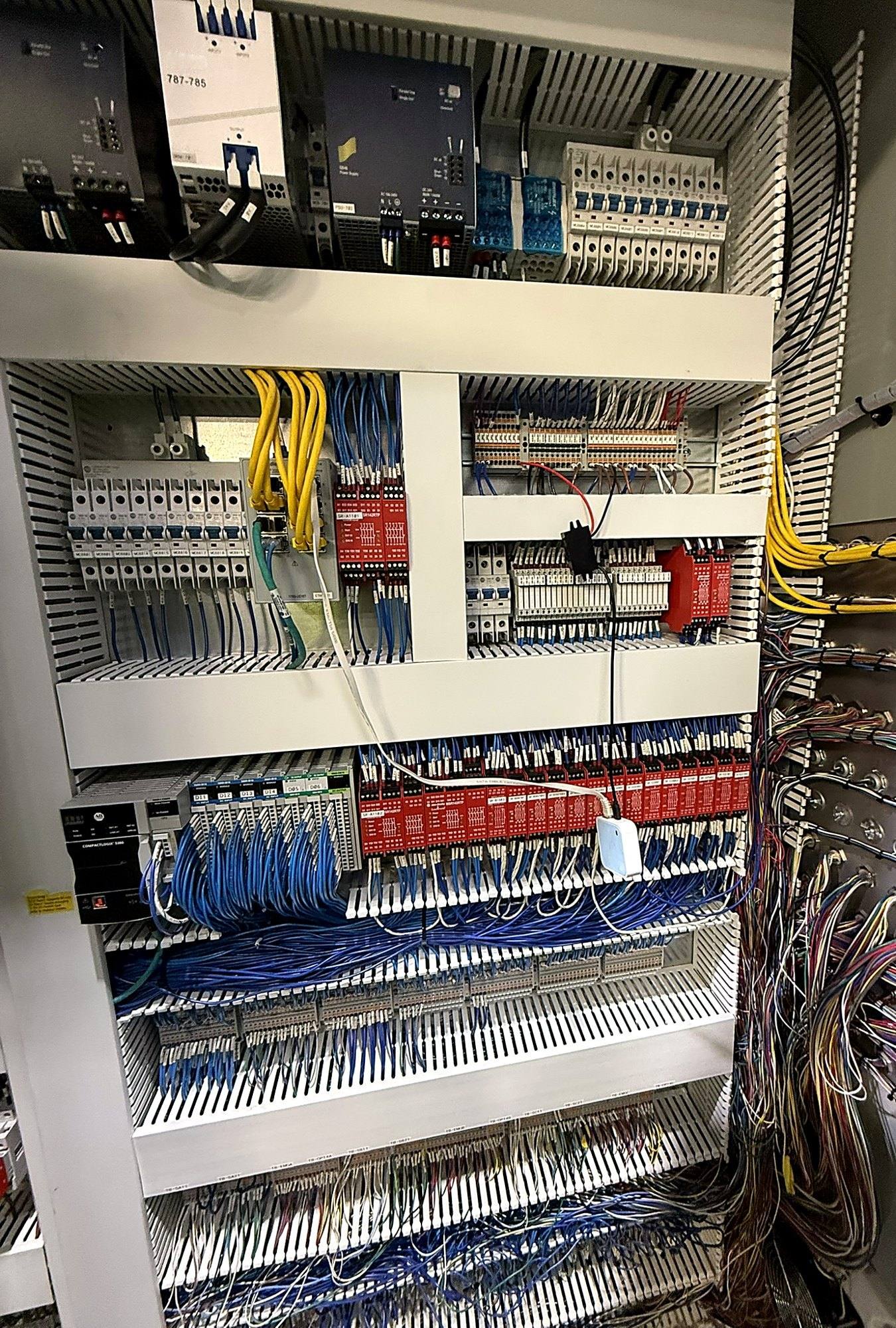
| Control panel | PLC, safety devices, power distribution, wiring to the robot controller and field devices |
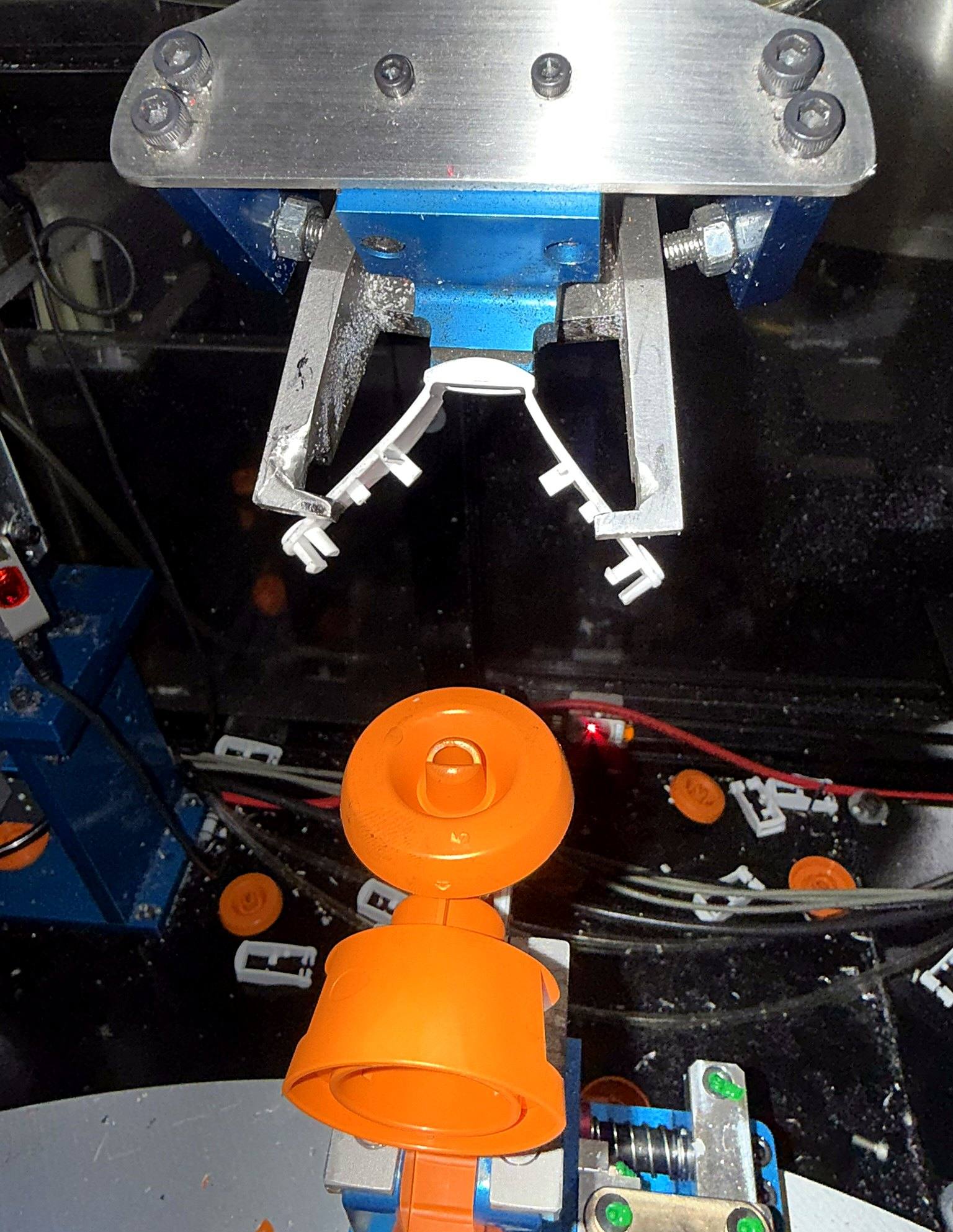
| Gripper | The end-of-arm tool: fingers or vacuum cups and the body that carries them |
| Robot program | Paths, pick and place logic, vision, conveyor tracking |
| PLC and safety logic | Sequencing, interlocks, fault handling, signals to the machines upstream and downstream |
| HMI | The operator screens |
| Run-off and install | Testing the cell before it ships, then commissioning it on your floor |
For our turnkey robot cells, every row has the same answer. We design, fabricate, wire and program each cell in our own shop in Fontana, run it off there, and commission it on your floor. The robot cell design and build page walks through those five steps. To choose a robot integrator, ask about each piece in the order the cell gets built.
Can you talk to a customer they built for?
Before the build questions, ask whether the integrator has built something like your job: a similar part, a similar move, a similar rate. Then ask for a reference on that application. Hearing from a plant that runs one of their cells tells you more than a list of past work.
Many integration jobs are covered by an NDA, so an integrator may not be able to give you a customer’s name or phone number. That is normal, and there are fair substitutes: photos or video of the actual cell running, a call the integrator sets up with the customer’s permission, or watching one of their cells run off in their shop. A rendering or an animation doesn’t count.
We don’t publish our customers’ names. Our project pages show photos and footage of cells we designed and built, and you can attend your own cell’s run-off in our Fontana shop before it ships.
Who designs the cell, and in what software?
Ask to see the model, not only a layout sketch. A full 3D model shows whether the robot reaches every pick and place point, whether the gripper clears the fixture, where the guarding and doors go, and whether a maintenance tech can get to a motor without pulling half the fence. Fixing a clash in the model takes an edit, while the same fix after the frame is welded means cutting and welding new steel.
Ask who checks the robot size. The robot has to carry the gripper and the part together, and a long or heavy tool can push a job to a bigger arm even when the part itself is light. That check belongs in the design, before the robot is ordered.
A complete answer names the software, the person doing the design, and when your team gets a design review. We model the full cell in SolidWorks and prove it there before any steel is cut.
Who builds the frame and guarding?
The frame, robot base, fixture tables and fence are the most visible part of a cell, and often the part bought from an outside fabricator. That can work fine. Ask where they are built, and who makes the change when something has to move after the design review: a door on the wrong side, a pass-through for a bin, a bracket for a sensor.
Our frames and guarding are cut, bent and welded in the same Fontana shop by our parent company, CalWest Manufacturing, which does tube and plate laser cutting, CNC tube bending, press brake forming, welding and 5-axis machining. Laser-cut guarding gives the cell a clean, OEM-style finish, and a change goes back through the shop that made the original part.
Who builds and wires the control panel?
The control panel holds the PLC, the safety relays or safety PLC, power distribution, and the terminals that tie the robot controller, sensors, light curtains and door switches together. When the cell faults on second shift, this is where maintenance ends up with a meter, so the drawings and the wire labels matter as much as the parts inside.
Ask who builds and wires it, and whether that happens in-house or at a panel shop. If it’s a panel shop, get its name and find out who you call about the panel after install. Ask what it is built to. NFPA 79 is the NFPA’s electrical standard for industrial machinery, and UL 508A is UL’s standard for industrial control panels; shops in UL’s panel shop program can apply the UL mark to panels they build. If your plant or local inspector requires a listed panel, put that in the RFQ and ask every integrator quoting the job to answer it in the quote. Then ask for as-built schematics, updated after the last change at commissioning.
We build, wire and test our control panels in our shop, before the cell is run off.
Who writes the robot, PLC and HMI code?
A cell usually runs three programs: the robot program on the FANUC controller, the PLC and safety logic, and the operator screens on the HMI. Ask who writes each one, by name. Where a contractor writes a piece, ask how that contractor is reached after the job closes.
Ask which PLC platform the cell will use. If your plant standardizes on Allen-Bradley or Siemens, the cell should match, so your maintenance team works with software and spare parts it already has. Ask whether any part of the robot, PLC or HMI program will be locked or password-protected, and get the answer in writing.
The HMI deserves its own question, because it is the part of the code your operators see all day. Ask to see screens from a past job. Good screens are written for the crew who will run the cell. On a set of LR Mate assembly tables we built, the operator screen shows cycle times for each table, color changeover and fault status.
Ask which robot brands the integrator programs day to day, since robot software, vision tools and spare parts differ by maker. We integrate FANUC only, as a FANUC Authorized System Integrator. Our cells have used robots from the LR Mate and FANUC delta robots up to the larger FANUC arms on our palletizing cells, with iRVision and iRPickTool for vision picks and conveyor tracking. We write the robot programs, the Allen-Bradley or Siemens PLC and safety logic and the custom HMI screens in-house.
Can they change the gripper in-house, and how fast?
Of everything in the cell, the gripper is the piece most likely to change. A new part variant shows up, a finger marks the part, a vacuum cup won’t seal on a textured surface, or a pick that worked in the builder’s shop misses on your line. Ask who designs and makes the gripper, and how long a finger change takes from the day you call.
The bought parts on a gripper, such as vacuum cups, valves and soft-touch fingers, come from component makers, and your maintenance team should be able to reorder them. The fingers and the body that carries them are usually custom. We design ours with the rest of the cell and machine them on our own 5-axis, so a gripper can be changed the same week. Our end-of-arm tooling page has more on how that works.
Where is the run-off held, and can you attend with your parts?
The run-off, or factory acceptance test (FAT), is the formal test of the whole cell in the builder’s shop before it ships, and it is usually your first chance to see the cell run. Ask where it happens, whether you can attend, and whether it runs your production parts. Send the marginal parts your crew still runs along with the clean ones, and parts from more than one batch, so the cell sees what your line will actually feed it.
Ask what counts as a pass, and get it written down before the build starts: the rate, each changeover, fault recovery, every guard door and E-stop. A pass defined on the day of the run-off tends to be whatever the cell happens to do that day.
We run off every cell in our Fontana shop before it ships. How we work covers what happens at the run-off and at the site acceptance test on your floor.
Which safety standard edition do they design to?
OSHA has no standards written specifically for robots, so the detail comes from consensus standards. In the US the main one is ANSI/A3 R15.06-2025, which adopts the 2025 editions of ISO 10218-1 and ISO 10218-2. It replaced the 2012 edition and changed a lot, so a quote that says only “designed to R15.06” doesn’t tell you much.
Ask which edition the integrator designs to, and who does the risk assessment. One common method is the task-based one in RIA TR R15.306-2016: list each task a person does at the cell, from normal operation to clearing a jam to maintenance, and the hazards that come with it. The guarding follows from that. We do a risk assessment for each cell we build, and the LR Mate assembly tables mentioned above are interlocked and light-curtained. Whoever builds your cell, have your own safety professional review the design. Our guide to robot safety standards covers what changed in 2025 and what OSHA asks for.
What do you get at handover?
Your maintenance team keeps the cell long after the project closes, and what they work from is the paperwork and the files. Settle the list before the PO.
Handover list to put in the RFQ
- Electrical schematics, as built
- Bill of materials and a recommended spare-parts list
- A full backup of each FANUC robot controller, plus the robot programs, vision setups and source files for any KAREL programs
- PLC and HMI project files, with any locked routines named
- I/O list and network addresses
- The risk assessment and the test records for each safety function, including FANUC DCS settings where the cell uses DCS
- Operator and maintenance instructions
- Training for the operators and for the maintenance tech who will own the cell
A full controller backup lets you restore a robot after a hardware failure without rebuilding its programs from scratch. The PLC and HMI project files let your own people, or another integrator years from now, change the cell without starting over. KAREL programs load onto the controller in compiled form, so the backup alone does not include their source.
What happens after install?
Ask who you call when the cell faults, what hours that covers, and what happens outside them. Ask how the warranty is split between the FANUC robot and the rest of the cell. If your plant runs nights or weekends, say so before the quote so support is agreed rather than assumed. If the integrator’s shop is a long way from your plant, ask how install and service visits will work; our page on how we work with plants far from Fontana explains our approach.
Our hours are Mon–Fri 7:00am – 3:45pm, and you can call or text the robotics line at (818) 397-4809. The same team designed, built, wired and programmed the cell, so your call reaches people who know it.
Questions to ask a robot integrator: a scorecard
Print this page, or copy the table into a spreadsheet with a column for each integrator you’re talking to, and fill it in on the call.
| Question | A complete answer names |
|---|---|
| Have you built something like this, and can we see it run or talk to that customer? | A similar job, and photos, video or a customer call that shows it running |
| Who designs the cell, and in what software? | The CAD package, the designer, and a design review with your team |
| Who builds the frame and guarding? | The shop that builds them, and who makes changes after install |
| Who builds and wires the control panel? | In-house or a named panel shop, NFPA 79, and UL 508A if you need a listed panel |
| Who writes the robot, PLC and HMI programs? | A person for each, the PLC platform, and whether anything is locked |
| Which robot brand do they program day to day? | The maker, the models they have installed, and the vision tools they use |
| Who makes the gripper, and how fast can it change? | Who designs and machines it, and a turnaround they will commit to |
| Where is the run-off, and can you attend? | The location, your parts, and pass criteria agreed before the build |
| Which safety standard edition? | The edition by name, and who does the risk assessment |
| What do you get at handover? | A named list of documents, backups and source files |
| Who do you call after install? | A name, the hours covered, after-hours arrangements, and the warranty split |
When the proposals come in, line them up piece by piece against the table before comparing totals. If two are far apart on price, the gap is often a piece one of them left out or listed as an extra, or an exclusion such as rigging, utilities or floor work. Our robot cell cost breakdown lists the line items that usually make up a cell’s price.
Put the same questions to us
Our quote can go on the scorecard next to the others. Send the job through our contact page and we’ll answer each row. If this is your plant’s first cell, automation for small manufacturers covers what to measure before you ask anyone to quote.
Common questions
- What should be in an integrator's proposal?
- Scope listed piece by piece with who does each one, the robot model, the rate the cell is designed for and what that rate assumes, and exclusions such as rigging, utilities and floor work. Add pass criteria for the run-off and the site acceptance test, the safety standard edition, the handover list, payment milestones, and warranty and support terms. With those in writing, two proposals can be compared line by line instead of by the total.
- How do we compare quotes from different robot integrators?
- Line the quotes up piece by piece: design, frame and guarding, control panel, gripper, robot program, PLC and safety logic, HMI, run-off, install, training and handover. A large price gap often comes from a piece one quote left out or listed as an extra. Then ask each integrator the same questions about who builds what, and fill in a scorecard like the one on this page so the answers sit side by side.
Sources
- OSHA: Robotics, standards
- A3: Updated ISO 10218, answers to frequently asked questions
- A3: New ANSI/A3 R15.06-2025 American National Standard for Industrial Robot Safety
- ISO 10218-2:2025, Robotics: Safety requirements, Part 2: Industrial robot applications and robot cells
- A3 Store: RIA TR R15.306-2016, Task-based risk assessment methodology
- NFPA 79, Electrical Standard for Industrial Machinery
- UL Solutions: Industrial control panels and the panel shop program