
When 2D robot vision is enough, and when a cell needs 3D
A 2D camera tells a FANUC robot where a part sits on a flat surface and how far it is turned. 3D adds height and tilt.
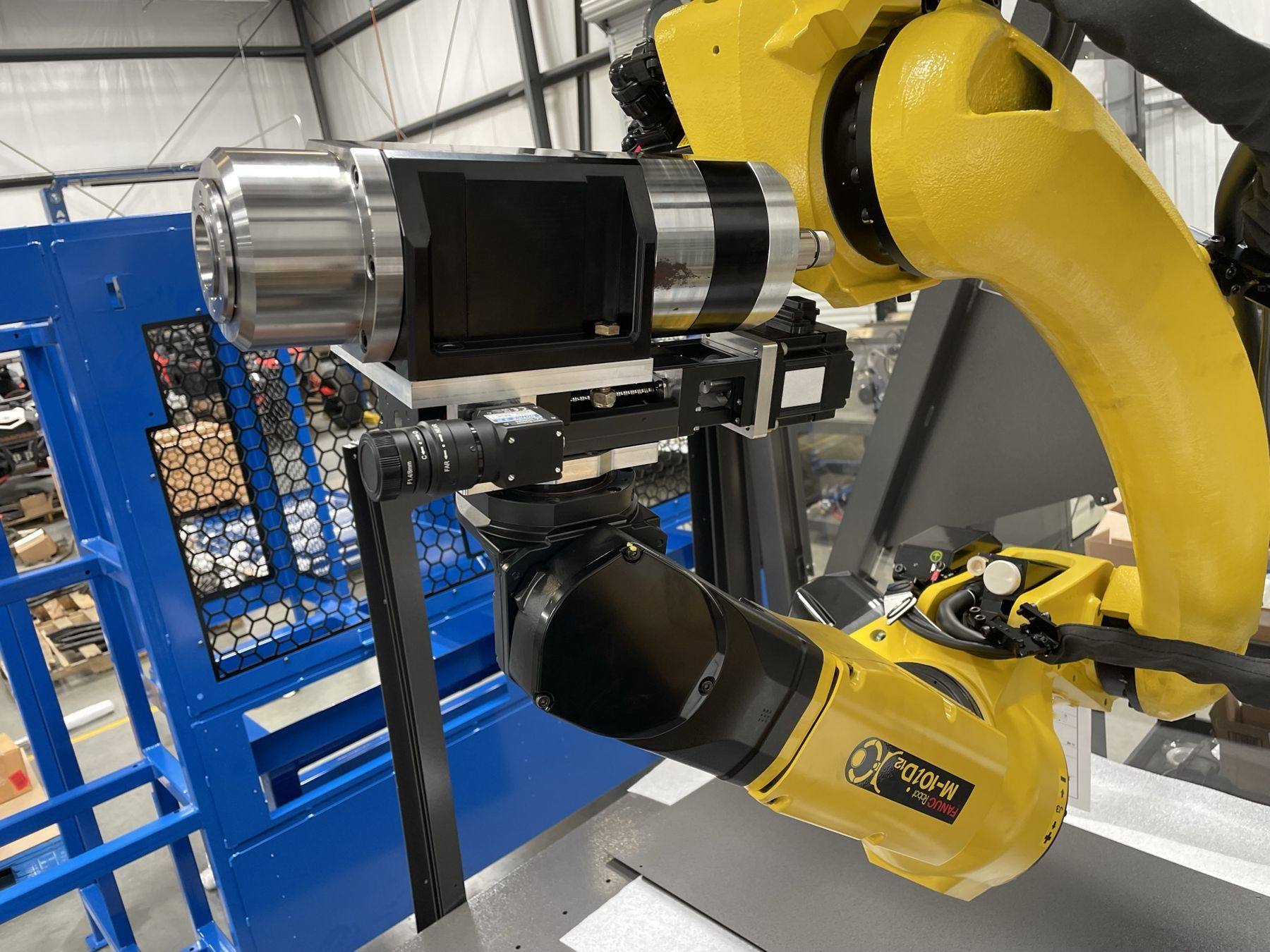
Choosing between a 2D and 3D vision system for a robot comes down mostly to how the parts arrive, not to the camera.
In short
What is the difference between 2D and 3D vision systems for robots?
A 2D camera takes a flat picture. FANUC iRVision finds the part in it and reports X and Y on a plane, plus R, how far the part is turned. FANUC’s brochure describes 2D as detecting objects positioned in one layer. The robot shifts its taught pick by that offset and picks the part where it lies.
A 3D sensor also measures distance. Area sensors build a depth map across their whole view, and a laser sensor measures along the lines it projects. From that data the software can report all six values of a robot position: X, Y and Z, plus the three angles FANUC calls W, P and R. That lets a robot reach for a part lying at an angle on top of a pile.
| 2D camera | 3D sensor | |
|---|---|---|
| Reports | X, Y and rotation on a known plane | X, Y, Z plus tilt and rotation (W, P, R) |
| Suits | Parts flat, one layer deep, at a known height | Parts piled, tilted, or stacked to unknown heights |
| Hardware | Camera, lens and a light | Sensor with its own projector or laser, or a stereo pair |
| Common jobs | Belt and table picking, arm-camera offsets, presence checks, code reading | Random bin picking, tote picking, mixed or uneven depalletizing |
A3 lists laser triangulation, stereo vision, structured light and time-of-flight among the common 3D sensor types. FANUC’s 3D Vision Sensor and 3D Area Sensor project structured light, and its 3DL sensor uses laser light. Like FANUC’s 2D cameras, they are set up and run through iRVision on the robot controller. Some heavier jobs, including some bin picking and real-time visual tracking, add FANUC’s iPC Box, a separate processing unit, so ask about it when the cell is quoted.
When is a 2D camera enough?
If the parts can be made to lie flat and apart, 2D is usually the simpler cell. The camera is smaller and the setup quicker, with fewer settings to recheck when picks drift. FANUC lists palletizing, depalletizing and inspection among the jobs its 2D vision suits.
Parts on a moving belt. On a delta robot tray loading line we built, parts come down a belt wherever they land. iRVision finds each one, iRPickTool tracks it downstream, and two delta robots share the picks and place the parts into trays. Product like that lies flat at the belt’s height, which 2D handles well. More on the robots in delta robot pick and place.
A camera on the arm. In Fig. 1 the camera rides on the robot next to the tool. The robot moves to a snap position, takes the picture, gets the offset and moves in, so one camera can look at several places or get close to a small feature. FANUC also has 2D processes that combine more than one snap to locate a large part.
Checking the work. Presence and position checks are common 2D jobs. Whether a hole or feature is there, and where it sits on the surface, can be judged from a flat picture. How deep it goes cannot. On a robotic drilling cell we built, a vision system verifies each drilled hole and logs the quality data.
Neat stacks of identical parts. When every part is the same known size, a part one layer closer to the camera looks bigger, and the software can estimate Z from that. A fixed camera can follow a neat stack of identical boxes down layer by layer this way, and FANUC’s iRVision 2D page lists Z alongside X, Y and R. It still can’t see tilt, and it gets less reliable when sizes are mixed or the layers are uneven.
Where 2D struggles: parts that touch or overlap, parts that land on different faces, pick surfaces at varying heights, and parts that barely stand out from the background.
When do you need 3D vision?
The points below come from FANUC’s published product information and A3’s material on 3D sensing. 3D is worth its extra cost and setup when:
- Parts are piled at random. The robot needs the top part’s height and tilt, and a way in and out that misses the bin wall and the other parts. FANUC’s bin picking software plans that approach and retract with interference avoidance, and a part list manager tracks every part found in the bin.
- Parts can land tilted or on a different face. A flat picture can’t show how far a part leans toward the camera.
- Stack heights aren’t known. Mixed cases on a pallet, uneven layers, parts heaped on a table.
- The part won’t stand out in a flat picture. FANUC notes its 3D Vision Sensor also suits 2D jobs with low contrast or hard-to-find targets, since depth can separate a part from its background when color can’t.
The gripper gets harder too. It has to reach a part at an angle among its neighbors, and FANUC points out that finger grippers, unlike vacuum or magnets, need extra space around the part. More on that in vacuum vs mechanical grippers.
Do I need 3D vision for bin picking?
For parts piled at random, almost always. A3 describes random bin picking as needing a point cloud, a set of 3D points that maps the pile, plus software that finds a part, chooses a grip and plans a collision-free path out of the bin.
Parts that arrive in layers on dividers or slip sheets are a different job. With known layer heights, a 2D camera can often find the top layer, and the robot works down one layer at a time.
Sometimes the better answer is to keep parts from piling up at all. A3 notes that robots usually pick at fixed spots, such as the escapement of a feeder bowl or the pockets of a formed tray. In the spray nozzle assembly cells we built, bowl feeders present parts nonstop to LR Mate robots, so no robot has to dig through a pile.
Lighting and calibration
A 2D camera sees contrast and nothing else. The part has to stand out from what is behind it and look the same on a sunny afternoon as at night. That usually means a light aimed at the part and some shielding from room light, like a bar light mounted over the belt. Shiny parts throw glare, and dark parts on a dark belt barely show. A backlight or a different belt color often fixes more than a better camera would.
3D sensors bring their own light, a projected pattern or a laser line, so room light matters less. But very shiny, very dark or clear surfaces can leave gaps in the depth data. Either way, test with real parts, including the worst ones you would still call good.
Calibration ties the camera to the robot, so a point in the picture becomes a position the robot can drive to. A 2D camera only sees the line of sight to the part, so the vision process has to be told the height of the surface it is finding. FANUC calls this the part Z height. If the real surface sits higher than the height entered, the part looks bigger and the vision process places it farther from the center of the view than it really is, so the pick misses by more toward the edge of the view.
Set the part Z height to the real pick surface, and check picks near the edges, not only the middle. A camera that gets bumped shows up as picks that are suddenly off and stay off. A mount or lens that is working loose shows up as picks that slowly drift. The FANUC steps are in our iRVision calibration guide.
Questions that decide it
- Do the parts lie flat and apart, all at the same height? Start with 2D.
- Does the pick height change from part to part? Plain 2D will miss unless the height is measured another way.
- Can parts overlap, tilt or land on a different face? That points toward 3D.
- Do the parts stand out from the surface behind them? If not, work on the light or the belt color first.
- Could a feeder, trays or a conveyor that spaces parts out change how they reach the robot? That alone can take 3D off the table.
The camera side of the cells we build is on our vision-guided robotics page.
What to send us
- A phone video of the parts as they arrive now: belt, bin, tray or pallet
- A drawing or model of each part
- A few real parts, including the shiny, dark or bent ones you would still call good
- What the robot does with each part next, and your target rate if you have one
Common questions
- How accurate is 2D robot vision?
- Mostly it depends on how much area each pixel covers. FANUC lists a 2D camera with a 1280 by 1024 pixel image. Spread across a view 640 mm wide, each pixel covers about half a millimeter. A narrower view gives finer detail but sees less. Calibration, the lens, lighting and how well the part stands out all add error, so the real number comes from test picks across the whole view.
- Is 3D vision slower than 2D?
- Usually the measurement takes longer, though it depends on the sensor and the job. A 3D sensor has to project its pattern or laser and build a depth map, and the software searches far more data than a flat image holds. Bin picking also adds path planning for every pick. A fixed sensor can often take the next measurement while the robot places the last part, which hides some of that time. Test with your parts before counting on a rate.
- Can we start with 2D and add 3D later?
- Sometimes. FANUC iRVision runs 2D cameras and FANUC's 3D sensors through the robot controller, though some heavier bin picking jobs add FANUC's iPC Box for processing. What changes is the sensor and its mount, the software options, the calibration, the vision programs, and often the gripper and the way the robot approaches the part. Check that the controller and its software version support the sensor. If 3D is likely later, leave room for the sensor and its view when the cell is laid out.
Sources
- FANUC America — iRVision robotic vision systems
- FANUC America — iRVision 2D
- FANUC America — iRVision brochure: machine vision in 2D and 3D (PDF)
- FANUC America — iRVision Bin Picking
- FANUC Corporation — iRVision cameras and 3D sensors
- A3 — How to tell if 3D sensing is right for your application
- A3 — How 3D machine vision addresses complex challenges of random bin picking