
Vacuum vs mechanical grippers for robot cells
Suction cups hold a part with air pressure. Fingers hold it by squeezing or by fitting its shape. The part's surface, its weight and how hard the robot moves it decide which one works.
Plenty of parts can be picked with either suction cups or fingers. Which one works usually comes down to the part: its surface, how much air leaks through it, what it weighs and where it has to go after the pick. We design the grippers for the FANUC cells we build in Fontana and machine the fingers on our own 5-axis.
In short
Part surface, porosity and weight: what to check first
Surface. A cup needs a flat or gently curved patch a little larger than the cup, free of holes, ribs and seams. Sheet metal, molded lids and sealed trays usually qualify. Bellows cups follow some curvature, but a cup that lands across a rib or a hole leaks.
Porosity. Corrugated board, uncoated paper, wood and fabric let air through. Vacuum can still work, but it takes a high-flow generator or a blower, often with a foam seal in place of separate cups. Porosity also changes from batch to batch, so a new carton supplier can turn a reliable pick into a dropped one.
Weight and load direction. Holding force is the pressure difference times the cup’s area, and the pressure difference can never exceed the atmosphere pushing on the part. A stronger pump only gets closer to that limit, so it can’t make up for too little cup area. Schmalz’s sizing method adds the acceleration of the move and a safety factor of at least 1.5 for smooth, dense parts and 2.0 or more for porous, rough or oily ones. When the load pulls sideways on the cup, friction at the cup lip is what holds the part, so a part that lifts fine can still slide off in a fast horizontal move.
The math gets the cup size close. Whether the part holds is settled by testing real parts on the real cup and generator, warped and dusty ones included, and cartons from every supplier you buy from.
When do machined fingers work better?
Fingers hold a part two ways. A friction grip squeezes flat jaws against it. A form-fit grip uses fingers cut to the part’s profile, so the part sits nested and can’t slide out even when the squeeze is light. Form-fit fingers also put the part in a known position, and on assembly work that position often matters more than holding force.
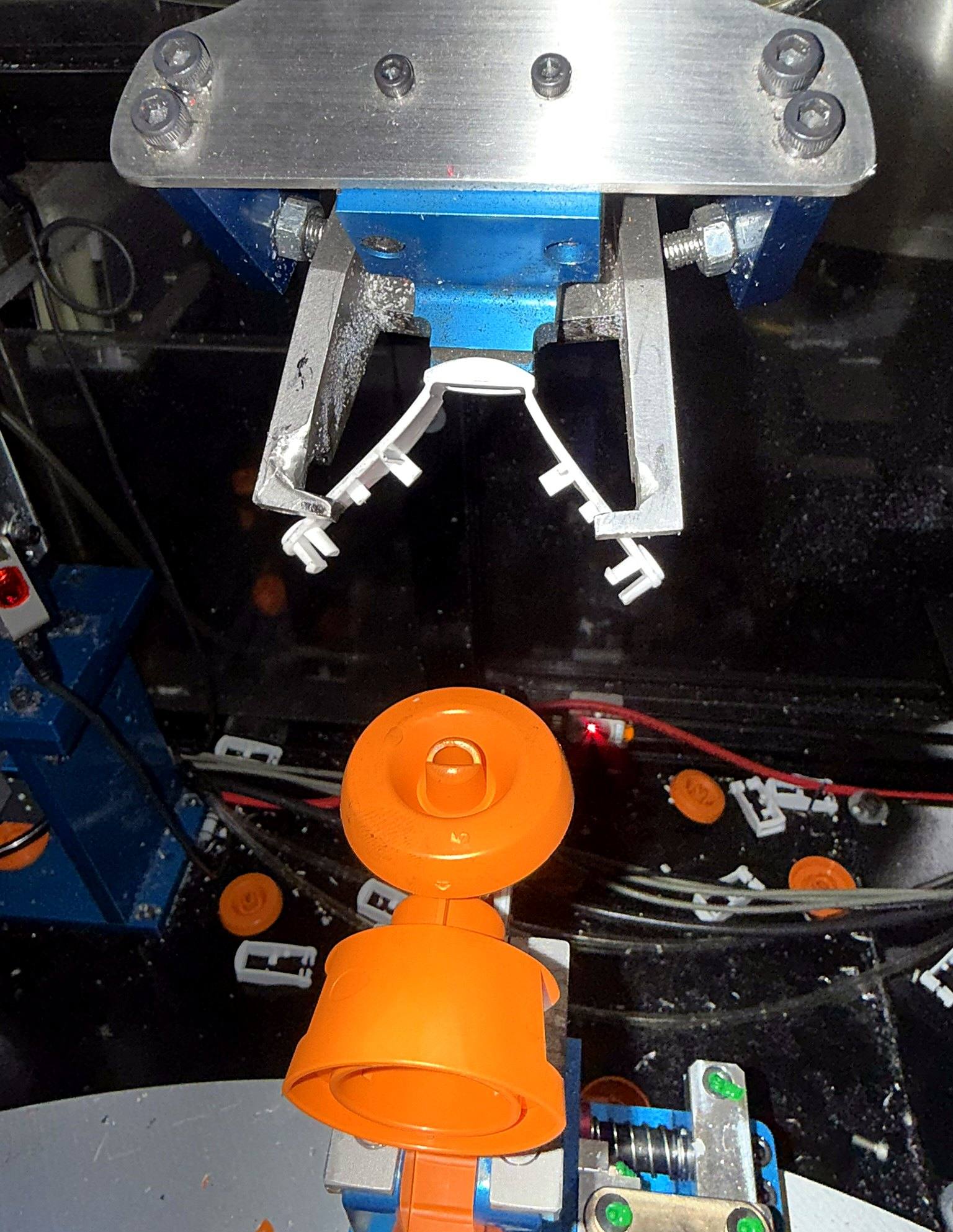
The spray nozzle assembly cells we built for a national lawn and garden brand work this way. LR Mate robots pick parts that bowl feeders present nonstop, and the fingers were machined in-house to fit the part (Fig. 1). See the spray nozzle assembly cells job, and robotic assembly cells for the feeders, fixtures and guarding around them.
Fingers are usually the better choice when the surface is oily or full of holes, when the part is heavy or moved hard sideways, or when it has to land in an exact spot for pressing or inserting. Jaw position sensors also tell the robot whether the gripper closed on a part or on nothing.
The trade-offs: fingers need room around the part to open, each part family needs its own finger set, and fingers wear. Most finger grippers are catalog air grippers with custom fingers bolted on. A new set can be cut in-house and fitted the same week; our custom end-of-arm tooling page covers how.
When is a vacuum gripper the better tool?
Vacuum is the better choice when the robot can only reach the top of the part: product lying flat on a belt, sheets on a stack, a part down in a nest with no room for fingers. One cup layout can often cover several part sizes, and cups add little weight, which suits light, fast robots like the deltas on our delta robot pick and place lines.
Three things around the cups decide whether a vacuum pick is reliable:
- Generator. A compressed-air ejector at the tool responds quickly. Leaky parts may need a pump or blower that moves more air. An ejector uses air the whole time it holds unless it has an air-saving control.
- Confirmation. A vacuum switch tells the robot the cups have sealed before it moves.
- Release. A short blow-off pulse drops the part at once instead of waiting for the vacuum to bleed down.
Soft-touch grippers for food and fragile product
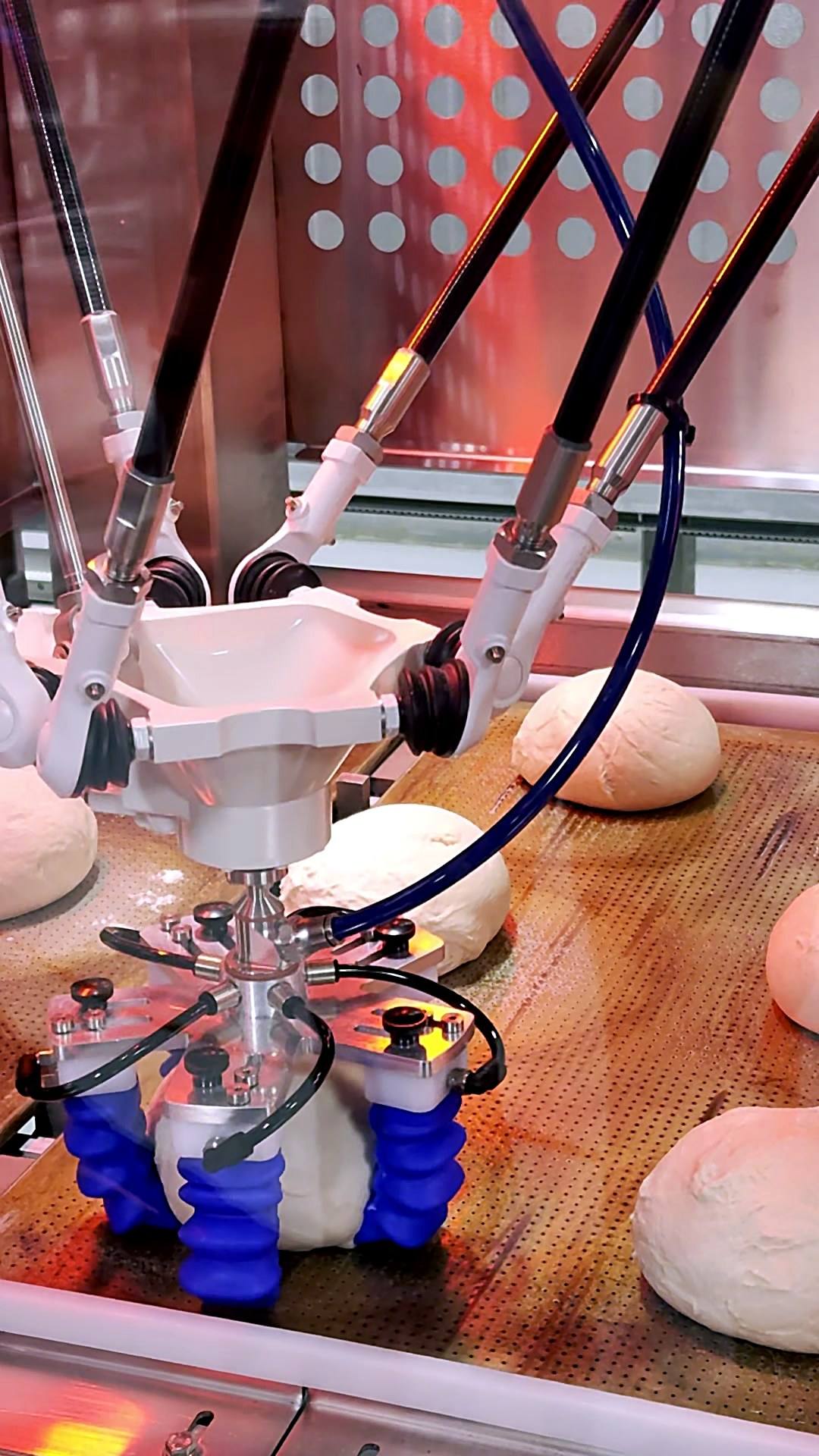
Raw dough is soft, sticky and easy to mark. A cup can pull the surface up into itself, and a hard jaw leaves a dent. On a job for a commercial bakery, robots move dough between trays and racks on a live production floor. The delta robots on that line use soft-touch grippers that pick raw dough without marking it (Fig. 2). The bakery automation page has more on that work.
Soft-touch fingers are molded elastomer driven by air. They wrap the product and spread the grip over a larger area than a hard jaw, and they tolerate pieces that vary in size, which dough always does.
Anything that touches food has to be made for it. In the US, rubber parts for repeated food contact fall under 21 CFR 177.2600, which lists silicone and nitrile rubbers among the allowed polymers. Ask the cup or finger maker for a compliance statement on the exact part number. Vacuum lines can also pull in flour and crumbs, so they need filters.
How does the gripper change the robot you need?
The payload rating has to cover the gripper and the part together, but payload is not the only limit. FANUC also rates each wrist axis for allowable moment and inertia. The M-20iD/25 carries 25 kg but is rated for 32 N·m and 1.2 kg·m² on J6. Ten kilograms of tool and part with the center of gravity 350 mm off the J6 axis puts up to about 34 N·m (10 kg × 9.81 m/s² × 0.35 m) on J6 when that axis is horizontal, and at least 1.2 kg·m² of inertia (10 kg × 0.35² m²). That is over the moment rating and at the inertia limit with 10 kg on a 25 kg robot.
The two gripper types load the wrist differently. A wide vacuum frame is light but spreads its mass out, and inertia grows with the square of distance, so the same mass twice as far out has four times the inertia. A finger gripper keeps the part close to the flange, but for a small part its body and fingers often outweigh a few cups.
Big tools are mostly structure. On the palletizing cells we built for a national lawn and garden brand, FANUC robots grip each case off the end of a packaging line and swing it onto the pallet. A case gripper has to span the largest case on the line, and its frame counts against the payload before any case is picked.
We model the whole cell in SolidWorks, gripper included, so the tool’s weight and center of gravity come straight from the model. On the FANUC controller, those numbers go into payload schedules for the empty gripper and the loaded one, and the controller uses them for motion control and collision detection.
Decision table: vacuum, fingers or soft-touch
| If the part or process… | Start with | Why |
|---|---|---|
| Has a flat, smooth, sealed top | Vacuum | Cups seal and reach from above |
| Can only be reached from above | Vacuum | No clearance needed beside the part |
| Is porous: corrugated, wood, fabric | Test both | Vacuum needs high air flow |
| Is oily, wet, textured or full of holes | Fingers | Cups leak or slide |
| Must land in an exact spot for assembly | Machined fingers | The profile locates the part |
| Is heavy or moved hard sideways | Fingers that nest the part | Form fit doesn’t rely on friction |
| Is soft, sticky or marks easily | Soft-touch fingers | Grip spread over a large area |
| Is steel and can take a magnet | Magnetic gripper | No seal or finger clearance needed |
What if the air supply drops mid-move?
OSHA’s technical manual names parts release and gripper mechanism failure as sources of mechanical failure hazards and injuries. Finger grippers can use spring-assisted closing or check valves to keep their grip. A vacuum tool can use check valves too, but a porous part still drops as the vacuum bleeds off. What a cell needs comes out of the risk assessment we do for each cell, and your own safety professional should confirm it; see our guide to robot safety standards.
Other types of robotic grippers
- Magnetic grippers hold steel parts. Electro-permanent and switchable permanent magnets hold without continuous power.
- Needle grippers push fine needles into textiles, composites and other porous sheet that cups can’t seal on.
- Bernoulli grippers use fast air flow to hold thin, delicate parts such as wafers with little or no contact.
End of arm tooling vs end effector
For most purposes they mean the same thing. ISO 8373 calls any device attached to the robot’s mechanical interface to do its task an end effector, whether it is a gripper, a weld gun or a spray gun, and a gripper is the kind built to seize and hold. OSHA notes end effectors are sometimes called end-of-arm tooling (EOAT). When you compare gripper quotes, check whether the adapter plate, any tool changer, the sensors and the air lines are included or priced separately.
What to send us to choose a gripper
- A CAD model or drawing of the part, and every variant the tool has to handle
- A few real sample parts, including the worst ones off the line
- Part weight and material, and any surfaces that must not be marked
- How the part arrives and where it has to go
- A phone video of the job being done by hand
The model, the video and the details can go in one email from the contact form.
Common questions
- Can one tool use both vacuum and fingers?
- Yes. Combination tools are common where one method alone is not enough, for example cups that lift a part while fingers or a clamp close underneath so it cannot slide off in a fast move. The second method adds weight, valves and air lines to the tool, so it makes sense when testing or the load calculation shows one method cannot hold the part through the whole move.
- Are electric grippers better than air grippers?
- Neither is better in general. Air grippers are simple, fast and cheap to replace, and most plants already have compressed air. Electric grippers let the robot program set stroke and grip force, which helps when one gripper handles several part sizes or a fragile part needs a controlled squeeze, and they need no air line to the tool.
- Do you build the gripper when you build the cell?
- Yes. We design the gripper in the same SolidWorks model as the robot, fixtures and guarding, machine the custom fingers and gripper bodies on our in-house 5-axis, and write the robot program that uses it. Cups, vacuum generators and soft-touch fingers are catalog parts, chosen for your part.
Sources
- ISO 8373:2021, Robotics: Vocabulary
- OSHA Technical Manual, Section IV Chapter 4: Industrial Robot Systems and Industrial Robot System Safety
- Schmalz, Theoretical holding force of a suction cup (load cases, safety factor, friction)
- FANUC America, M-20iD/25 specifications (payload, allowable wrist moment and inertia)
- 21 CFR 177.2600, Rubber articles intended for repeated use (Cornell LII)