
Robotic welding cell cost, and what drives it
We don't publish prices. This guide goes through the parts of a weld cell quote, what moves each one, and how to compare a robot cell against manual welding.
A robotic welding cell cost depends more on the parts it welds than on the robot doing the welding. We don’t publish prices, because we quote each cell from the drawings and volumes. What we can do is lay out what a weld cell quote is made of, line by line, and which choices move each line. CalWest Robotics builds FANUC weld cells in our Fontana, CA shop, and our parent company, CalWest Manufacturing, is a contract shop that welds parts itself, so we see the question both as a cell builder and as a welding shop.
In short
What a published price range tells you
The range above comes from an article in Automation World, a trade publication, written by the chief executive of an automation company, and it covers complete systems with integration. A cell that welds one bracket on a fixed table and a cell that welds twenty frame variants on a two-station positioner can both land inside it. Use it as a sanity check, not a budget.
The same article calls the robot arm the most commoditized part of the cell. Two integrators quoting the same FANUC arm with the same weld package are quoting the same hardware. What differs is everything built around it for your parts, which is what the rest of this guide covers. Our general robot cell cost breakdown covers the lines every cell shares; this page covers what is specific to welding.
Robotic welding cell cost by line item
| No. | Line item | What it covers | What pushes it up |
|---|---|---|---|
| 1 | Robot, controller and weld software | The arc welding arm, controller, teach pendant and software options | Reach for long or large parts, a second robot, sensing and seam tracking options |
| 2 | Power source and torch package | Power source, wire feeder, torch, cables and gas regulation | Pulse or aluminum packages, a second process, water-cooled torches for high current |
| 3 | Torch maintenance | A cleaning and reaming station, anti-spatter, wire cutter | Long unattended runs that need more automatic upkeep |
| 4 | Positioner | Anything from a fixed table to a two-station turntable or a multi-axis positioner | Heavy or long parts, coordinated motion, two stations |
| 5 | Fixtures | Locators, clamps and part-present sensors, one set per part number | Many part numbers, pneumatic clamps with sensors, tight fit-up |
| 6 | Guarding and arc screening | Opaque panels or weld screens, doors, safety devices at the load side | Two-station loading, large parts, crane loading |
| 7 | Fume extraction | A hood or enclosure, ducting and a collector | Stainless steel and other alloys, high deposition, enclosed cells |
| 8 | Controls and operator station | PLC, safety circuit, part select, fixture signals | Several fixtures with sensors, data to the ERP, your plant’s PLC standard |
| 9 | Programming and weld development | Paths for each part, weld parameters, test welds | Many part numbers, many short welds, code or customer weld procedure requirements |
| 10 | Run-off, install and training | Testing with your parts, freight, rigging, power and gas hookups, training | Travel, training more than one shift |
Robot, controller and weld package
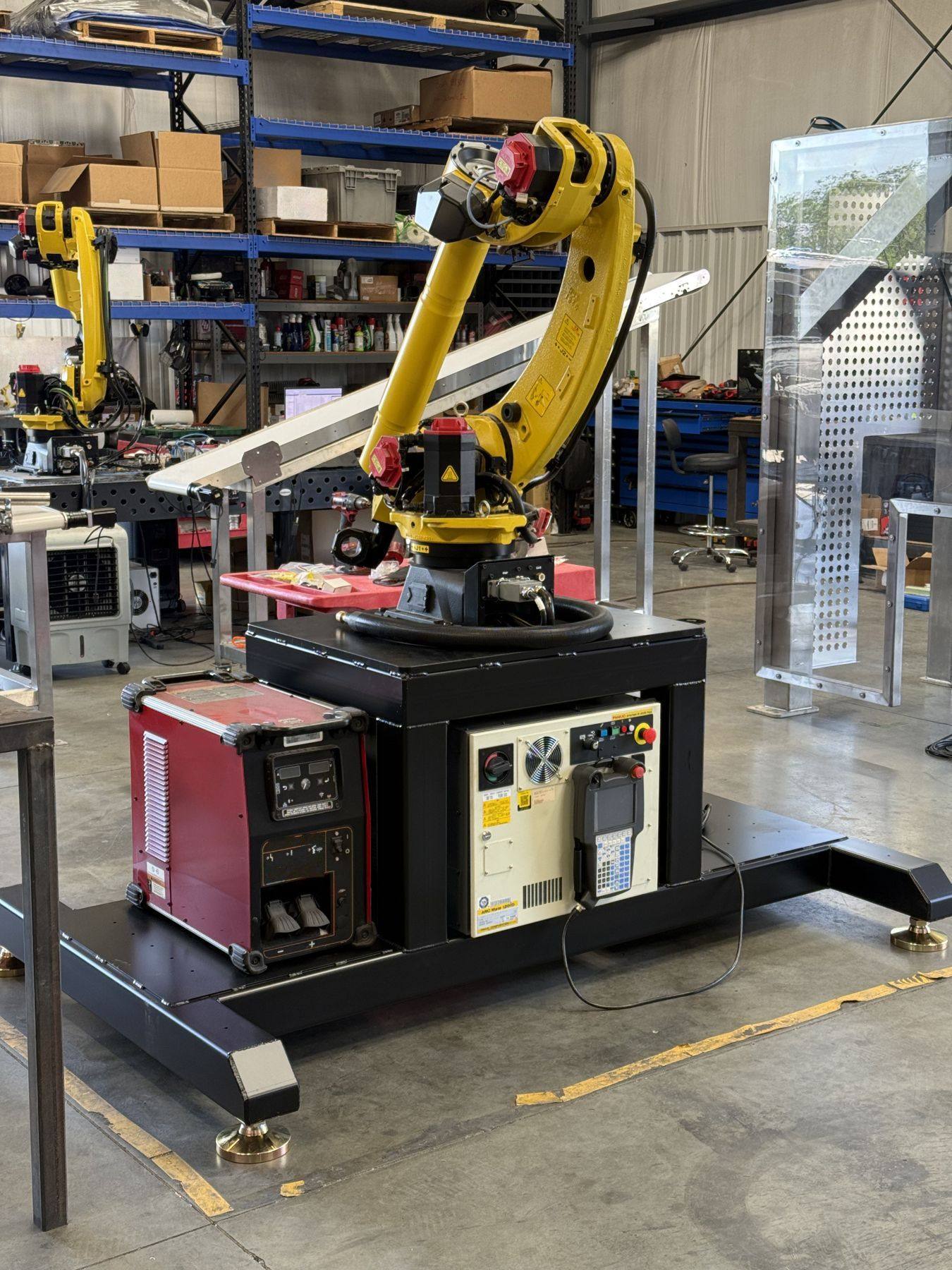
FANUC’s arc welding robots are its ARC Mate series. FANUC’s hollow wrist designs route the weld cable through the arm, which protects the cable from wear, and its ArcTool software handles touch sensing, weaving, multi-pass welding and through-arc seam tracking. Ask which of those features a quote includes, because they decide how much part variation the cell can handle. A smaller arm covers many brackets and small weldments. Long frames may need a larger arm, a track, or a positioner that brings the joints to the robot.
Positioner
On a fixed table the robot welds, then waits while the operator unloads and reloads. A two-station positioner lets the operator load one side while the robot welds the other, so the arc runs more of the shift. A headstock and tailstock turn long parts so every seam can be welded in a good position. FANUC describes integrating its robots with welding positioners so they move together, which keeps the torch angle right while the part turns. Each step up in positioner adds cost and floor space. What it buys back is time the robot would otherwise spend waiting for the operator or welding a joint out of position.
Fixtures
On a cell that welds many part numbers, fixtures are often the largest custom line. Every part needs locators that put each joint where the program expects it and clamps that hold it there while the weld pulls on the metal. Manual toggle clamps cost less per fixture. Pneumatic clamps with part-present and clamp sensors cost more, but the PLC can confirm the part is loaded and clamped before the robot starts.
We design fixtures with the rest of the cell, and they are cut, formed, welded and machined in the same building by our parent company. Quick-change fixture plates on a positioner shorten changeover when the cell runs several parts a shift.
Guarding, arc screening and fume extraction
Arc light has to be screened from the operator and anyone walking past, so a weld cell is usually enclosed with opaque panels or weld-rated screens rather than open fence. The load side gets an interlocked door or a light curtain, depending on how parts are loaded. We lay those out from a risk assessment of the tasks people do at the cell, and our robot cell guarding page covers the layout side.
Fume extraction depends on the material and how much the cell welds. OSHA’s general industry welding rules are in 29 CFR 1910 Subpart Q, and OSHA names welding on stainless steel as a major source of worker exposure to hexavalent chromium. A robot usually keeps the arc on for more of the shift than a person does, so plan the extraction with your EHS team before the layout is final.
Programming and weld development
Each part number needs paths, weld parameters and test welds. We lay out and check paths in FANUC ROBOGUIDE before they run on the robot, then step new motion through slowly in T1 on the floor. Simulation lets a new part be programmed without tying up the cell; our offline robot programming page goes into how that works. Many short welds take more programming per part than a few long ones. If the welds must meet a code or a customer’s weld procedure, plan for test coupons and paperwork as well.
Why part fit-up matters more than the robot
A welder sees a gap and adjusts. A robot follows its program. If one part arrives with a tight joint and the next with a wide gap, the robot welds both the same way unless sensing tells it otherwise. Touch sensing finds the joint before each weld, at the cost of some cycle time. Through-arc seam tracking follows the joint during longer welds. Neither fixes a gap that is too wide to bridge.
The cheapest cure is often upstream. Laser-cut and press-brake-formed parts usually arrive more consistent than parts that were saw-cut, torch-cut or bent by hand, and consistent parts need simpler fixtures and less sensing. Because our parent company cuts, bends and welds parts for customers, we look at the parts before the cell. Our metal fabrication automation page covers that side.
How part mix changes the cell
| Few parts, high volume | Many parts, lower volume | |
|---|---|---|
| Fixtures | One or two dedicated fixtures, often pneumatic | A fixture per part, often on quick-change plates |
| Positioner | Can be simple if the parts don’t need turning | Two stations to keep the arc running through changeovers |
| Programming | A few programs, tuned hard for cycle time | Many programs, prepared offline, touched up on the robot |
| Where the cost goes | Hardware and cycle time | Fixtures, programming and changeover |
Robotic vs manual welding cost: how to compare them
Compare cost per part, not robot price against a welder’s wage. Time a few parts the way they’re made today: loading, tacking, welding, flipping, grinding spatter, unloading. Note how much of that time the arc is actually on, how many parts need rework, and how much overtime the job eats. The robot’s cycle can be estimated from simulation before anything is built.
The Bureau of Labor Statistics puts the median wage for welders, cutters, solderers and brazers at $25.84 an hour in May 2025. Wages are only part of what a welder costs: across manufacturing, BLS found wages made up $32.50 of $48.62 an hour in total employer compensation in June 2026, with benefits making up the rest. Use your own payroll figures where you have them.
The cell still needs a person. On a two-station cell, one operator loads while the robot welds, and that operator is often a welder who checks welds and touches up programs. The robot ROI calculator works out payback from your labor, scrap and overtime numbers.
What to send for a weld cell quote
What a weld cell quote is built from
- Part drawings or CAD models with the weld callouts
- Material and thickness, and the process: MIG, pulsed MIG, aluminum or other
- Annual volume and batch size for each part number
- How the parts are cut and formed today, and a few sample parts
- Current time per part, including tacking, flipping and grinding
- Any welding code or customer weld procedure the parts must meet
- Floor space, power and gas at the spot, and how parts reach the cell
- Fume extraction requirements from your EHS team
The automation RFQ builder puts those answers into one brief. Our robotic welding cells page shows how we design, build and teach FANUC weld cells in our shop before they ship. To start a quote, send drawings or a video of the job through our contact page.
Common questions
- How much of a welding cell's cost is the robot itself?
- Less than most buyers expect. The arm, controller and weld package are catalog items that cost about the same from any integrator quoting the same model. The fixtures, positioner, guarding, fume extraction, controls and programming are designed for your parts, and on a cell that welds many part numbers they can add up to more than the robot. An April 2026 Automation World article called the robot arm the most commoditized part of the cell.
- What is the payback on a robotic welding cell?
- It depends on how many hours a year the cell welds, what those hours cost you now, and how much grinding, rework and overtime it removes. Measure your current time per part, including loading, tacking, flipping and grinding, then run the numbers in a payback calculator with your own labor rate. Count freed hours as savings only if the welders move to other work or the extra output gets sold.
- Can one welding robot handle many different parts?
- Yes, if each part has a fixture and a program. Quick-change fixture plates on a positioner cut changeover time, and programs written offline in simulation keep new parts from tying up the robot. A high-mix cell costs more in fixtures and programming than a cell built for one part, so count your part numbers and annual volumes before you ask for a quote.
- Do we still need welders after we automate?
- Yes. Robot weld cell operators are often welders, because they can tell a good weld from a bad one and know what to change. Someone still loads parts, checks welds, touches up programs and handles the welds that don't suit the robot. The Bureau of Labor Statistics projects about 40,300 openings a year for welders, cutters, solderers and brazers from 2025 to 2035.
- Does a robotic weld cell need fume extraction?
- Plan for it. A robot usually keeps the arc on for more of the shift than a person, so the fume goes up with the arc time. OSHA's welding rules for general industry sit in 29 CFR 1910 Subpart Q, and OSHA names welding on stainless steel as a major source of hexavalent chromium exposure. Your EHS team or an industrial hygienist should set the requirement for your materials and your building.
Sources
- Automation World (Apr. 16, 2026): Robotic welding cells, why the robot shouldn't be your first area of focus
- FANUC America: Arc welding robots (ARC Mate series, ArcTool software)
- FANUC America: ROBOGUIDE robot simulation software
- OSHA: Welding, cutting and brazing, standards (29 CFR 1910 Subpart Q)
- OSHA: Hexavalent chromium
- U.S. Bureau of Labor Statistics: Occupational Outlook Handbook, Welders, cutters, solderers and brazers
- U.S. Bureau of Labor Statistics: Employer Costs for Employee Compensation, June 2026, Table 4 (manufacturing)