
Palletizing robot cost: what the cell is priced on
We quote each palletizer from the line data, so there are no prices here. This is what the quote is made of, which choices move it, and how to check it against what palletizing costs you now.
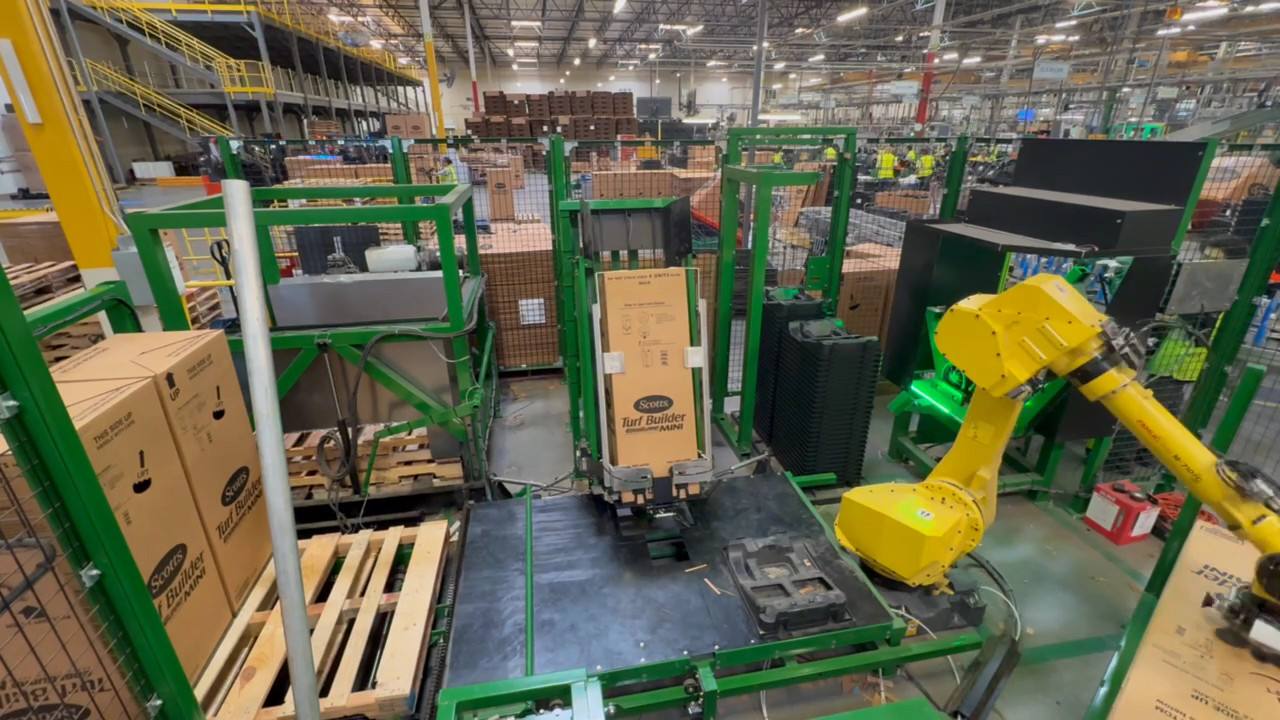
A palletizing robot cost is mostly decided before anyone picks a robot model. The heaviest case, the tallest stack, how many lines feed the cell and how full pallets leave the area set most of the quote. CalWest Robotics builds FANUC palletizing cells in Fontana, CA, including the cells at the end of the packaging lines in a national lawn and garden brand’s plant in Temecula, CA, and installs cells at plants across the US. This guide breaks a palletizer quote into its lines.
In short
Our robotic palletizing page shows how a case moves through one of our cells, from the pick point to the finished pallet. This page is about the money: what each part of the cell costs to build, and how to judge whether it pays.
What goes into a palletizing cell quote
| Line item | What decides it | Ask each quote |
|---|---|---|
| Robot and controller | Heaviest case plus gripper, reach to the far top corner of each pallet, cases per minute at peak | Which model, and how much payload is left for future cases |
| Gripper | Case type and weight, single or multi-case picks, slip sheets | How many tools, and what a new case size means |
| Pallet stations | One or two, and how full pallets leave | Forklift pickup or a pallet conveyor out |
| Empty pallets and slip sheets | Placed by hand, or a dispenser and a magazine | Who supplies the dispenser, and how it is guarded |
| Infeed conveyors | A fixed pick point, accumulation, more than one line in | Whether conveyors are included or by others |
| Guarding and safety | Fence, light curtains or scanners at each opening, muting | Each safety device, and the risk assessment behind it |
| Patterns and programming | Number of SKUs and patterns, mixed loads | Who adds patterns after install, and how |
| Controls and line integration | PLC, operator screen, signals to the line, wrapper and labeler | Which PLC platform, and which machines it talks to |
| Run-off and install | Patterns to prove out, the install window | What is tested at run-off, and the install scope |
Robot size: payload, reach and rate
The robot has to carry the heaviest case plus the gripper, and stay within FANUC’s limits for wrist moment and inertia, which a tall case or a wide multi-case tool can exceed before the weight does. It also has to reach the far top corner of each pallet at full stack height. Those two checks, plus cases per minute at the line’s best hour, pick the robot.
FANUC builds robots for this job. Its M-410 series are 4- or 5-axis parallel-link palletizing robots designed for stacking pallets up to 2 meters high, and general six-axis arms are used for palletizing too. We choose the model once we have the case data and a floor layout.
If a heavier case or a taller pattern is coming, size for it now. Leaving margin costs less than replacing a robot that turns out too small.
The gripper and what it has to handle
Vacuum foam pads suit sealed cases with flat tops. Clamp grippers hold heavy cases and cases with weak tops. Fork or finger tools slide under bags and bundles that sag. A tool that picks two or three cases at once cuts the number of robot moves, but it weighs more and needs more room beside the cases on the pallet.
Every extra job the tool does adds cost: picking slip sheets, sensing whether a case is present, handling a second product family. We design grippers with the cell and machine them in our own shop. The end-of-arm tooling page covers how.
Pallet stations, dispensers and slip sheets
A single pallet station costs less, but the line has to stop or back up while a full pallet is pulled. Two stations let the robot build on one while the other is swapped, which is why they are common.
An empty-pallet dispenser saves a forklift trip for each pallet, but it adds the dispenser, a pallet conveyor through the guarding and the safety devices at that opening. Slip sheets placed by the robot need a magazine and usually a vacuum feature on the tool. Full pallets that leave on a conveyor to a stretch wrapper need a guarded exit that lets the pallet out without letting a person in, usually a muted light curtain.
Infeed conveyors
The robot needs each case to stop at a fixed pick point, with a sensor that says it’s there. Upstream accumulation keeps the packaging line running while the robot waits on a pallet change. A cell fed by two or more lines needs a conveyor for each, and a pick point the robot can reach on each one. If the conveyors at the end of your line already exist, part of this line can come off the quote. Our conveyor integration page covers that work.
Guarding and safety at the pallet stations
The pallet stations are where people get closest to the robot, often on a forklift while the line keeps running. Each opening gets a light curtain or an area scanner, and the safety logic keeps the robot out of a station while someone is in it. On a FANUC robot, Dual Check Safety zones can hold the arm out of one station while it keeps building on the other.
More openings mean more devices, more muting and more safety logic. Our guide to light curtains vs area scanners compares the two at a pallet station. We lay the devices out from a risk assessment, and your own safety professional should review it.
Stack patterns and programming
Stack patterns are data in the robot program: the layer layout, the orientation of each case and the number of layers. FANUC’s PalletTool 3 lets operators create, edit and compare pallet patterns on the Tablet TP. A cell with three patterns costs less to program and prove out than one with thirty, and mixed-SKU pallets, where several products go on one load, need more logic again.
Decide in the design review whether your crew will add new patterns from a screen or call a programmer, because it shapes both the program and the screens. Our guide to FANUC palletizing programming goes into the program structure.
Conventional vs robotic palletizer
A conventional palletizer forms layers by machine. Cases are turned and pushed into rows, rows into a layer, and the layer is set on the pallet. A robot places cases one or a few at a time and turns them in the air on the way.
| Conventional, layer-forming | Robotic | |
|---|---|---|
| How layers are built | Cases turned and pushed into rows by the machine | The robot places each case or group |
| New pattern | Recipe and mechanical settings | A pattern in software, if the case fits the gripper |
| Lines served | Usually one | One or more, if the combined rate fits and the robot can reach each pick point |
| Footprint | A layer-forming section plus the pallet area | The robot and its pallet stations inside a fence |
| Fits | High case rates, few SKUs | Moderate rates, many SKUs or patterns, several lines |
Which one costs less depends on your peak rate and your SKU count. If one robot can’t keep up with the line, compare a multi-case robot tool, a second robot and a conventional machine on the same numbers.
What a palletizer saves: checking the ROI
Manual palletizing is repetitive lifting and twisting. The Bureau of Labor Statistics says hand laborers and material movers have some of the highest rates of injuries and illnesses of all occupations. NIOSH publishes its revised lifting equation for evaluating manual lifting tasks like this one, and your safety team can use it to score the station you have now.
For labor, BLS puts the May 2025 median wage at $40,240 a year for hand laborers and freight, stock and material movers, and $36,280 for hand packers and packagers. Those are wages only. Across manufacturing, wages were $32.50 of $48.62 an hour in total employer compensation in June 2026, with benefits making up the rest. Use your own payroll figures where you have them.
Count the people at the end of the line on each shift, then add overtime, temp labor, product damaged by dropped cases, and lost output when the line waits on a palletizer that isn’t staffed. Count freed hours only if those people move to other work. The robot ROI calculator works out payback from those inputs, and our robot cell cost breakdown covers the lines every cell shares.
Decisions that move a palletizer quote most
Settle these before you compare quotes
- The heaviest case today, and any heavier or taller one planned
- Cases per minute at the line's best hour
- One pallet station or two
- How full pallets leave: forklift, pallet jack or conveyor to a wrapper
- Empty pallets and slip sheets by hand, or a dispenser and a magazine
- How many lines feed the cell
- How many patterns now, and who adds new ones
- Which machines the cell has to signal: line, wrapper, labeler, ERP
- When the line can stop for install
The Temecula palletizing cells write-up shows a set of cells we designed, built and programmed in Fontana and commissioned on a live production floor. For a first look at your line, a phone video of the end of the line and a photo of a finished pallet are enough.
Common questions
- Why is the robot only part of a palletizer's price?
- The arm and controller are catalog items. The gripper, pallet stations, conveyors, guarding, safety devices, controls and programming are built for your cases, your patterns and your floor, and together they usually make up much of the quote. Two integrators quoting the same FANUC robot can come in far apart because one includes conveyors, dispensers or install and the other lists them as by others.
- Can one palletizing robot handle more than one packaging line?
- Sometimes. It works when the combined case rate of the lines is within what one robot can place, the lines end close enough for the robot to reach both pick points, and there is room for a pallet station per product. It saves a robot, but adds conveyor work and makes the program and screens more involved. Line rates and a floor sketch are enough to tell which way it goes.
- What happens when we add a new case size or stack pattern?
- A new pattern is data in the robot program: the layer layout, case orientation and layer count. FANUC's PalletTool 3 lets operators create and edit patterns on the Tablet TP. A new case size also has to fit the gripper and stay within the robot's payload and wrist limits, so tell your integrator about planned products before the robot and tool are sized.
- Is a robotic palletizer cheaper than a conventional palletizer?
- It depends on the line. A conventional layer-forming palletizer is built for high case rates with few patterns. A robot cell handles many SKUs and patterns, can serve more than one line and changes patterns in software, but places cases one or a few at a time. Compare both on your peak rate, SKU count and floor space rather than on the price of the machine alone.
- What should we send to get a palletizer quote?
- A phone video of the end of the line at normal speed, the size and weight of the largest, smallest and heaviest cases, a photo or drawing of each finished pallet pattern, cases per minute at your best hour, a floor sketch with columns, doors and forklift paths, and how full pallets leave the area today. That covers most of what decides the robot, gripper and layout.
Sources
- FANUC America: M-410 series palletizing robots
- FANUC America: PalletTool 3
- FANUC America: Dual Check Safety (DCS) position and speed check
- U.S. Bureau of Labor Statistics: Occupational Outlook Handbook, Hand laborers and material movers
- U.S. Bureau of Labor Statistics: Employer Costs for Employee Compensation, June 2026, Table 4 (manufacturing)
- NIOSH (CDC Stacks): Revised NIOSH equation for the design and evaluation of manual lifting tasks