
California manufacturing sales tax exemption and robot cell incentives
California has three programs that can lower what a robot cell costs you: a partial sales tax exemption, a jobs-based tax credit and training funds. Here is what each one covers and the paperwork it takes, with links to the state's own pages.
A robot cell bought in California comes with a sales tax bill, and usually with training and depreciation questions too. The California manufacturing sales tax exemption, run by CDTFA, is the incentive almost every qualifying manufacturer can use, and it needs no application. Two other California manufacturing incentives take more planning: the CalCompetes tax credit from GO-Biz, and Employment Training Panel funds for training the crew. We build FANUC cells in Fontana. We don’t prepare tax returns, so read this as a map of the rules and have your CPA confirm how they apply to your purchase.
In short
How does the California manufacturing sales tax exemption work?
The partial exemption in Revenue and Taxation Code section 6377.1 takes 3.9375 percentage points off the sales or use tax rate on qualifying equipment. CDTFA puts it this way: the statewide 7.25 percent rate drops to 3.3125 percent, plus any district taxes, which the exemption does not touch. On $100,000 of qualifying purchase price, that is $3,937.50 less tax.
There is nothing to file with CDTFA up front. You give the seller a signed exemption certificate and the seller charges the lower rate.
The rate has been 3.9375 percent since January 1, 2017, and the exemption runs through June 30, 2030 unless the Legislature extends it. Lease payments due after that date are taxed at the full rate. Purchases under the exemption are capped at $200 million a calendar year, with no carryover. The cap applies to each qualified person, or to a combined reporting group of related companies as a whole, and few robot cell buyers will reach it.
A purchase has to pass three tests.
| Test | What CDTFA requires |
|---|---|
| Qualified person | Primarily engaged in a line of business under NAICS codes 3111 to 3399, or R&D codes 541711 and 541712. Primarily means 50 percent or more of gross revenue, or of operating expenses, in the prior financial year. |
| Qualified property | Machinery and equipment, including component parts, plus equipment used to operate, control, regulate or maintain it, including computers and software. It needs a useful life of one year or more, which CDTFA reads from your state tax return. Property you capitalize, or deduct under California’s own Section 179 or first-year rules, counts. Property you treat as lasting less than a year does not. |
| Qualified use | Used 50 percent or more of the time in manufacturing, processing, refining, fabricating or recycling, in R&D, or to maintain, repair, measure or test that equipment. |
There is also a one-year rule. If the equipment leaves California, or moves to a use that doesn’t qualify, within a year of purchase, you owe the tax that was exempted.
Does a robot cell qualify for California’s exemption?
For a manufacturer that passes the first test, most of a cell fits CDTFA’s definition of qualified property. The FANUC robot and controller are machinery. The gripper, frame, guarding and conveyors are component parts and operating structures. The control panel, PLC, safety devices, operator screen and vision system operate, control or regulate the machinery, and CDTFA names computers and software in that group.
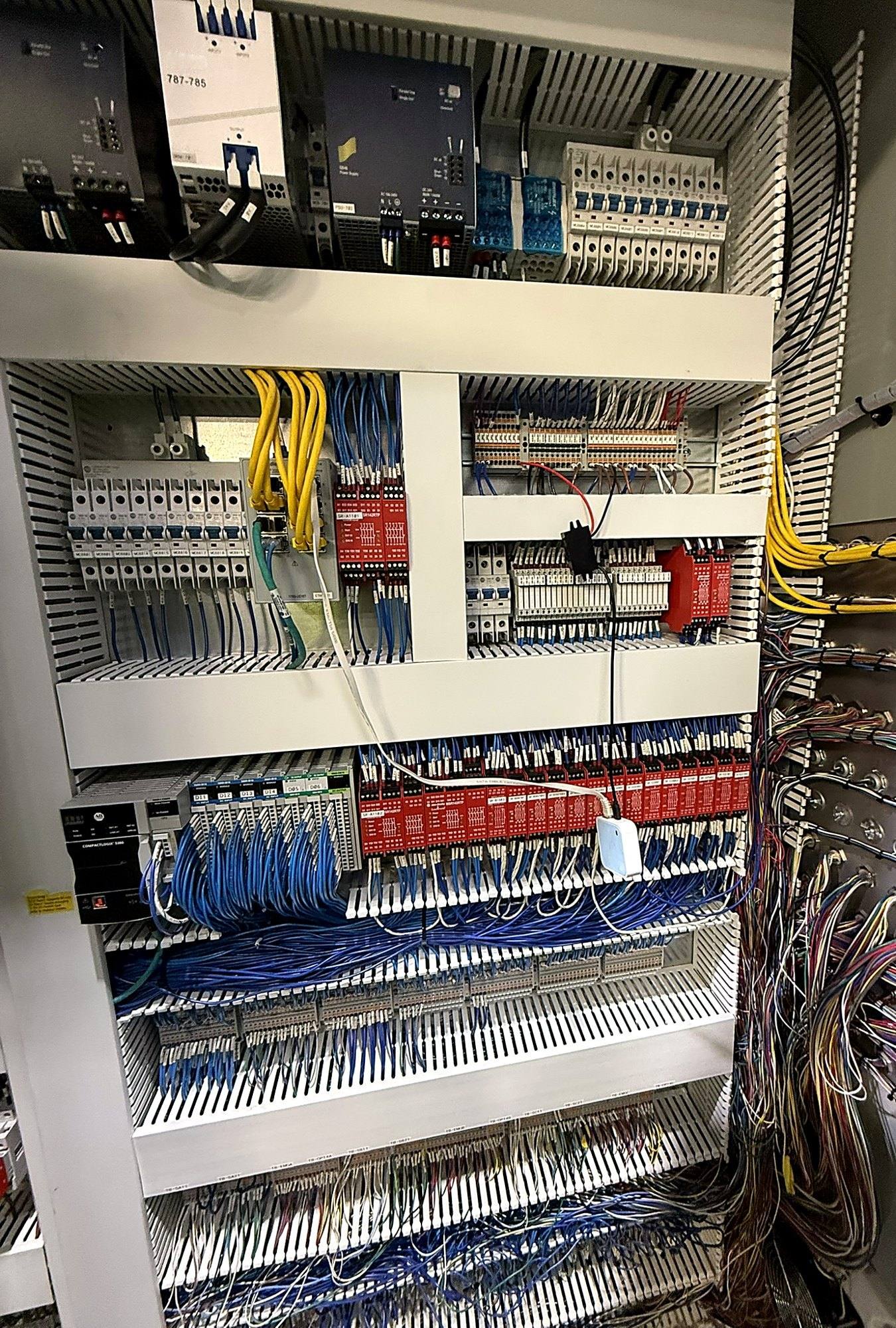
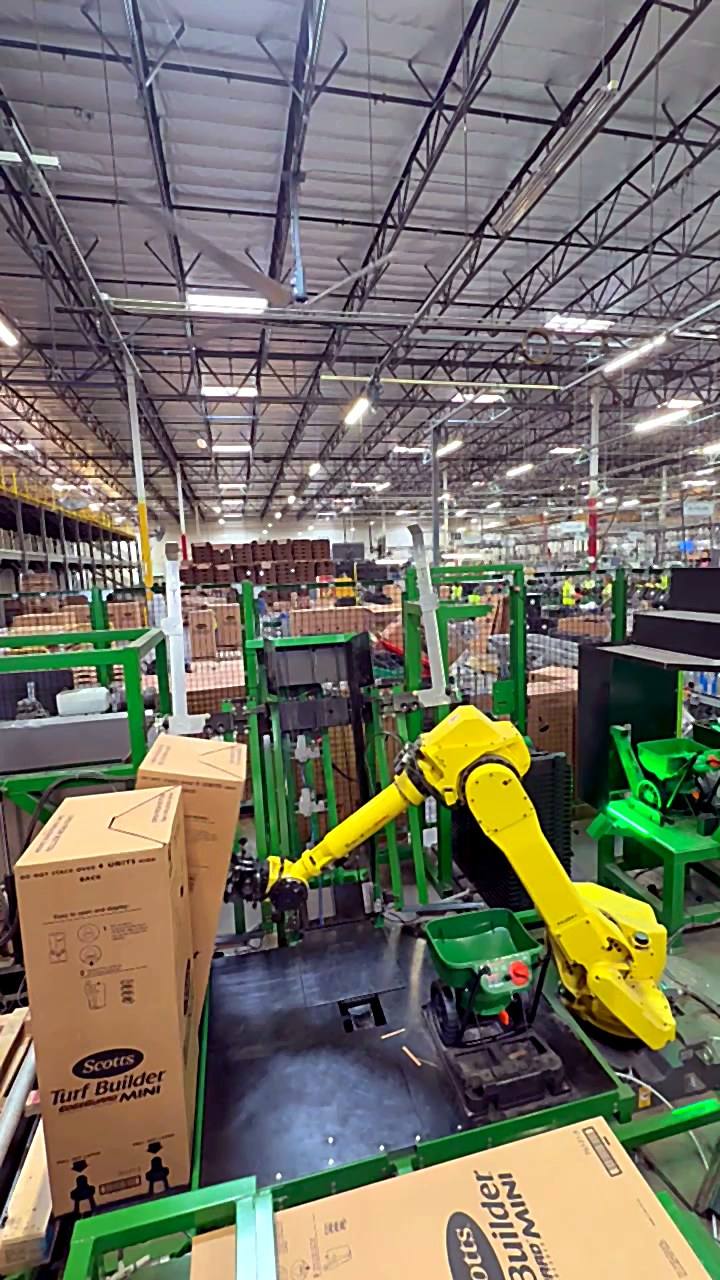
A few things fall out. Tools and supply items don’t qualify, and neither do items replaced on a cycle shorter than a year, which can take in vacuum cups and gripper pads bought as spares. Repair and replacement parts do qualify when they have a useful life of a year or more.
Where the cell sits in the plant matters too. CDTFA defines the manufacturing process as running from the point raw materials are received to the point the product reaches its completed form, “including packaging, if required.” Its guidance on material-handling equipment says equipment moving goods between stages of production at one site can qualify, while a forklift loading finished pallets onto trucks generally doesn’t. Cells that tend a machine, assemble parts or pack product into trays work inside that window.
End-of-line robotic palletizing sits at the edge of it. Regulation 1525.4 counts packaging only when it prepares goods for placement in your finished goods inventory. It says packaging that consolidates goods before shipping, or protects them on the way to the customer, is not packaging for this exemption.
Whether a palletizer qualifies depends on which of those jobs it does in your plant, so have your CPA review it before you count on the lower rate. You can also put the question to CDTFA in writing: under section 6596, a taxpayer who reasonably relies on written advice CDTFA gave them can be relieved of the tax.
How are equipment, fabrication and installation taxed on a cell quote?
A cell quote is not all equipment. California sales tax treats the lines differently, and the exemption can only reduce tax that applies in the first place. Our robot cell cost breakdown walks through the lines on a quote. This is how each kind is generally treated.
| Line on the quote | General California sales tax treatment |
|---|---|
| Robot, controller, gripper, frame, guarding, conveyors, control panel | Sale of tangible property, taxable. The partial exemption can apply. |
| Fabrication labor: building the frame, machining the gripper, wiring the panel | Taxable as part of the sale. CDTFA’s labor publication lists manufacturing a new piece of machinery as fabrication. |
| Installation labor on your floor | Excluded from the taxable measure under Regulation 1546. Fabricating property in place does not count as installation. |
| Custom robot, PLC and HMI programs | Regulation 1502 says tax does not apply to custom computer programs other than basic operational programs. How a machine’s control program is classed is a question for your CPA. |
| Freight by common carrier | Not taxable when separately stated at actual cost. Handling charges are taxable, at the partial rate when the sale qualifies. |
Ask any integrator to split the quote along those lines, and have your CPA look at it before the purchase order goes out. That is also the time to settle how the cell will be treated on your state return, since the useful-life test follows it.
Which form do we give the seller?
Form CDTFA-230-M, the Partial Exemption Certificate for Manufacturing, Research and Development, and Electric Power Equipment. For a single purchase, write in the purchase order or invoice number and a precise description of the equipment. For recurring purchases you can issue a blanket certificate, and then tell the seller in writing which orders don’t qualify.
The certificate is timely if the seller has it before they bill you, within their normal billing or payment cycle, or at or before delivery. The seller keeps it for at least four years. A construction contractor buying qualified property for a construction contract with you, such as a special purpose building, uses the construction version, CDTFA-230-MC.
If you already paid the full rate, the fix depends on which tax you paid. For sales tax, give the seller the certificate and records showing the purchase qualified. The seller can file the claim with CDTFA and pass the refund to you. For use tax, such as on a purchase from an out-of-state seller that didn’t collect, you file form CDTFA-101 yourself. Refunds can generally be claimed within three years.
The CalCompetes tax credit for expansions that add jobs
The California Competes Tax Credit, run by GO-Biz, is a credit against state income tax for businesses that locate, stay or grow in California. It is non-refundable, unused credit carries over for six tax years, and it is tied to hiring and investment milestones in a negotiated agreement, with recapture if the business misses them. The minimum request is $20,000.
Applications are first ranked on a ratio: the credit requested divided by the total pay of the new employees plus the total investment. GO-Biz’s application guide counts equipment as investment in personal property, so a robot cell bought as part of an expansion adds to that side. The application asks for a five-year plan of new full-time hires, wages and investment, and GO-Biz weighs whether the credit will influence the decision to add jobs in California. A project that adds a cell without adding full-time jobs has little to offer on that score.
The fiscal 2026-27 windows are July 20 to August 10, 2026 (now closed), January 4 to 25, 2027, and March 1 to 15, 2027. Investment bought before the application deadline doesn’t count toward the ratio, so apply while the expansion, and the cell, are still a plan.
Can Employment Training Panel funds pay for automation training?
A new cell means new skills for operators and maintenance techs. The Employment Training Panel repays part of that training for California employers who pay the Employment Training Tax. It is performance-based. ETP pays a fixed hourly rate per trainee, but only after each trainee completes 8 to 200 hours of approved training and then stays employed full time, 35 hours a week or more, for 90 consecutive days at ETP’s minimum wage. ETP opened its fiscal 2026-27 application window on May 1, 2026.
What matters for a robot cell:
- ETP funding is not retroactive. The contract has to be in place before training starts, so begin the application when the cell is ordered, not at handover.
- Productive Lab training, where a dedicated trainer supervises people using the actual equipment in production, is the method ETP says most often applies to manufacturing skills. If new equipment is the reason for the training, the application lists the equipment and how each job uses it.
- Safety training on new equipment is capped at 10 percent of each trainee’s hours.
- Any employer that pays the Employment Training Tax can hold its own contract. Small businesses, meaning 100 or fewer employees in California and no more than 250 worldwide, have their own program with modified requirements. Trade associations, chambers of commerce, community colleges and workforce boards also hold ETP contracts that cover several employers. For programs outside California, including MEP centers, WIOA funds and SBA 504 loans, see our guide to automation funding across the US.
California doesn’t follow federal Section 179 or bonus depreciation
Federal expensing is covered in our Section 179 guide for robot cells. The California return works differently. Under California law, as the Franchise Tax Board’s 2025 instructions state, the Section 179 limit is $25,000, reduced dollar for dollar once the Section 179 property you place in service in a year passes $200,000. At $225,000 of that property, the California deduction is zero, and California does not allow Section 179 on off-the-shelf software.
California also does not conform to federal bonus depreciation under IRC section 168(k). Corporations can elect a separate first-year deduction under R&TC section 24356 instead, capped at $2,000.
A cell expensed in its first year on the federal return can still be depreciated over several years on the California return, so the two sets of books differ. To see what that does to payback, run your own figures through the robot ROI calculator.
CAEATFA’s full exclusion for a narrow group of manufacturers
The California Alternative Energy and Advanced Transportation Financing Authority runs a Sales and Use Tax Exclusion program that removes state and local sales and use tax on property in an approved project. Its advanced manufacturing category requires specific technology areas such as semiconductors, advanced materials, nanotechnology, additive manufacturing or industrial biotechnology. The exclusion applies only after CAEATFA approves the project. Equipment bought earlier is taxed and can’t be put to use before approval, and the tax can be refunded once the project is approved.
The program charges an administrative fee of 0.4 percent of the qualified property (minimum $15,000) on top of the application fee, and scores applicants higher when they can’t use the partial exemption. It is authorized through January 1, 2028. For most robot cell buyers, the partial exemption is the practical one.
How to line up the incentives on a cell purchase
-
Confirm you are a qualified person
Check your NAICS code, the 50 percent revenue or expense test for the prior financial year, and how the cell will be treated on your state return, with your CPA.
-
Get the quote split
Equipment, fabrication, installation, programming and freight as separate lines, reviewed before you order.
-
Check CalCompetes timing
If the cell is part of an expansion that adds full-time jobs, plan for the January or March 2027 window while the decision is still open.
-
Start ETP before training
Apply while the cell is being built so the contract is in place when your crew starts training on it.
-
Give the seller CDTFA-230-M
Send it with the purchase order, before the first invoice.
-
Keep the cell in qualifying use
Keep it in California and in qualifying work for at least the first year after purchase.
If this is your first cell, our guide to automation for small manufacturers covers where to start.
Common questions
- We paid full sales tax on equipment that qualified. Can we get the difference back?
- Generally yes, within the statute of limitations, which is usually three years. If you paid sales tax, give the seller a completed CDTFA-230-M and records showing the purchase qualified. The seller can file the claim with CDTFA and pass the refund on to you. If you paid use tax, for example on a purchase from an out-of-state seller that did not collect tax, you file form CDTFA-101 with CDTFA yourself.
- Does the exemption reduce tax on installation and programming?
- Only where tax applies in the first place. Under Regulation 1546, installation labor is excluded from the taxable measure, so there is nothing for the exemption to reduce. Fabrication labor, such as building the frame or wiring the panel, is taxable as part of the sale and can be partially exempt. Custom programs are covered by Regulation 1502. Have your CPA review the quote lines before you place the order.
Sources
- CDTFA: Tax Guide for Manufacturing, and Research & Development, and Electric Power Equipment & Buildings Exemption
- CDTFA: Qualifications for the partial exemption
- CDTFA: Purchasers (certificates, $200 million cap, one-year rule, refunds)
- CDTFA: Sellers (3.3125 percent plus district taxes, timely certificates)
- CDTFA: Industry topics (useful life, repair parts, material handling, leases, shipping, refunds)
- CDTFA: Revenue and Taxation Code section 6377.1
- CDTFA: Regulation 1525.4, Manufacturing, Research and Development, and Electric Power Equipment
- CDTFA-230-M, Partial Exemption Certificate for Manufacturing, Research and Development, and Electric Power Equipment
- CDTFA Publication 108, Labor Charges: taxable labor
- CDTFA: Regulation 1546, Installing, Repairing, Reconditioning in General
- CDTFA: Regulation 1502, Computers, Programs, and Data Processing
- CDTFA: Revenue and Taxation Code section 6596, reliance on written advice
- GO-Biz: California Competes Tax Credit
- GO-Biz: California Competes Application Guide (updated November 2024)
- GO-Biz: California Competes Tax Credit Frequently Asked Questions (updated February 27, 2023)
- Employment Training Panel
- Employment Training Panel: Detailed Program Overview (July 2025)
- Employment Training Panel: Eligible entities
- Employment Training Panel: Small Business Program
- Employment Training Panel: Apply now for FY 2026-27 funds (May 1, 2026)
- FTB: 2025 Instructions for Form FTB 3885, Corporation Depreciation and Amortization
- FTB: 2025 Instructions for Form FTB 3885A, Depreciation and Amortization Adjustments
- CDTFA: CAEATFA Sales and Use Tax Exclusion
- California State Treasurer: CAEATFA Sales and Use Tax Exclusion Program
- California State Treasurer: CAEATFA Sales and Use Tax Exclusion FAQ