
When a guarded industrial robot cell beats a cobot
A guarded industrial FANUC cell beats a cobot on some jobs, and a cobot is the better buy on others. We build guarded cells in Fontana, so weigh our view with that in mind.
Many cobot vs industrial robot comparisons online are written by companies that sell cobots. This one comes from the other side. What decides it is the heaviest load, the rate the line needs, how close people have to be while the robot runs, and what the robot is holding.
In short
What is a cobot, and how is it different from an industrial robot?
A cobot, short for collaborative robot, is an arm built for power and force limiting. It senses contact through force or torque sensors in its joints or its base, stops when it hits something, and runs slowly enough that a bump or a pinch stays under set force and pressure limits.
The 2025 edition of ISO 10218, adopted in the US as ANSI/A3 R15.06-2025, dropped the term “collaborative robot”. A3’s summary gives the reason: only an application can be confirmed as collaborative, not a robot on its own. If a cobot carries a blade, the risk assessment has to cover the blade, whatever the arm is rated for. Our robot safety standards guide covers the other 2025 changes.
ISO/TS 15066 and a NIST paper on the subject describe four ways people and robots can share space: a safety-rated monitored stop (called monitored standstill in the 2025 edition), hand guiding, speed and separation monitoring, and power and force limiting. Only the last one needs an arm built to take contact. The other three rely on the controller’s safety functions plus external devices, such as an enabling switch on a hand-guiding handle or scanners around the cell, so they work with industrial robots too.
In a guarded robot cell vs cobot comparison, these are the rows that usually decide it:
| Cobot, power and force limiting | Industrial robot in a guarded cell | |
|---|---|---|
| How people are protected | The arm limits its own speed and force | Guarding, interlocked doors, light curtains or area scanners keep people out of reach |
| Payload | FANUC’s highest-payload cobot, the CR-35iB, is rated up to 50 kg | FANUC arms run from the LR Mate up to the M-2000iA/2300, rated 2,300 kg |
| Speed near people | Set from the risk assessment, low enough to keep contact under the limits | Full speed with people outside; slows or stops when a sensor sees someone |
| Washdown | CR-35iB body is IP54; FANUC’s smaller food-grade cobots, shown in 2025, are IP67 | Food-grade FANUC arms and deltas, up to IP69K on FANUC’s stainless delta |
| Tooling | A blade, spindle, torch or hot part brings guarding or sensors back | Blades, spindles, torches and hot parts stay behind the guard |
| Risk assessment | Required | Required |
How much can a cobot carry compared with an industrial robot?
The top of the cobot range is FANUC’s CR-35iB. FANUC rates it at 35 kg with 1,831 mm of reach, or 50 kg in a payload mode that cuts the reach to 1,643 mm. Industrial arms keep going from there: FANUC’s M-2000iA/2300 is rated for 2,300 kg with 3,734 mm of reach.
In the middle of the range the two overlap. FANUC’s M-20iD/25, an industrial arm we have used, has the same 1,831 mm reach as the CR-35iB and a lower 25 kg rating. At that size, speed, tooling and how people work around the cell decide it more than payload does.
Payload means the gripper plus the part. FANUC also rates its arms on the moment and inertia allowed at the wrist, so a long tool can hit a wrist limit before it reaches the kilogram rating. A long part loads the wrist the same way, because inertia grows with how far the mass is spread from it. Long tools and wide loads go on bigger FANUC arms for that reason.
Why does a cobot slow down near people?
Power and force limiting keeps the energy of any contact low. ISO/TS 15066, whose collaborative requirements are now part of ISO 10218-2:2025, sets out how hard a robot may press on or strike each region of the body. Clamping, where a hand is pinned against a fixture, is held to lower limits than a brief bump in open space. Speed, tool weight and part weight all add energy, so a heavier load means a slower robot.
FANUC America lists the CR-35iB at 300 mm/s in collaborative mode and 750 mm/s in high-speed mode. FANUC’s catalog notes that the 750 mm/s figure assumes a separate safety sensor watching the area, and that the working speed is set from the system’s risk assessment.
An industrial arm in a guarded cell runs at the rate the process needs, because nobody is within reach. Opening a door trips an interlock that stops it. At load openings a light curtain or area scanner does that job without a door. With speed and separation monitoring, a scanner can slow the robot as someone approaches and stop it at close range, and the robot goes back to full speed once they leave, where the risk assessment allows an automatic restart. Our light curtain vs area scanner guide compares the two, and robot cell guarding shows how we build the fence, doors and safety logic.
Which robots can take a washdown?
FANUC lists the CR-35iB body at IP54, with the wrist and J3 arm at IP67. The food-grade cobots FANUC showed at PACK EXPO Las Vegas in 2025, lower-payload models than the CR-35iB, use NSF H1 food-grade grease and a white epoxy coating, and are rated IP67. The stainless DR-3iB/6 delta robot FANUC showed alongside them is rated IP69K.
The two ratings test different things. IP67 means dust-tight and protected against temporary immersion (IEC 60529). IP69K is tested with close-range, high-pressure, high-temperature water jets (ISO 20653). Check the rating against how your crew cleans: hot, high-pressure water at close range points to IP69K, which in that lineup was the delta, not the cobots.
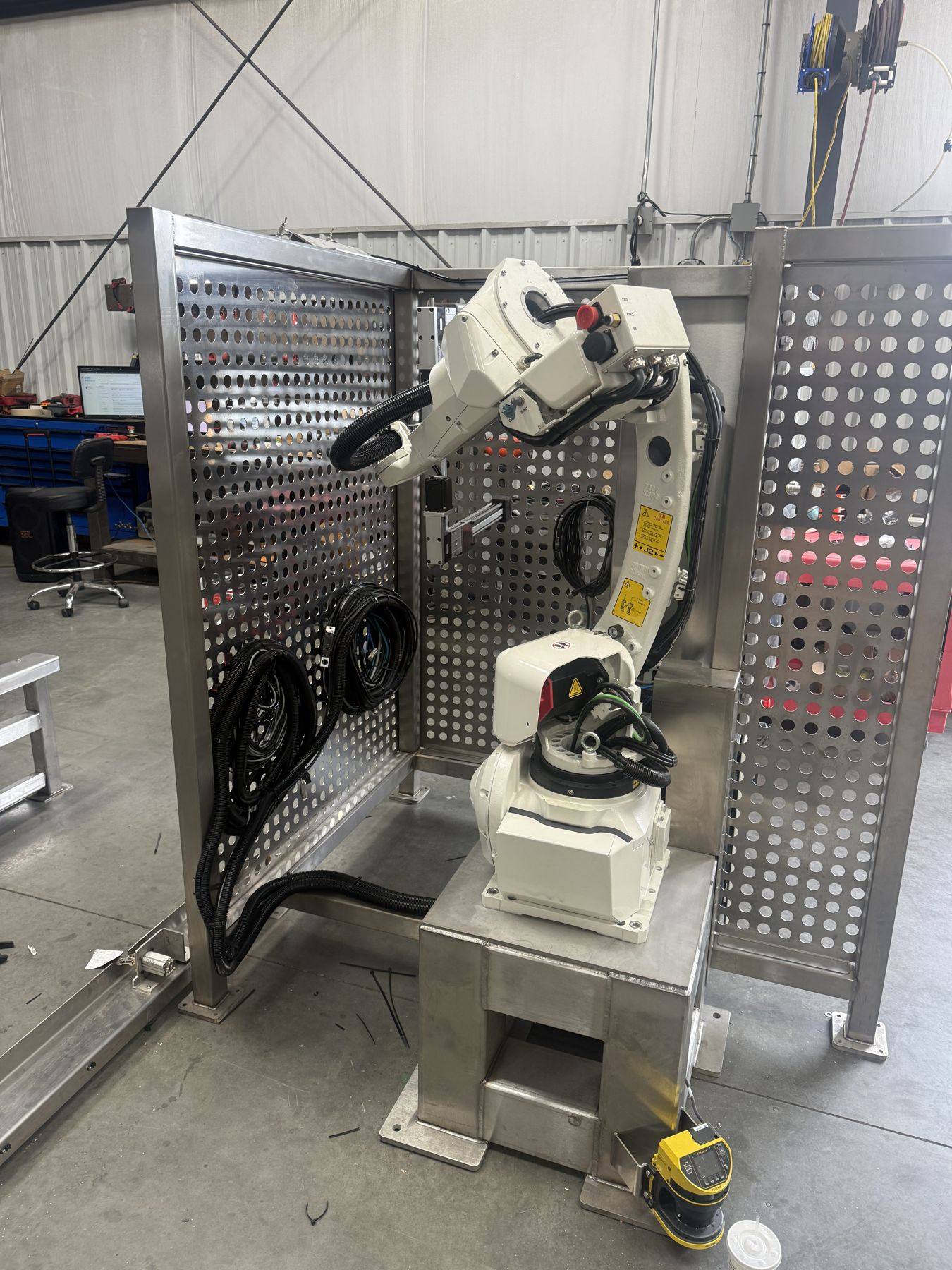
Guarding, pedestals and frames get washed too, so for food and bakery floors we put washdown-rated FANUC robots inside stainless guarding. At a commercial bakery, our FANUC robots move raw dough between trays and racks on a live production floor. The bakery automation page covers that work.
Which jobs need an industrial robot instead of a cobot?
Past the top of the cobot range there is no choice to make: the load needs an industrial arm. Below it, the tool and the part can still decide. Power and force limiting keeps the arm’s contact under the limits. It does nothing about a spindle, a weld arc, a sharp edge on the part, or a part fresh out of a heater.
Heavy loads add a second hazard. A dropped or swinging load hurts however gentle the arm is, so large-part handling goes behind guarding. Our cutting and hot-process jobs include a drilling and milling cell with a tool-changing router head, and a machine tending and forging cell that moves parts from a Swiss lathe into a heater and then into a forge. Both run FANUC industrial arms. Other guarded FANUC cells we build are listed by application, and delta vs SCARA vs 6-axis covers choosing among industrial robot types.
Cobot palletizer vs robot palletizer
A robot palletizer is an industrial arm inside guarding at the end of the line. It picks each case, turns it to the stack pattern and places it layer by layer. The pallet stations are often reached through light-curtained or scanned openings, so a forklift can pull a full pallet while the robot builds the next one.
A cobot palletizer can fit when the heaviest case plus the gripper sits well inside the cobot’s rating, the line’s best hour is within what it can place at the speed its risk assessment allows, and people need to walk up to the pallet without a fence in the way. Check what the cobot quote includes. Area scanners at the pallet stations mean the cell keeps people and robot apart with sensors, which is the same idea as a guarded cell.
Either way, the arm is one line on the quote. Both kinds of cell need a case gripper, an infeed conveyor, pallet stations, safety devices, programming and installation, so compare whole cells, not arm prices. Our robot cell cost breakdown goes through each of those lines.
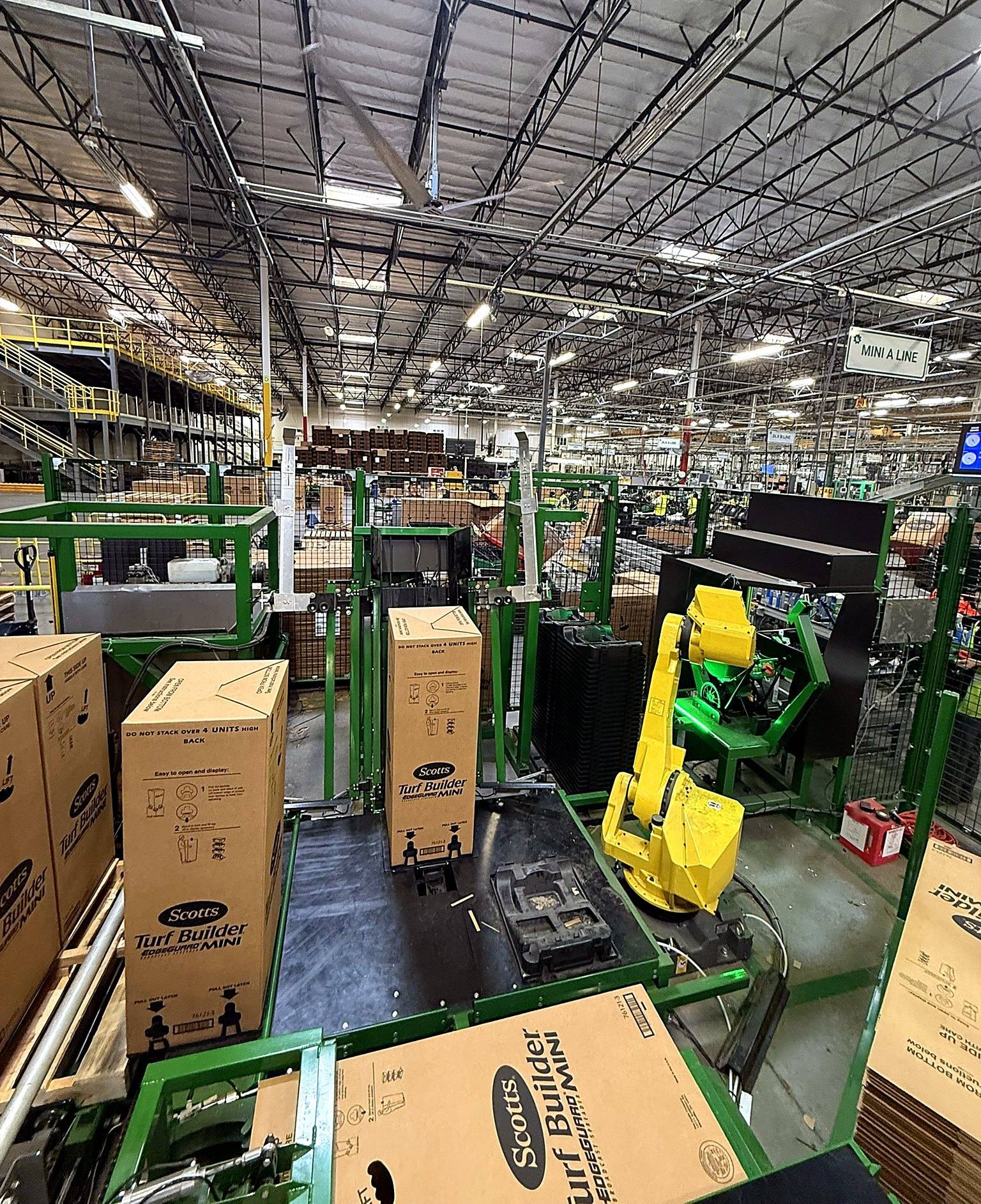
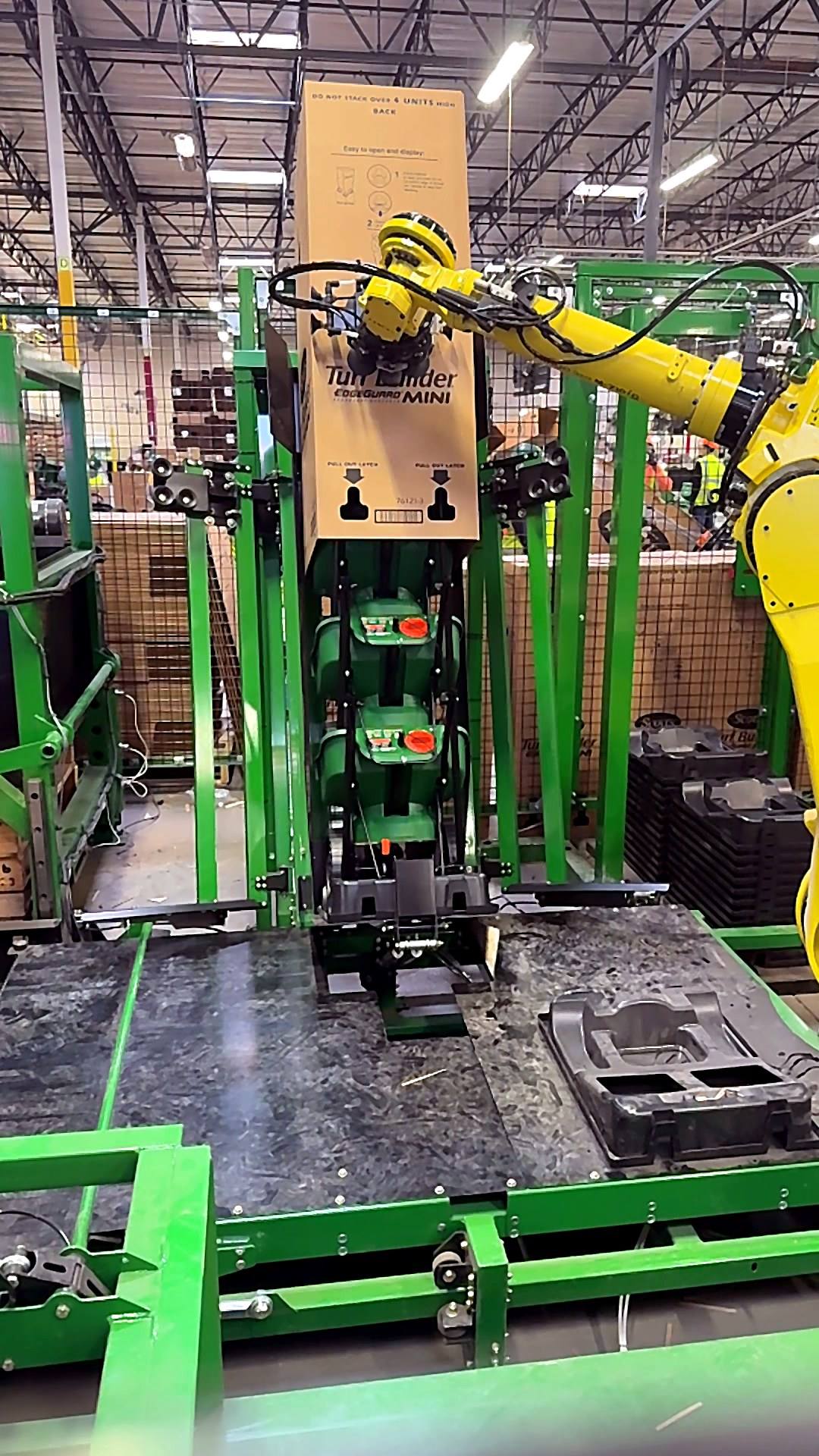
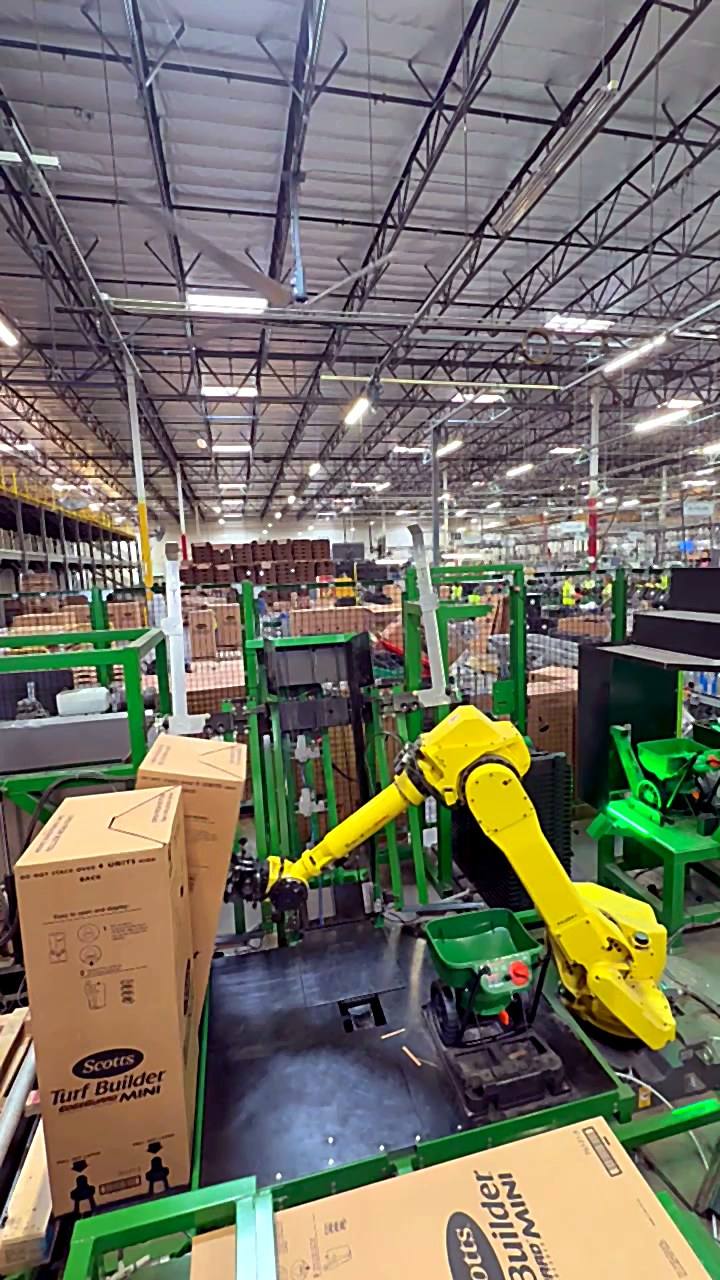
For a national lawn and garden brand’s plant in Temecula, we built FANUC robotic palletizing cells at the end of each packaging line, designed, fabricated, wired and programmed in Fontana.
Where a cobot may be the better fit
This list is general guidance, not experience from cobot projects of our own. A cobot is worth a serious look when most of these are true:
- The part and the gripper together are light, well inside the cobot’s rating.
- The rate is modest, so the speed set by the risk assessment doesn’t hold up the line.
- A person works at the same fixture as the robot through the shift, handing parts in or checking them.
- The robot moves between jobs often, and there is no floor space for a fenced cell.
- The tool is harmless to touch: no blade, spindle, torch or hot part.
The application still needs a risk assessment, and it may still call for sensors or partial guarding. If the list describes your job, a cobot supplier is a reasonable first call.
Which one fits your job?
What we need to answer it
- The heaviest part, and a photo of how it is held today
- The rate at the line's best hour
- Where people stand and what they do at the station through a whole shift
- Anything sharp, hot or spinning on the tool or the part
- How the area is cleaned, if it gets washed down
- A floor plan or photos of the space
Whoever builds the cell, have your own safety professional review the design.
Common questions
- Can an industrial robot work near people?
- Yes, with safeguarding designed from a risk assessment. Most cells keep people out of reach while the robot runs, using guarding, interlocked doors, and light curtains or area scanners at load openings. With speed and separation monitoring, a scanner slows the robot as someone approaches and stops it at close range. OSHA has no robot-specific standard; its general machine-guarding and lockout rules still apply, and the robot detail comes from ISO 10218 and ANSI/A3 R15.06-2025. Have your own safety professional review the design.
- Is a cobot safe to use without guarding?
- Not automatically. The 2025 edition of ISO 10218 dropped the term collaborative robot, because only an application can be confirmed as collaborative. The tool, the part, the speed and where people stand all go into the risk assessment. A cobot carrying a blade, a hot part or a heavy load may still need guarding or safety sensors, and the risk assessment decides which.
- Can operators load parts into a guarded cell without stopping the robot?
- Often, yes. A light curtain at a load opening, or a two-position station or turntable, lets an operator load one side while the robot works on the other. If the robot has to reach into the operator's side, the safety system stops or holds it. Where the stations sit and how far the curtain must be from the hazard are worked out in the design, from the risk assessment and the robot's stopping time.
Sources
- A3: Updated ISO 10218, answers to frequently asked questions
- A3: ANSI, A3 publish revised R15.06 industrial robot safety standard (September 2025)
- ISO 10218-1:2025, Robotics: Safety requirements, Part 1: Industrial robots
- ISO 10218-2:2025, Robotics: Safety requirements, Part 2: Industrial robot applications and robot cells
- ISO/TS 15066:2016, Robots and robotic devices: Collaborative robots
- NIST: Marvel and Norcross, Implementing speed and separation monitoring in collaborative robot workcells (PDF)
- OSHA: Robotics, standards
- FANUC: CR-35iB catalog, RCR35iB(E)-04 (PDF)
- FANUC America: CR-35iB specifications
- FANUC America: M-20iD/25 specifications
- FANUC America: M-2000iA/2300 specifications
- FANUC America: food-grade robotics at PACK EXPO Las Vegas (September 2025)
- IEC 60529, Degrees of protection provided by enclosures (IP Code)
- ISO 20653:2023, Road vehicles: Degrees of protection (IP code)