
What is industrial automation? Types, parts and examples
A plain explanation from a shop that builds FANUC robot cells and custom machines: the three types, the parts every system is built from, real examples, and how a plant usually starts.
Industrial automation is machinery and control equipment doing production work that people would otherwise do or control by hand: moving parts, joining them, machining, inspecting, packing. At CalWest Robotics we design, build, wire and program FANUC robot cells and custom machines in our shop in Fontana, CA, and install them at plants across the United States. This guide explains the field the way we would to a plant manager looking into it for the first time.
In short
What industrial automation means on a plant floor
The International Society of Automation (ISA) defines automation as “the creation and application of technology to monitor and control the production and delivery of products and services.” On a factory floor that comes down to two things working together: a machine that does the physical work, and a controller that decides when and how it does it.
A conveyor that stops when a photo-eye sees a case is automation. So is a press that won’t stroke until its light curtain is clear, and a robot that stacks every case on a pallet to the same pattern for a whole shift. The scale differs but the pattern is the same. Sensors report what is happening, a controller runs the logic, and actuators such as motors, air cylinders and robot arms do the work.
Factory automation and process automation
“Factory automation” usually means discrete manufacturing, where the product is counted in pieces: brackets, cases, molded parts, assemblies. “Process automation” usually means continuous or batch processes measured by volume or weight, such as chemicals, refining, water treatment or the mixing and cooking side of a food plant. There the work is controlling flows, temperatures and pressures.
Many plants run both. A bakery controls mixing and baking as a process, then handles dough, trays and finished cases as discrete parts. This guide covers the discrete side, which is where robots, PLC-controlled machines and custom mechanisms do most of their work.
Types of industrial automation: fixed, programmable and flexible
Britannica’s article on automation splits production automation into three types, sorted by how easily the equipment changes from one product to another.
| Type | How it works | Typical examples | Fits when |
|---|---|---|---|
| Fixed (hard) automation | The sequence of operations is set by how the equipment is built | Machining transfer lines, dedicated assembly machines, a custom feeder and tapping machine | One part or a narrow family, at high volume, for years |
| Programmable automation | The equipment is reprogrammed and set up again for each batch | CNC machine tools, a robot cell loaded with a new program and gripper between runs | Batches of different parts, with downtime between them for changeover |
| Flexible automation | The equipment changes over between a limited set of parts quickly, often automatically | A robot cell that picks its program from a recipe or a part ID, a flexible manufacturing system | A known mix of parts running together with little or no changeover time |
The trade-off runs one way. Fixed automation takes a large investment up front and is usually the fastest way to make one part in volume, but it is the hardest to change. A new product can mean rebuilding the machine. Programmable and flexible automation give up some of that speed in exchange for running a different part tomorrow.
Where a robot cell fits
An industrial robot is programmable by definition. The International Federation of Robotics (IFR) bases its definition on ISO 8373:2021: an “automatically controlled, reprogrammable multipurpose manipulator, programmable in three or more axes.” The same arm can stack cases this year and load a machine next year with a different gripper and a new program.
Whether a robot cell works as programmable or flexible automation depends on how it is built. A cell that needs a technician, a gripper swap and a long setup between part numbers is programmable. A cell that reads which part is coming, calls the right program and handles the whole family with one gripper is flexible. On the spray nozzle assembly tables we built for a plant in Temecula, CA, the operator starts a color changeover from the operator screen, not from the robot’s teach pendant.
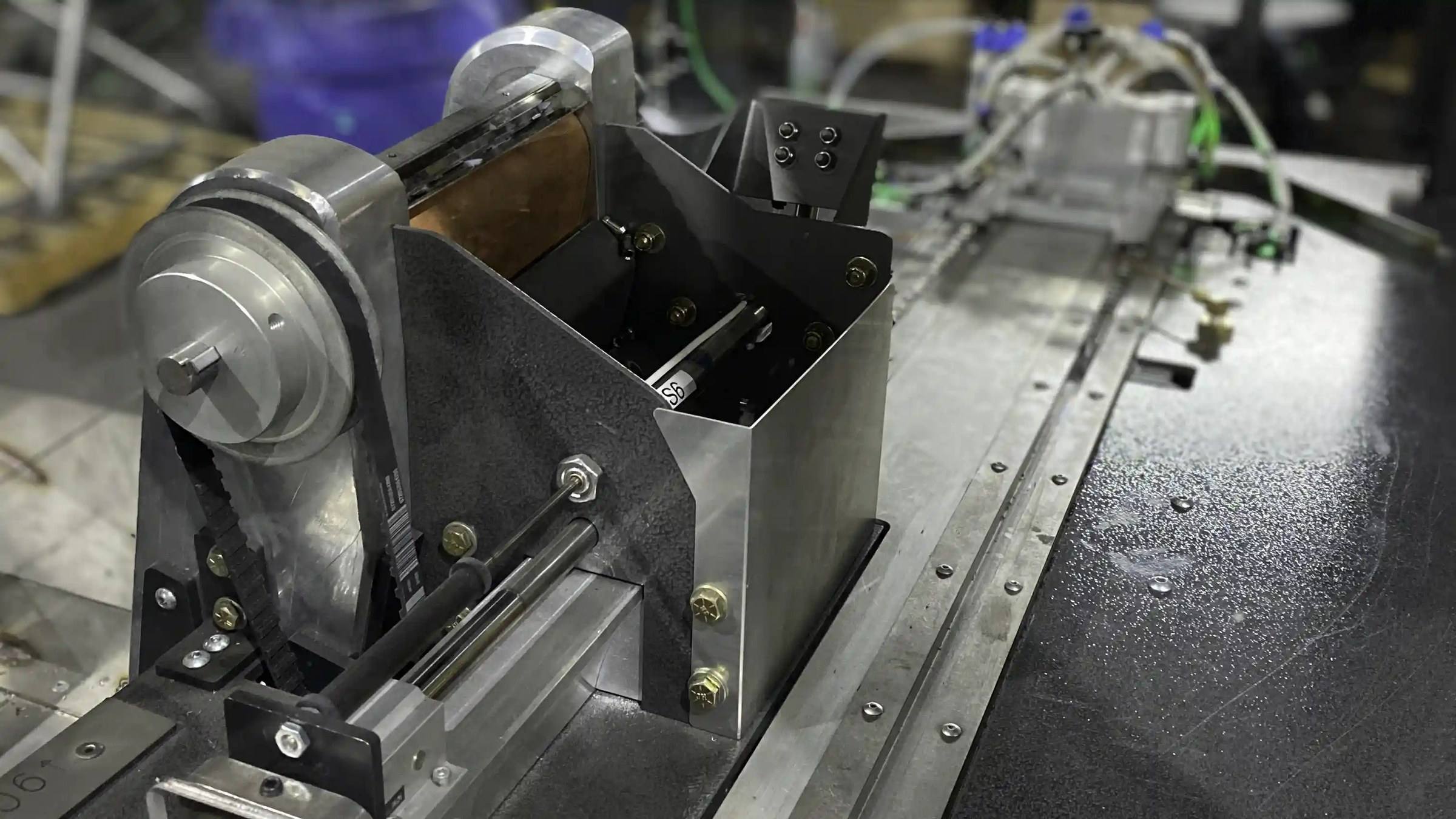
Not every job needs a robot. The automated tapping machine we built for an aerospace supplier is fixed automation: a custom feeder and tapping mechanism made for high-volume production of one aircraft part, with a PLC running every mechanical function and an HMI showing the machine’s state as it runs. Our custom automation page covers machines like it.
What are the parts of an industrial automation system?
A single automated press and a multi-robot line are built from the same kinds of parts. The table lists them, with the equipment we program most often.
| Part | What it does | Examples we work with |
|---|---|---|
| Robot | Moves the part or the tool along taught paths | FANUC LR Mate, M-10iD/12, M-20iD/25 and delta robots on R-30iB controllers |
| PLC | Runs the sequence: reads inputs, runs the logic, sets outputs | Allen-Bradley CompactLogix and ControlLogix, Siemens S7, AutomationDirect Do-more and BRX, Beckhoff TwinCAT |
| Safety system | Stops hazardous motion when a person enters or a device trips | E-stops, door interlocks, light curtains, safety relays, GuardLogix safety PLCs |
| HMI | The operator’s screen: status, counts, recipes, faults | FactoryTalk View and Optix-style screens, C-more panels, custom web HMIs |
| Sensors and vision | Tell the controller where the parts are and whether they are right | Photo-eyes, proximity switches, encoders, FANUC iRVision 2D cameras, Keyence measurement |
| Motion and part handling | Move and present the parts | Kinetix servo drives, conveyors, bowl feeders, fixtures, air cylinders |
| Networks and software | Connect the pieces to each other and to the business | EtherNet/IP between the PLC and the robot, cycle and fault logging, ERP links |
Robots
Six-axis arms do most handling, welding, assembly and machine loading. Delta robots hang over a belt and make fast, light picks. Large arms, some built only for palletizing, stack cases at the end of packaging lines. Robot size is set by the part plus the gripper, the reach to the farthest point and the rate. We integrate FANUC robots only.
PLCs
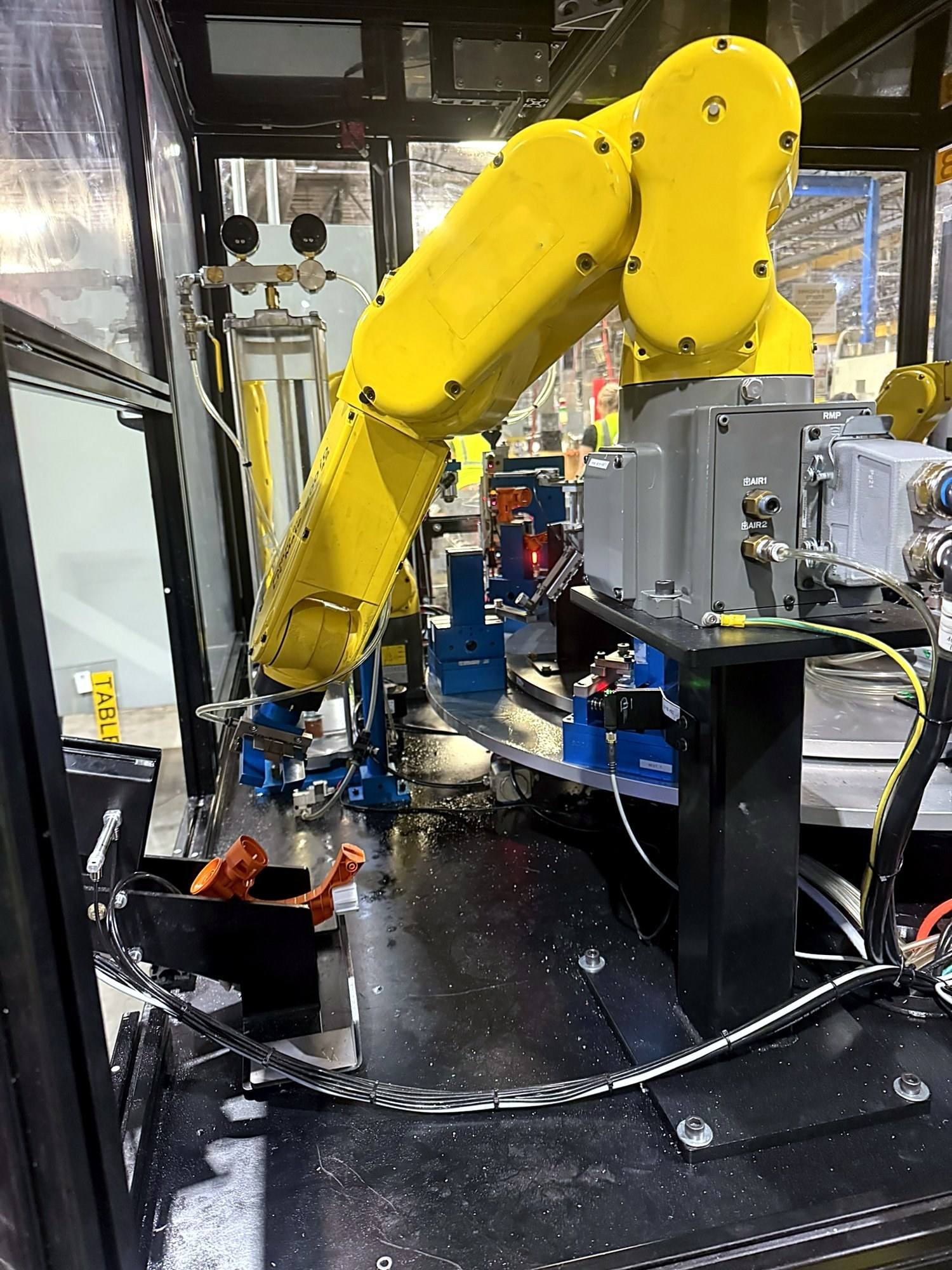
The programmable logic controller is the cell’s sequencer. It reads every sensor, runs the logic that decides what happens next, and switches motors, valves and signals. In a robot cell, the robot controller handles the arm’s motion and the PLC runs everything around it: conveyors, clamps, the safety circuit, and the handshake with the machines upstream and downstream.
IEC 61131-3, revised in 2025, defines the common PLC programming languages, among them ladder diagram, function block diagram and structured text. Ladder logic reads like the relay drawings it replaced, which is one reason many maintenance techs find it easy to follow. We write PLC code in Studio 5000, TIA Portal, Do-more Designer and TwinCAT; see PLC programming for how we approach it.
Safety system
Guarding and safety logic are part of the design from the first layout. In the US the robot safety standard is ANSI/A3 R15.06-2025, published in three parts: one for robot makers, one for robot applications and cells, and a new third part for the companies that use robot cells. It puts heavy weight on risk assessment. We do a risk assessment for each cell we build, and your own safety professional should review it. Our robot safety standards guide covers what changed in 2025.
HMIs and data
The operator screen is the part of the system people look at all day. On the Temecula assembly cells it shows cycle times for each table, color changeover and fault status, because that is what the crew watches. Behind the screen, every cycle and fault can be logged with a time stamp, and counts, jobs and scrap can post straight to the ERP so nobody re-keys them. Machine data and ERP integration explains how that link gets built.
Industrial automation examples from cells we built
These are jobs we designed, built and programmed in our Fontana shop, with the type of automation each one is closest to.
| Job | What does the work | Type |
|---|---|---|
| Palletizing at the end of packaging lines, Temecula, CA | FANUC robots pick, turn and place every case to the stack pattern, layer by layer | Programmable: patterns are data in the robot program |
| Spray nozzle assembly, Temecula, CA | LR Mate robots, bowl feeders presenting parts nonstop, three interlocked and light-curtained tables, a custom HMI | Flexible within the part family: color changeover from the screen |
| Bakery dough handling | Robots moving dough between trays and racks on a live floor; delta robots with soft-touch grippers that don’t mark raw dough | Programmable |
| Machine tending and forging | A robot moves parts from a Swiss lathe into a heater, a second robot places them in a forge, and parts go out onto two trays | Programmable, set up for lights-out running |
| Drilling 3D parts | A FANUC M-10iD/12 with a router head and tool changing, mounted upside down over a fixture table; vision checks each hole and logs the result | Programmable |
| Tapping an aircraft part | A custom feeder and tapping mechanism under PLC control, with an HMI | Fixed |
The palletizing cells are the clearest example of a robot doing one heavy, repetitive task for a whole shift. Our robotic palletizing page walks through how a case moves through one of those cells.
How much industrial automation do US plants use?
More every year, and in more industries. The IFR counted 38,400 industrial robots installed in the United States in 2025, up 12% from the year before, which made the US the second-largest market after China. China installed 354,200. Worldwide, factories installed more than 600,000 robots in 2025, and the IFR puts the number in operation at a record 5 million.
Automotive is still the largest US customer, with 13,500 installations in 2025, about 1% fewer than in 2024. Metal and machinery came second at 3,000, down 15%. Food and beverage grew fastest of the three, up 30% to 2,900 robots.
Orders tell the same story. A3 (the Association for Advancing Automation) reports that companies in North America ordered 36,766 robots worth $2.25 billion in 2025, up 6.6% in units from 2024, and that orders from outside the auto industry outpaced automotive. Robots are no longer mainly an auto plant tool.
What automation does well, and what it doesn’t
Automation is good at:
- Repeating the same motion to the same position all shift, every shift.
- Holding a steady rate, which makes the steps after it easier to plan.
- Taking people off heavy, repetitive or hazardous stations and moving them to setup, inspection and running the next job.
- Recording every cycle and fault, so downtime has a reason attached to it.
It struggles with:
- Parts that arrive in a different position or condition each time. A robot repeats whatever the process hands it, including the variation.
- Drawings that change every week.
- Tasks that need a person’s judgment on each part.
- A scrap problem nobody has traced. Automating that step tends to automate the problem.
Automated equipment also needs owners. Someone has to run it, keep its program backups, stock its wear parts and change it when the part changes. Plan for that before the equipment arrives.
How a plant starts with industrial automation
Most first projects follow the same path. Measure the shop for a few weeks, choose one repetitive step the work waits on, get the parts arriving the same way every time, write down what the cell must do, and ask for a concept. Our step-by-step guide on how to automate a manufacturing process goes through each stage, and automation for small manufacturers covers what to measure first.
For a plant buying its first robot, a turnkey robot cell puts design, fabrication, wiring, programming and install with one supplier, so one team answers for the result. We build every cell in Fontana, run it off in our shop with your parts, and install and commission it on your floor wherever your plant is in the United States.
Common questions
- What is the difference between industrial automation and robotics?
- Robotics is one branch of industrial automation. Plenty of automated equipment has no robot at all: conveyors, bowl feeders, presses, CNC machines and custom machines built for one part. A robot is the programmable arm. Automation is the whole system around it, including the PLC, the safety devices, the sensors and the operator screen. A robot cell is a robot plus that system.
- Is a PLC the same thing as industrial automation?
- No. A PLC is the controller that runs a machine's sequence. It reads sensors, runs the logic and switches motors, valves and signals to other machines. It is one part of an automated system, along with the robot or mechanism doing the work, the safety devices, the operator screen and the network that ties them together. Most automated cells and machines have one.
- Which type of automation suits high-mix, low-volume production?
- Programmable or flexible automation. A robot cell with a gripper that handles a family of parts, recipes the operator picks from the screen and programs prepared offline can change over between part numbers with little downtime. Fixed automation is hard to justify when the product changes often, because a new product can mean rebuilding the machine.
- Do we need to automate the whole line at once?
- No, and most plants shouldn't. Automating one station first, usually the step the work queues behind, lets your crew learn to run and maintain the equipment and gives you real numbers before the next project. Plan the first cell so it can exchange signals with the machines on either side, which makes the next step easier to add.
- What does a plant need in-house to run automated equipment?
- Someone who owns it. That usually means an operator lead who runs the cell every shift and a maintenance tech who can read the PLC program, clear faults, replace a sensor or a gripper part and restore a program backup. Settle training, the spare-parts list and who you call for support before you buy the equipment, not after it arrives.
- Who designs and builds industrial automation systems?
- System integrators and machine builders. An integrator takes a robot or other bought equipment and designs, builds, wires and programs a working cell around it for your part. We are a FANUC Authorized System Integrator that does every step in one shop in Fontana, CA, and we ship and install the cells at plants anywhere in the United States.
Sources
- ISA: What is automation?
- Britannica: Automation, manufacturing applications of automation and robotics (fixed, programmable and flexible automation)
- IFR: Industrial robots, definition based on ISO 8373:2021
- IFR press release, Sept. 24, 2026: U.S. now second-largest robotics market, following China (World Robotics 2026)
- IFR press release, Sept. 24, 2026: Five million robots now operate in factories globally
- Robotics 24/7: A3, robot orders grow 6.6% in 2025 as general industries drive broader automation adoption
- IEC 61131-3:2025, Programmable controllers, Part 3: Programming languages
- The Robot Report: A3 releases full three-part national safety standard for industrial robots (ANSI/A3 R15.06-2025)