
Automation for small manufacturers starts with data and one bottleneck
Our parent company is a contract job shop, and we build FANUC robot cells in the same Fontana shop. What we'd tell another small shop: get a few weeks of real numbers, then automate the one step everything waits on.
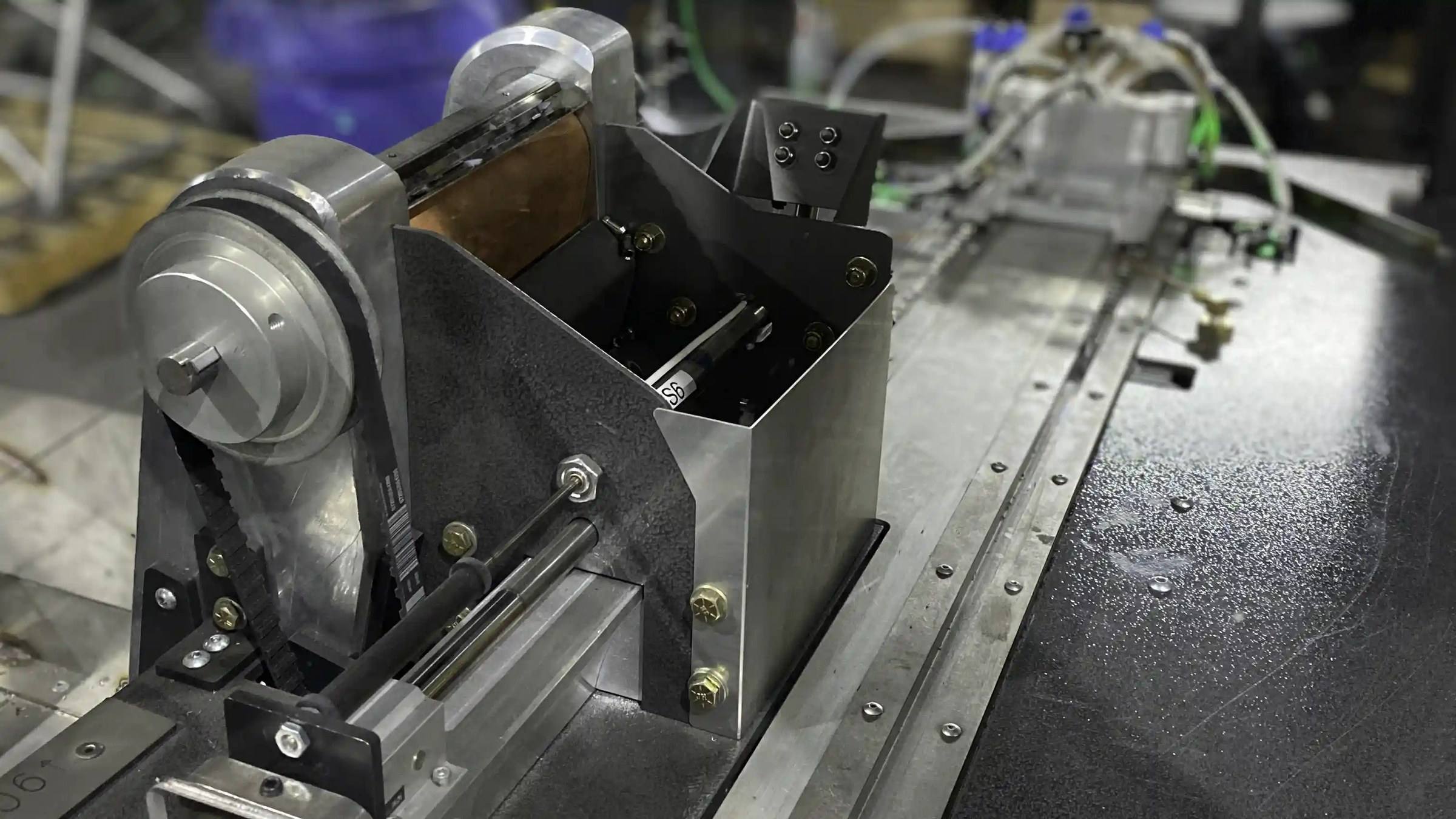
Our advice starts one step before the robot, with the numbers. CalWest Manufacturing is a contract manufacturer in Fontana, CA, doing tube laser cutting, plate laser cutting, CNC tube bending, press brake forming, welding and 5-axis CNC machining. CalWest Robotics designs, builds and programs FANUC robot cells in the same shop. So we see the question from both sides: as a shop that makes parts for other companies, and as the team that builds the cells.
In short
We run a job shop too
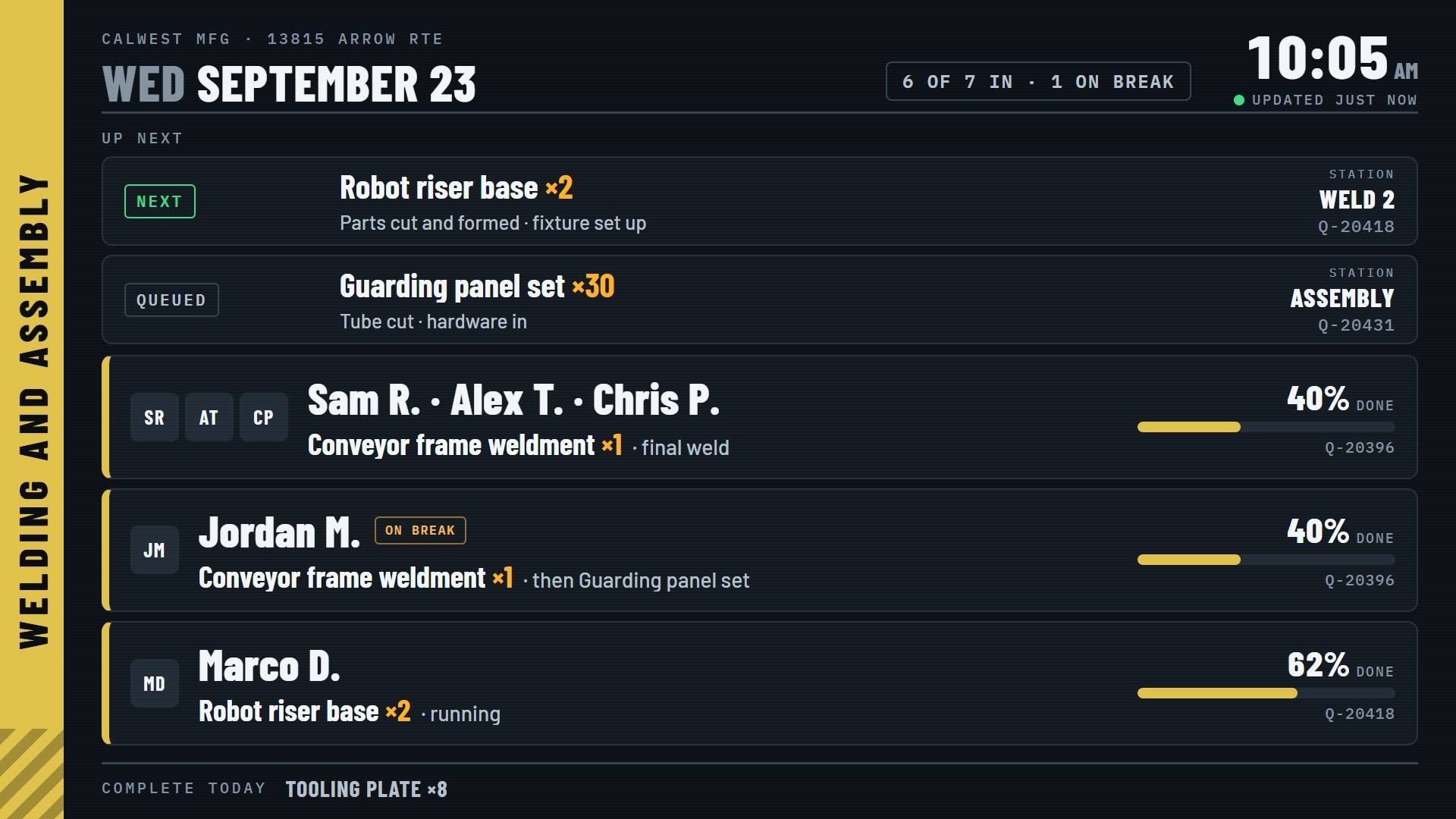
We run our own shop on software we wrote: department boards on the shop TVs, live job tracking, and an iPhone app with jobs, schedules, team chat and push alerts. The welding and assembly board (Fig. 2) shows what is up next at each station, who is on which job and how far along each job is. The plate cutting board shows the job on the table, what is queued behind it and what has just finished.
The boards put the state of the shop floor where anyone can see it, so on any given morning you can tell which department the work is stacked up in front of. In a small factory, that is where choosing the first thing to automate starts.
What to measure before you buy a robot
You don’t need a new system to start. A sheet at each station, filled in honestly for a few weeks, gives you most of what a first project needs. Keep it simple enough that people actually fill it in.
| Track | How to collect it by hand | What it tells you |
|---|---|---|
| Parts made per shift, by job | A tally at the station | Real output against what the job was quoted at |
| Where jobs wait | The time each job arrives at a department and the time work starts | Which department the queue builds in front of |
| Downtime | Stop time, restart time and a one-line reason | Which stops cost the most hours |
| Scrap and rework | Count and a reason for each | Whether a process problem needs fixing before anything is automated |
| Changeovers | How many per shift, and how long each takes | Whether a cell would spend its day being set up |
| Touch time | A stopwatch on a few cycles of each step | The labor hours a cell could free up, which is the input for payback |
If your machines have PLCs, the part counts, cycle times and fault stops can often be read straight off them. On the machines and cells we connect, every cycle and fault is logged with a time stamp and can be searched later, and custom Python posts counts, jobs and scrap to the ERP so nobody re-keys them. Our page on machine data and ERP integration covers how that link gets built.
You don’t have to do the measuring alone. The NIST Manufacturing Extension Partnership (MEP) works with small and medium-sized manufacturers through centers across the U.S. and in Puerto Rico, on operational improvements as well as growth. MEP centers, state training grants and other programs are listed in our guide to automation grants and funding.
How do you pick the first process to automate?
Look for the step the queue builds in front of. An hour saved there is an hour saved for every job behind it. An hour saved at a station that already sits waiting for work only adds an hour of idle time there, and the jobs still queue at the bottleneck. The rest of the sequence, from choosing the process to support after install, is in our guide to automating a manufacturing process step by step.
Signs a job is ready for a robot cell
- Your numbers show it is the step the work waits for
- The motion repeats: the same pick, turn and place many times a shift
- The part is stable: one part or a small family, not a new drawing every week
- Parts can arrive the same way every time, from a conveyor, a feeder, a fixture or a stack
- It is a station that is hard to keep staffed: heavy, repetitive or tiring work
- The steps before and after it can keep up with a faster station
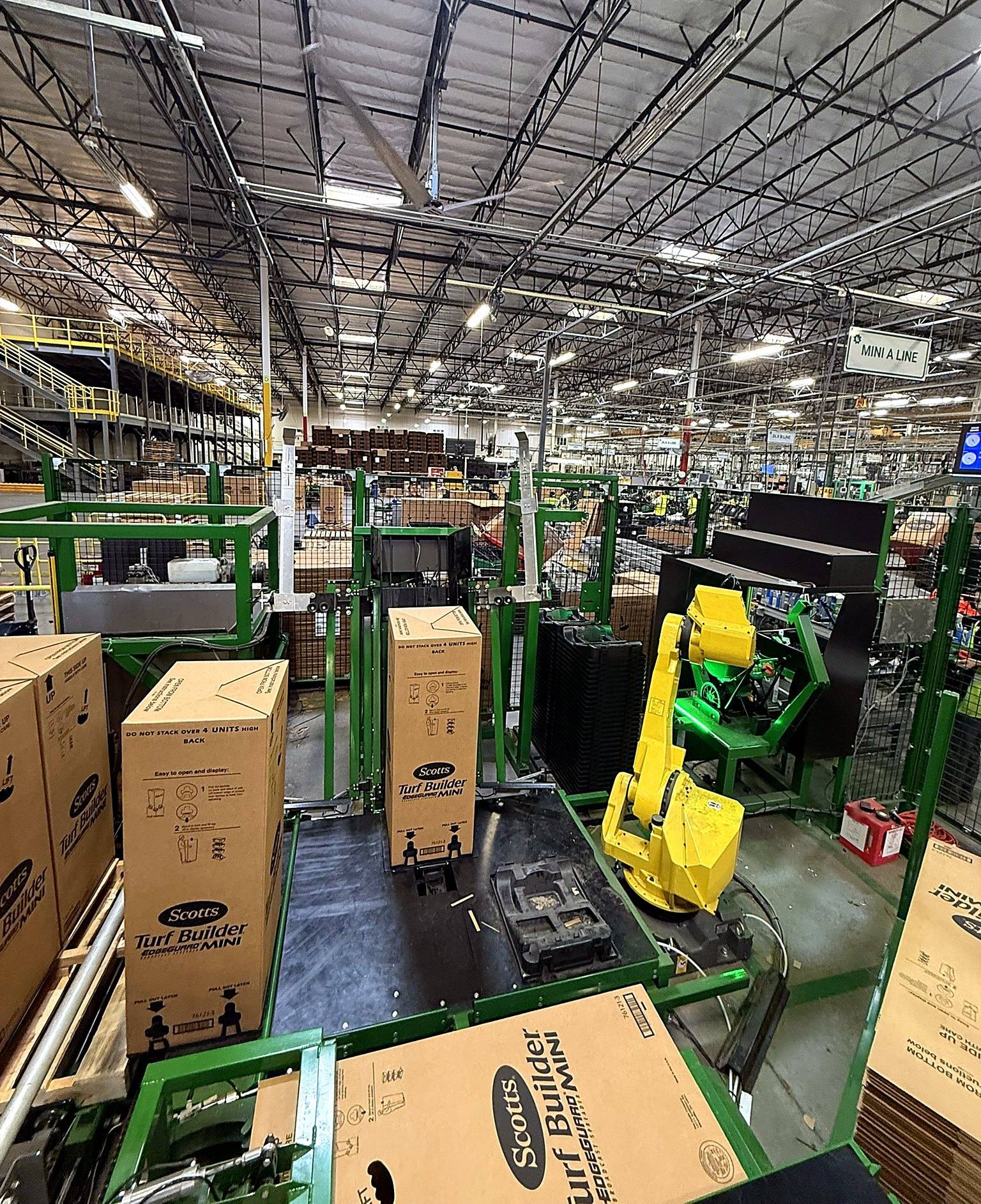
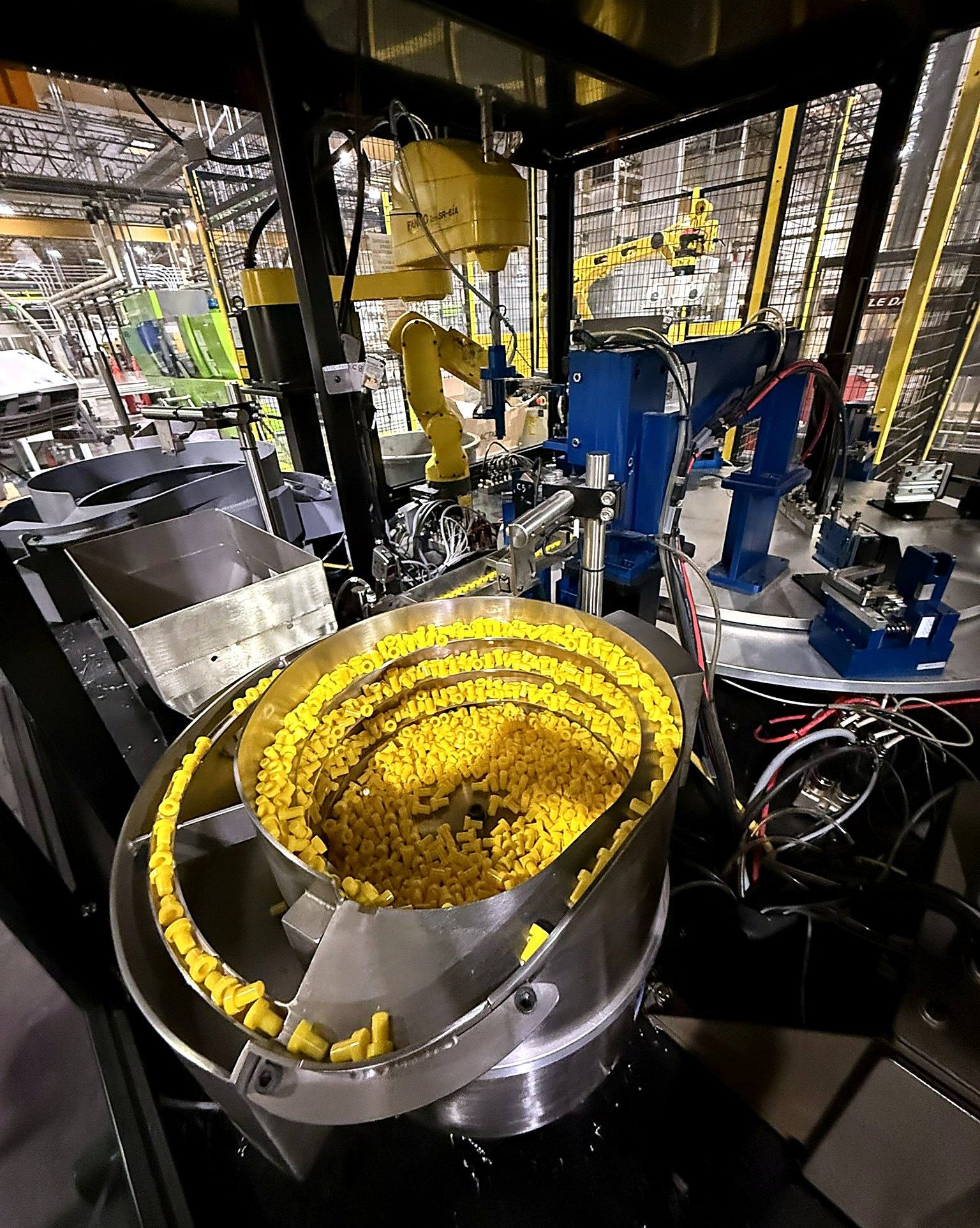
Several of the cells we’ve built do this kind of repeated work. At a plant in Temecula, FANUC robots build pallets at the end of each packaging line, picking, turning and placing every case to the stack pattern, layer by layer. In the same plant, LR Mate robots assemble spray nozzles, with bowl feeders presenting the parts nonstop. The Temecula palletizing cells and spray nozzle assembly cells case studies cover both in more detail.
A machine tending cell we built moves parts from a Swiss lathe into a heater, and after the heating cycle a second robot places them into a forge. The parts go out onto two trays, and the cell supports lights-out operation.
Some jobs should wait. If parts show up in a different position every time, if nobody knows yet what causes the scrap, or if every part needs a person’s judgment, automating the step tends to automate the problem. Fix the part presentation or the process first.
Whether the cell uses a collaborative robot or an industrial arm is a hardware choice, and it comes after you have picked the job and know its payload, reach and guarding needs. We integrate FANUC industrial robots, and our guide to cobots vs industrial robots lays out the trade-off.
Is automation worth it for a small manufacturer?
It can be, when the job repeats, the part is stable and the step is a real bottleneck. Simple payback is the cell’s installed cost, meaning the quote plus freight, rigging, utility hookups and training, divided by what it saves each year after what it costs to run. The savings side is the labor hours the cell frees up at your burdened rate, plus the scrap and overtime it removes. The cost side is maintenance, spare parts and the time of whoever owns the cell. The touch times from your sheets are the inputs.
Freed hours only count as savings if the people move to other work or the extra output gets sold. Decide which one applies before you ask for a quote. The robot ROI and payback calculator works only from numbers you type in, and the robot cell cost breakdown explains what makes up the price side.
What the labor shortage numbers say about automation
Deloitte and the Manufacturing Institute estimate that US manufacturing could need as many as 3.8 million more workers from 2024 to 2033, and that as many as 1.9 million of those jobs could go unfilled.
For a single shop, the national numbers matter less than a local one: the station you have the hardest time keeping staffed. If that station also passes the rest of the checklist above, it is a good place to look first.
What a first project looks like with us
Bring the numbers from your station sheets to the first conversation: parts per shift, how many part variants run through the step, and how the parts arrive at the station. Every cell is modeled in SolidWorks, fabricated, wired and programmed in our Fontana shop, run off there, and then commissioned on your floor. For a first cell, buying it as a turnkey robot cell means one supplier answers for the whole result, which matters most when nobody in the plant has run a robot before.
How we work walks through each step. If you’d rather write the job up first, the automation RFQ builder covers the rate, the part variants, floor space, utilities and your plant’s PLC standard.
Common questions
- Do we need an ERP or new machines before we automate?
- No. A tally sheet at each station is enough for the first few weeks of data. If your machines have networked PLCs, counts and faults can usually be read from them as they are. Older machines with relay logic or a closed controller may need a few signals brought out to a PLC, or a controls retrofit. Tying machines to the ERP helps later, so counts, jobs and scrap post without anyone re-keying them.
- Will a robot solve our labor shortage?
- Not on its own. A robot cell takes one repeated task off the schedule, such as palletizing cases or loading a machine, and someone still has to run it, maintain it and change it when the part changes. What it can do is move the people you have off a hard-to-staff station and onto work that needs judgment, such as setup, inspection and running the next job.
- What makes a process a poor first candidate for a robot?
- Parts that arrive in a different position or condition every time, a scrap problem nobody has traced, a drawing that changes every week, or a step that depends on a person's judgment on each part. A robot repeats whatever the process hands it, including the variation. Get the parts arriving the same way and the scrap cause traced first, or pick a steadier job for the first cell and come back to this one later.