
Turnkey vs DIY robot integration: when your own team can do it
Some plants should integrate their own robot, and plenty do it well. We sell turnkey FANUC cells, so weigh our view with that in mind. This guide is meant to help you decide either way.
Turnkey vs DIY robot integration is a question about who does the work around the robot. A FANUC robot arrives as an arm, a controller and a teach pendant. Everything that makes it do a job on your line, from the gripper to the guarding to the code, is integration, and your own team can do some or all of it. We build turnkey FANUC cells in Fontana, CA, so we have a stake in the answer. We’ve tried to write this so it helps even if the right answer for your plant is to do it yourself.
In short
Can you buy a robot without an integrator?
Yes. Robots are sold on their own, new and used, and plenty of plants buy one that way. What you get is the robot and its controller. The rest of the cell is still to be done, by someone:
- Choosing the robot model for the payload, reach and speed the job needs, with the gripper counted in the payload.
- Designing and making the gripper, the fixtures and the way parts arrive.
- Designing and building the base, the frame and the guarding.
- A risk assessment, and the safety devices and safety logic that come out of it.
- The control panel and its wiring, covered in the US by NFPA 79, the electrical standard for industrial machinery, plus the signals to the machines on either side.
- The robot program, the PLC program and the operator screens.
- Testing with real parts, then install, training and documentation.
Our guide on how to choose a robot integrator breaks these into the pieces a quote should name. The same list is the job description for an in-house team.
When does in-house robot integration work?
DIY works best when most of the middle column describes your plant.
| Factor | In-house is realistic | Turnkey is usually lower risk |
|---|---|---|
| Experience | Someone on staff has programmed FANUC robots and maintains your PLCs | Nobody on staff has programmed a robot |
| The job | A fixed pick and place, or tending one machine with simple signals | Vision, conveyor tracking, many part variants, tight placement |
| Part presentation | Parts arrive in the same place and orientation every time | Parts arrive loose, jumbled or different each time |
| Safety | Full fencing with interlocked doors, nobody inside while it runs | Operators load parts while the robot runs, or the cell needs light curtains, muting or DCS zones |
| Fabrication | Your shop can build bases, guarding and fixtures and change them quickly | All of it would be bought from different vendors |
| Time | A project owner with hours set aside and a date that can move | A start date tied to a customer order |
| Support | Your maintenance team will own the cell either way | The person who builds it may move on |
A plant that already runs robots and has a controls engineer on staff can often add a simple cell itself. A plant buying its first robot, for a job with hard gripping or a fixed date, is usually taking on more than it expects.
What usually goes wrong with DIY robot integration
The robot is rarely the problem. These are the places in-house projects tend to stall.
Guarding and safety validation
OSHA has no standards written specifically for robots. Its robotics page points to general industry rules such as machine guarding (1910.212) and lockout/tagout (1910.147), and the detail comes from ANSI/A3 R15.06-2025. Part 2 of that standard covers robot applications and robot cells, and Part 3 covers the plants that use them.
When your own team builds the cell, the work Part 2 describes is yours: the task-based risk assessment, choosing guards and safety devices, wiring them to the performance level the assessment calls for, and proving that every stop actually stops the robot. Teams that are strong on the robot program often underestimate this part. Our robot risk assessment guide walks through the method. Whoever builds the cell, have your own safety professional review it.
The gripper takes more than one try
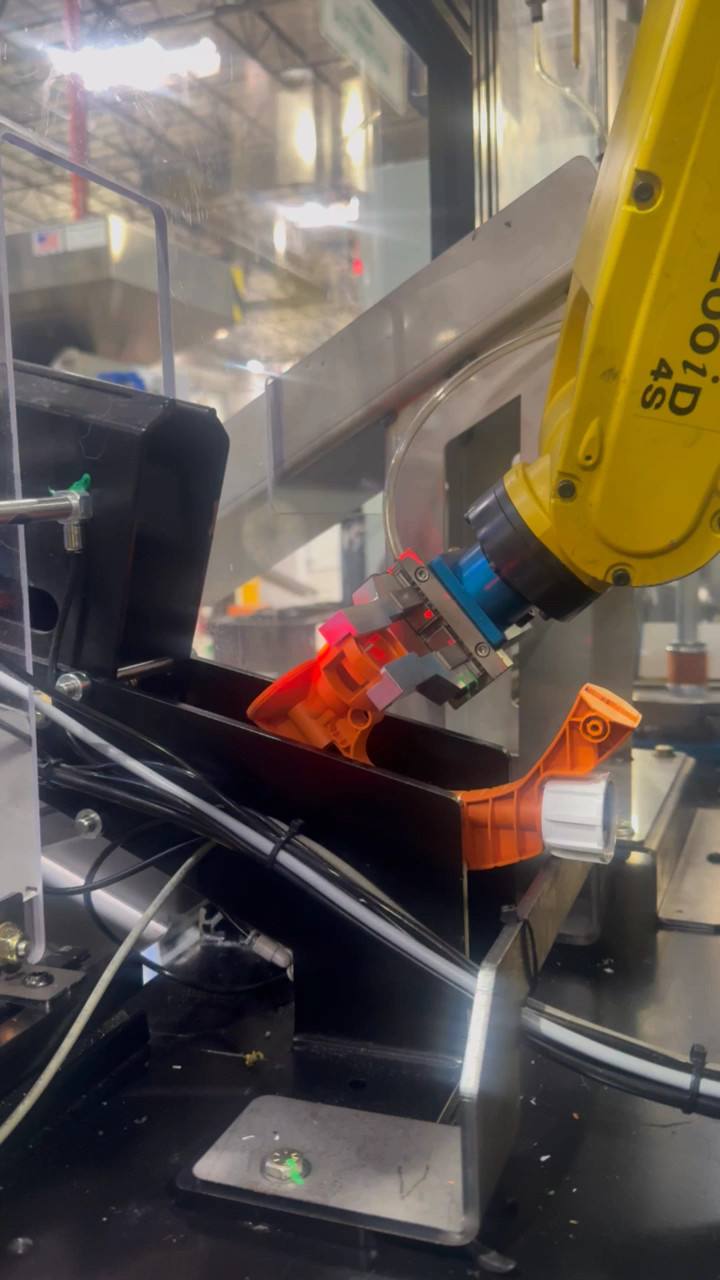
A gripper that works on the bench can mark parts, drop them at speed, or miss on the parts at the bottom of the bin. Many cells go through a few finger or cup changes before they run steadily. Without a machine shop on call, each change waits on an outside vendor, and the cell sits. We design end-of-arm tooling with the rest of the cell and machine it on our own 5-axis, so a finger change can happen the same week.
Controls and handshakes
The robot has to talk to a PLC, a conveyor, a machine tool or a camera. Each signal needs a meaning both sides agree on, a timeout, and a plan for when it never arrives. Handshake bugs show up as a cell that runs fine for an hour and then waits forever. Plants with a PLC standard and a controls engineer handle this well. Plants without one can end up with the sequence spread across the robot program, a relay panel and the operator’s memory.
Fault recovery
Writing the normal cycle is the quick part. The time goes into what happens after a missed pick, a jam, an empty feeder, an E-stop in the middle of a move, or a power loss with a part in the gripper. If recovery isn’t written into the program, the operator recovers by jogging the robot by hand. That is slow, and it is how robots get crashed into fixtures.
Documentation and support
Six months after start-up, someone has to change a program, replace a sensor or recover from a flat pulsecoder battery. If one engineer built the cell and has since moved on, the plant owns a machine nobody can change. Keep as-built schematics and an I/O list, and take controller backups as if someone else will need them, because someone will.
The project owner’s day job
In-house projects usually belong to an engineer who also keeps the plant running. When a line goes down, the cell waits. Count those hours honestly, along with the time it takes to learn what the team hasn’t done before.
What in-house integration really costs
The hardware costs about the same either way. The difference is hours, and who pays for rework. On the DIY side of the ledger, count:
- Engineering hours for design, programming, debugging and documentation, at the loaded cost of the people doing it.
- Training. FANUC offers programming courses, electrical and mechanical maintenance courses and advanced application courses.
- Software: offline simulation such as FANUC ROBOGUIDE, which builds and simulates robot cells in 3D, plus PLC and HMI licenses if you don’t already have them.
- Rework: the second gripper, the guard panel that had to move, the sensor nobody planned for.
- Production lost while the cell is debugged on your floor instead of in a builder’s shop.
Our robot cell cost breakdown lists every line a turnkey quote covers. It works as a checklist for a DIY budget too.
Hybrid ways to split the work
Turnkey and DIY are the two ends. Many of the useful options sit in between.
| Split | The integrator does | Your team does |
|---|---|---|
| Integrator builds, your team programs later | Design, build, safeguarding, run-off and training during the build | Part changes and new paths after handover |
| Your team builds, an integrator does the safety design | Risk assessment, safety circuit design and testing each safety function | The mechanics, the robot program and the PLC sequence |
| Your team builds, an integrator programs | Robot and PLC programs, debugged on the finished cell | Frame, guarding, tooling and panel |
| Concept and gripper trials first | A concept, a simulation and gripper trials with real parts | The decision on who builds it |
| Your team builds, with support on call | Help when the robot side stalls | Everything else |
Whichever split you pick, write down who owns each piece and who owns the result. A cell built by three parties with no one responsible for the whole tends to fail at the seams between them. If your team plans to take over programming, say so in the RFQ, so the integrator plans the training and hands over unlocked programs.
Here is where we fit. Our turnkey robot cells are designed, fabricated, wired and programmed in our Fontana shop, run off there, and installed at plants across the US. We write safety PLC programs in-house. We also service and reprogram FANUC robots we didn’t build, which covers the plant that built its own cell and wants help on the robot side.
Should I integrate a robot myself? A self-check
Tick the ones that are true today
- Someone on staff has written and debugged FANUC teach pendant programs
- Someone can write and troubleshoot PLC logic on your plant's platform
- Someone has done a task-based risk assessment and tested safety functions
- Your shop can make and remake fixtures, brackets and gripper fingers quickly
- The project has an owner with time set aside for it
- The start date can move if the first gripper doesn't work
- Your maintenance team will be trained before production starts
If most boxes are ticked, a DIY or hybrid build is realistic, and the guides on this site are written to help with it. If only a few are, a turnkey cell, or a hybrid where an integrator does the safety and controls, carries less risk. Either way, a phone video of the job done by hand is a good start. Send it through our contact page and we’ll come back with a concept and a plan, including which pieces your own team could take on.
Common questions
- Can we buy a FANUC robot without an integrator?
- Yes. A robot can be bought on its own, new or used, and many plants do. What arrives is an arm, a controller and a teach pendant, with no gripper, guarding, safety circuit or program for your job. Someone still has to do that integration work. The real choice is whether it is your team, an integrator, or a split between the two, with each piece written down as someone's job.
- What skills does an in-house team need to integrate a robot?
- Robot programming on the brand you buy, PLC programming on your plant's platform, electrical design for the control panel, mechanical design for the gripper, fixtures and guarding, and safety work: a task-based risk assessment, choosing and wiring safety devices, and testing every stop. One person rarely covers all of it. Add a project owner with time set aside, and a shop that can make and remake parts quickly.
- Who is responsible for safety if we build the robot cell ourselves?
- Your company is. OSHA has no robot-specific standard, so it relies on general rules such as machine guarding and lockout/tagout, and the detail comes from ANSI/A3 R15.06-2025. Part 2 covers robot applications and cells, which is the work your team takes on by building one. Part 3 covers the plants that use robot cells. Have your own safety professional review the risk assessment and the finished cell before production.
- Is DIY robot integration cheaper than turnkey?
- The hardware costs about the same either way. The difference is engineering hours, training, rework and the production lost while a cell is debugged on your floor. A team that has built cells before can come out ahead. A team doing it for the first time often spends the savings on a second gripper, guarding changes and a longer start-up. Price both with honest hours before deciding.
- Can an integrator build the cell and our team take over programming later?
- Yes, and it is a common split. Say so in the RFQ, so the integrator plans training for your programmers and maintenance tech, structures the programs for someone else to edit, and hands over unlocked robot, PLC and HMI files with the backups. Ask which parts of the program they would still want to change themselves, such as safety logic, and get that answer in writing.
Sources
- OSHA: Robotics, standards (no robot-specific OSHA standards; 1910.212 machine guarding and 1910.147 lockout/tagout listed)
- The Robot Report: A3 releases full three-part national safety standard for industrial robots (ANSI/A3 R15.06-2025)
- FANUC America: Training (programming, electrical/mechanical maintenance and advanced applications courses)
- FANUC America: ROBOGUIDE robot simulation software
- NFPA 79, Electrical Standard for Industrial Machinery